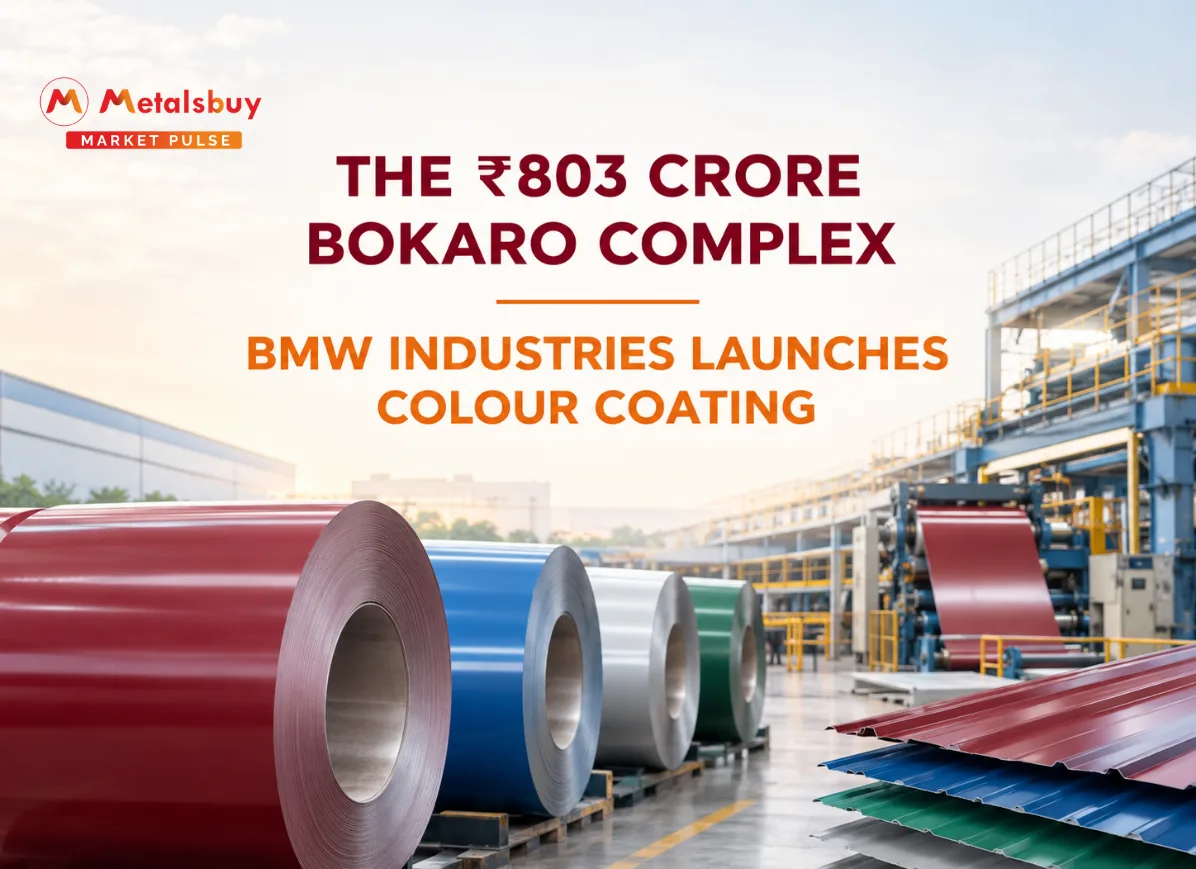
India's domestic steel processing sector marks a significant technological upgrade as BMW Industries Limited officially commences operations at its highly anticipated greenfield manufacturing hub in Jharkhand, setting a new benchmark for value-added metal production.
The Indian metallurgical landscape is witnessing a strategic evolution as mid-tier processors rapidly scale up their technical capabilities to meet the growing national demand for specialized industrial materials. Kolkata-headquartered BMW Industries Limited has achieved a major operational milestone by commissioning the first phase of its ₹803 crore greenfield downstream steel complex in Bokaro. By successfully bringing its new colour coating line online this October, the company is actively transitioning from a traditional conversion-led enterprise into a fully integrated, value-added steel manufacturer. For the broader domestic market, this massive capital deployment signals a robust corporate confidence in India's consumption trajectory and heavily supports the government's push for localized, high-end manufacturing.
Strategic shift toward value added manufacturing
The initiation of the colour coating line represents a fundamental transformation in the company's long-term commercial strategy. Historically, BMW Industries has leveraged its four decades of operational experience primarily as a tolling and processing service center, maintaining strong relationships with primary steel producers like Tata Steel. However, the new Bokaro complex represents a calculated pivot towards proprietary, high-margin manufacturing. The newly commissioned colour coating line allows the company to produce specialized coated steel products directly tailored for the demanding infrastructure, construction, and automotive sectors.
By pushing heavily into value-added products, the company aims to capitalize on the widening gap between domestic demand and supply for specialized coated sheets. This move is specifically designed to act as a mechanism for import substitution. As the central government enforces strict quality control orders and implements safeguard duties against cheaper foreign steel, integrated downstream facilities like the one in Bokaro are perfectly positioned to capture the market share previously dominated by imported materials.
Massive capacity expansion and financial rollout
Executing a greenfield project of this magnitude requires a highly disciplined approach to capital allocation and capacity phasing. The overarching blueprint for the Bokaro facility involves a total estimated project cost of ₹803 crore. According to the company's financial disclosures, the operationalization of this first phase has been achieved with a capital deployment of ₹341.6 crore. The management has maintained a balanced funding structure, utilizing ₹139.2 crore from internal corporate accruals while securing the remaining ₹202.4 crore through debt. To guarantee the seamless completion of the subsequent phases, BMW Industries has successfully tied up a ₹500 crore debt facility from a strong banking consortium led by the State Bank of India, HDFC Bank, and Yes Bank.
The physical capacity additions tied to this funding are substantial. While the colour coating line is now active, the subsequent phases of the project will introduce a massive 550,000 tonnes per annum of Cold Rolled Full Hard capacity. Parallel to this, the company will integrate an additional 540,000 tonnes per annum of combined galvanised, galvalume, and ZAM steel processing capabilities. These sequential upgrades will exponentially widen the manufacturer's product portfolio, allowing them to diversify their end-use customer base. Financial returns are expected to follow closely, with corporate leadership anticipating revenue generation from this new capacity to formally commence by the third quarter of the 2026-27 financial year, followed by a steady operational ramp-up.
Leveraging policy incentives and green energy
The commercial viability of the Bokaro complex is significantly enhanced by its alignment with progressive state and central industrial policies. A massive competitive advantage for BMW Industries is the facility's qualification under the central government’s Production Linked Incentive 1.1 Scheme. Specifically selected under the coated and plated steel category, the company is eligible to receive substantial financial incentives on its incremental sales generated up to the 2028-29 financial year. Furthermore, the strategic location in Bokaro allows the manufacturer to benefit heavily from the Jharkhand Industrial and Investment Promotion Policy, while simultaneously ensuring immediate logistical proximity to essential raw material feeds from major primary steel plants operating in the region.
Beyond raw economics, the company is actively embedding sustainable practices into its new operational footprint. The manufacturer has established a formal partnership with the Indian Oil Corporation to supply piped natural gas directly to the Bokaro facility. By utilizing piped natural gas over traditional, heavier fossil fuels, the plant will operate with a significantly reduced carbon footprint. This integration of cleaner energy sources, combined with the company's broader corporate initiatives to achieve zero liquid discharge across its plants, ensures that BMW Industries is building an industrial asset that is not only highly profitable but also environmentally resilient for the decades ahead.