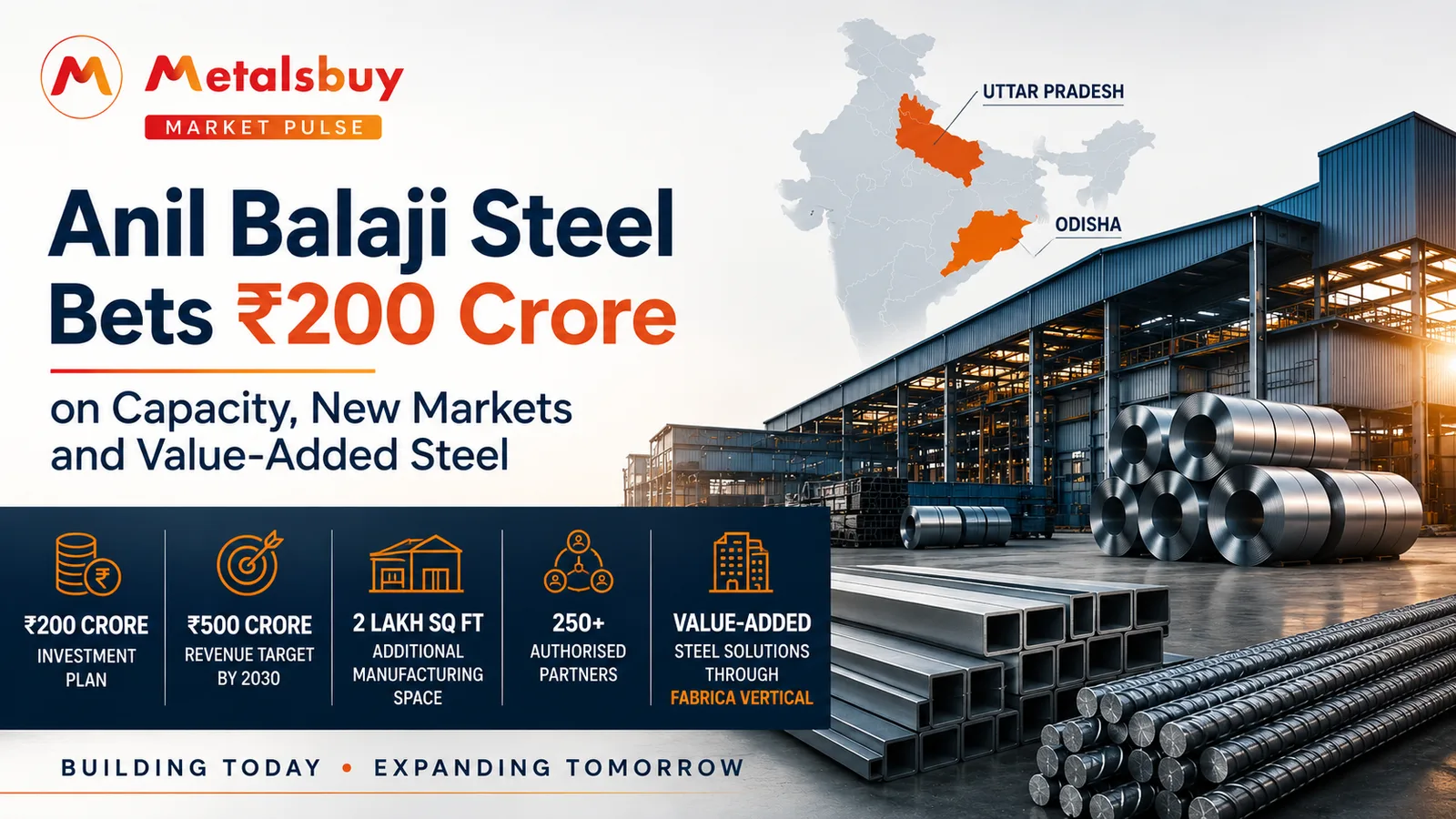
Key Numbers
-
Planned investment: ₹200 crore
-
Investment planned in West Bengal: ₹100 crore
-
Current annual volume: Around 25,000 tonnes
-
Current turnover: More than ₹125 crore
-
Revenue target: ₹500 crore by 2030
-
Additional manufacturing space planned: Around 2 lakh sq ft
-
Expansion markets: Odisha and Uttar Pradesh
-
Current authorised partners: More than 250
A Growth Strategy Built Around More Than Capacity
Anil Balaji Steel is preparing for a significant expansion phase with a planned investment of ₹200 crore across manufacturing, geographical expansion and value-added steel solutions. The West Bengal-based company currently operates from its manufacturing facility in Jangalpur, Howrah, and has built a growing presence through its dealer and distribution network. It now wants to use the next few years to increase its manufacturing footprint while entering new markets and developing additional steel-related solutions. The company has set itself a target of reaching ₹500 crore in revenue by 2030, compared with its current turnover of more than ₹125 crore.
The investment is interesting because the company is not approaching growth through capacity addition alone. Around ₹100 crore is expected to be invested in West Bengal, while the remaining investment is expected to support expansion into other markets and business areas. The company is also looking at Odisha and Uttar Pradesh as potential locations for additional manufacturing facilities, which would give it a wider geographical footprint. Taken together, the plan points towards a business strategy built around manufacturing, market access and higher-value applications rather than simply increasing the number of tonnes produced.
Expanding the Manufacturing Footprint
The company's existing manufacturing facility in Howrah covers around 1 lakh sq ft, and the expansion plan envisages adding another 2 lakh sq ft of manufacturing space. This would materially increase the physical scale of its operations and provide room for the company to support its targeted growth over the next few years. The planned expansion in West Bengal is also being accompanied by an evaluation of facilities in Odisha and Uttar Pradesh, indicating that the company wants to establish a presence closer to different consumption markets. For steel products, this geographical consideration can be important because freight and delivery timelines can have a direct impact on the competitiveness of the final product.
The decision to look beyond West Bengal therefore has a clear commercial logic. Steel is a relatively heavy commodity, and transporting material over long distances can quickly add to the delivered cost, particularly in markets where customers are price sensitive. A manufacturing presence closer to major consumption centres can allow a company to respond faster to local demand while potentially improving logistics efficiency and customer service. If the planned facilities are executed in stages and matched with sufficient demand, the broader footprint could become an important part of Anil Balaji Steel's strategy to move from a regional business towards a wider national presence.
Distribution Will Be Equally Important
Manufacturing capacity alone does not guarantee growth in the steel business, particularly when a company is expanding into new geographical markets. Anil Balaji Steel has already been building its distribution network and currently has more than 250 authorised partners, with further expansion planned over the coming years. This network can become particularly important as the company adds capacity because dealers and channel partners provide access to a much larger base of construction, fabrication and industrial customers. The ability to place additional production into the market efficiently will ultimately determine how effectively the new capacity contributes to revenue and profitability.
The distribution strategy also gives the company an opportunity to build a stronger relationship with customers rather than depending entirely on spot-market transactions. In many parts of India's steel market, buyers value consistent availability and dependable delivery almost as much as the headline material price. A manufacturer that can maintain inventory closer to consumption centres and support its dealers with reliable supply can create a meaningful advantage in a competitive market. As Anil Balaji Steel expands into new states, the strength and quality of its distribution network could therefore be just as important as the size of its manufacturing facilities.
Moving Towards Value-Added Steel Solutions
Another significant element of the company's strategy is its move into value-added and functional steel applications. Under its proposed "Fabrica" vertical, the company plans to focus on areas such as architectural façades, pre-engineered buildings and automated structures, while also developing a dedicated experience centre. This represents a potential shift from competing primarily on the supply of steel towards providing more application-oriented solutions to customers. The importance of such a move is that value-added products and services can potentially create a different margin profile from conventional commodity steel, although the success of the strategy will depend on execution and market acceptance.
The move also fits into a broader change taking place across the Indian steel ecosystem. Customers increasingly want suppliers that can provide more than a basic steel product, particularly in construction, industrial and architectural applications where fabrication and design can influence the overall project economics. Companies that can combine material supply with processing, fabrication or application-specific solutions may be able to develop deeper customer relationships and reduce their exposure to pure commodity price competition. For Anil Balaji Steel, developing this vertical alongside its manufacturing expansion could therefore provide another route to growth beyond simply increasing production volumes.
Can the ₹500 Crore Target Be Achieved?
The company's target of reaching ₹500 crore in revenue by 2030 represents a substantial increase from its current turnover of more than ₹125 crore. Reaching that level would require a combination of higher production, stronger utilisation of new facilities, successful entry into new markets and meaningful contribution from the value-added business. The expansion plan provides several of the building blocks required to pursue that target, but the ability to execute those plans profitably will be more important than the headline investment number. The next few years will therefore be critical in determining whether the planned capacity and market expansion translate into sustainable business growth.
There is also a natural risk in expanding capacity ahead of demand. New facilities bring additional fixed costs, while entering new markets requires investment in distribution, working capital, people and customer acquisition before the benefits fully appear. If demand develops as expected, the additional capacity can help the company scale quickly, but weaker utilisation could put pressure on margins and cash flows. The balance between expansion speed and actual market absorption will therefore be something worth watching as the company moves through the investment cycle.
Why Odisha and Uttar Pradesh Matter
The proposed expansion into Odisha and Uttar Pradesh is particularly interesting because both states offer access to significant industrial and construction markets. Odisha is closely linked to India's steel and mining ecosystem and has a large base of industrial activity, while Uttar Pradesh offers access to one of the country's largest consumption markets. Establishing manufacturing or processing capabilities in these regions could allow the company to reduce the distance between production and customers while creating opportunities to build new dealer networks. The success of this strategy, however, will depend on selecting the right locations and ensuring that each facility has a commercially viable market around it.
For a company expanding across multiple states, operational discipline becomes increasingly important. Different markets have different customer profiles, competitive dynamics, logistics costs and working-capital requirements, so simply replicating the existing business model may not produce the same results everywhere. The company will need to understand local demand patterns and build the right product and distribution mix for each market. If that execution is managed well, the geographic expansion could help diversify the company's revenue base and reduce its dependence on any single regional market.
Potential SME IPO Adds Another Dimension
Anil Balaji Steel is also considering an SME IPO within the next three years, which could provide another source of capital for its expansion programme. An eventual public listing could help the company strengthen its balance sheet and provide additional resources for manufacturing, distribution and the development of its newer business verticals. At the same time, becoming a listed company would bring greater scrutiny around financial performance, corporate governance, capital allocation and the ability to deliver against growth projections. That makes the period leading up to a potential IPO particularly important because the company would need to demonstrate that its expansion is generating profitable and sustainable growth rather than simply increasing its scale.
For the company, access to public capital could become useful if the expansion programme gathers momentum. However, the market will ultimately judge the business on how effectively that capital is deployed and whether the resulting investments generate adequate returns. A larger factory, wider distribution network and additional business verticals can create significant opportunities, but they also increase the complexity of managing the organisation. The quality of execution will therefore become increasingly important as the company moves from its current phase into a much larger operating structure.
What This Means for India's Steel Ecosystem
The expansion plan also offers an interesting view of how India's steel industry is developing beneath the headline numbers reported by the country's largest producers. India's steel consumption is expanding across infrastructure, construction, manufacturing, warehousing and industrial applications, creating opportunities for companies across different parts of the value chain. These opportunities are not limited to integrated steelmakers; processors, manufacturers, fabricators, distributors and specialised solution providers can all participate in the growth. Companies that can establish strong regional positions while developing differentiated products and services may be able to capture a meaningful share of this expanding market.
This is also why the shift towards value-added steel deserves attention. Commodity steel will remain highly competitive and closely linked to global and domestic price cycles, while specialised applications can potentially offer greater customer stickiness and additional value. A company that can combine manufacturing scale with distribution strength and application expertise has more levers available to manage changing market conditions. Anil Balaji Steel's strategy appears to be moving in that direction, with its ₹200 crore investment supporting several parts of the business simultaneously.
Metalsbuy Market Pulse View
Anil Balaji Steel's ₹200 crore expansion is ultimately a story about building a broader steel business rather than simply adding production capacity. The company is investing in manufacturing, looking at new geographical markets, strengthening its distribution network and exploring value-added applications that could take it closer to the end customer. Its ₹500 crore revenue target by 2030 is ambitious, but the company has identified multiple avenues through which it intends to pursue that growth. The next phase will be about converting those plans into utilisation, customers, cash flow and sustainable margins.
For the broader Indian steel market, this is an encouraging sign of how companies are responding to rising domestic consumption and changing customer requirements. The next stage of industry growth is unlikely to be defined only by who adds the most tonnes, because logistics, customer reach, processing capability and product differentiation are becoming increasingly important. Companies that invest in these areas can potentially build stronger positions even when commodity steel prices remain volatile. Anil Balaji Steel's expansion is therefore worth watching not simply for the ₹200 crore investment, but for whether its integrated growth strategy can turn a regional manufacturing base into a wider, value-added steel business.