Metalsbuy Editorial
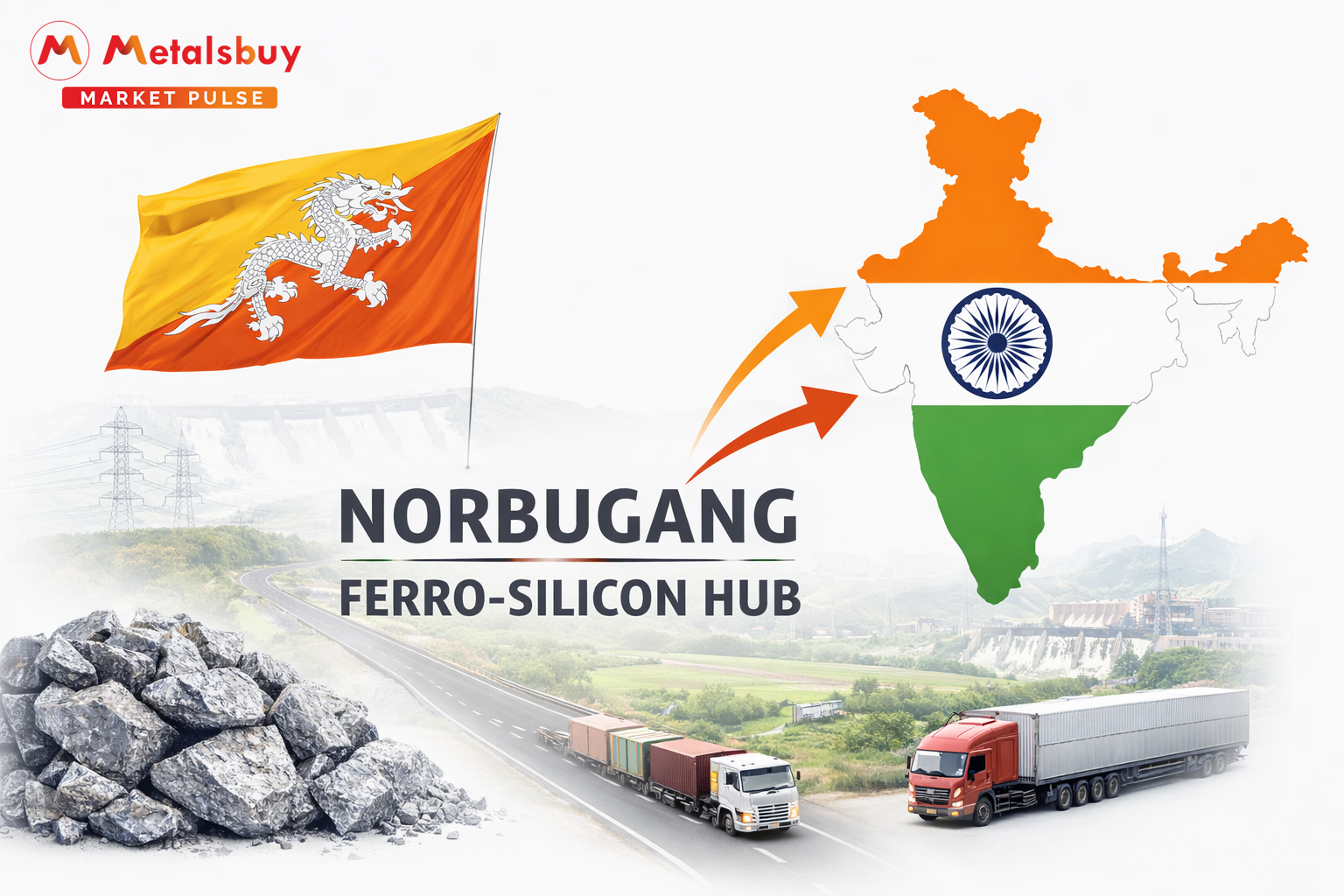
Bhutan’s ferro-silicon industry has quietly emerged as one of South Asia’s most strategically relevant alloy supply bases, anchored by a structural advantage that few producing nations can replicate, abundant, renewable hydropower. At the centre of this transformation lies Norbugang Industrial Park (NIP) in Samtse Dzongkhag, which is rapidly consolidating into Bhutan’s most concentrated ferro-silicon manufacturing hub.
Although Norbugang is not formally designated as a Special Economic Zone (SEZ), its scale, sectoral concentration and infrastructure-first development model position it as a dedicated ferro-silicon industrial cluster. With nine out of ten industrial units within the park belonging to the ferro-alloy segment, Norbugang reflects a deliberate policy choice rather than organic, scattered industrial growth.
For India, Bhutan’s largest trading partner and a structurally net importer of ferro-silicon, the emergence of Norbugang has implications that go well beyond incremental trade volumes. These include long-term alloy security, cost competitiveness, green steel positioning, cross-border logistics efficiency and procurement risk management.
1. Strategic Objective Behind Norbugang Industrial Park
The development of Norbugang Industrial Park reflects Bhutan’s evolving industrial strategy, which seeks to monetise natural advantages through targeted value addition.
1.1 Monetising Hydropower Through Industrial Value Addition
Ferro-silicon production is among the most electricity-intensive metallurgical processes globally, typically consuming 9,000–10,000 kWh of electricity per tonne. In most producing geographies, electricity alone accounts for 35–45% of total production cost, making power availability, stability and pricing the single most decisive competitive factor.
Bhutan’s hydropower-dominated electricity system allows the country to convert renewable energy into exportable industrial value instead of relying solely on electricity exports. Norbugang provides the physical platform to execute this strategy at scale, positioning ferro-silicon as a preferred pathway for hydropower monetisation.
1.2 Cluster-Led Industrialisation
Rather than dispersing energy-intensive industries across multiple industrial estates, Bhutan has adopted a cluster-based development model. Concentrating ferro-silicon units at Norbugang enables:
-
shared transmission and substation infrastructure,
-
common roads, water systems and safety buffers,
-
faster commissioning timelines,
-
lower per-unit infrastructure and logistics costs,
-
streamlined environmental and regulatory oversight.
This model reduces execution risk while improving long-term operational efficiency.
1.3 Export-Oriented Growth Focus
Ferro-silicon is among Bhutan’s largest export earners, with India accounting for the majority of demand. Norbugang is designed to reinforce Bhutan’s position as a reliable regional supplier, capable of delivering scale, consistency and traceability to Indian steelmakers and foundries.
1.4 Employment and Regional Development
Located along the Samtse–Sipsu highway, Norbugang supports industrialisation in Bhutan’s southern belt. The park has already generated hundreds of direct jobs, alongside indirect employment in logistics, construction and services, aligning industrial expansion with regional economic development.
2. Norbugang Industrial Park: Key Facts and Development Status
Table 1: Norbugang Industrial Park – Snapshot
| Parameter | Details |
|---|---|
| Location | Norbugang, Samtse Dzongkhag (Southern Bhutan) |
| Total Area | 183.86 acres |
| Total Industries | 10 units |
| Ferro-Alloy Units | 9 out of 10 |
| Ownership Mix | 6 domestic, 4 foreign-invested |
| Employment | 678 employees (655 Bhutanese, 23 skilled foreign workers) |
| Public Infrastructure Spend (FY24–FY25) | Nu 608 million |
| Estimated Total Infrastructure Cost | ~Nu 3.6 billion |
| Development Status | Multiple units at advanced construction or commissioning stage |
The overwhelming presence of ferro-silicon units confirms Norbugang’s role as a purpose-built alloy manufacturing cluster, even without SEZ labelling.
3. Why Norbugang (Samtse) Was Chosen: The Strategic Location Logic
The selection of Norbugang as the nucleus for Bhutan’s ferro-silicon industry was not incidental. It reflects a convergence of power infrastructure feasibility, land economics, export logistics, raw-material access and institutional readiness.
3.1 Power Infrastructure Scalability: The Primary Driver
Ferro-silicon smelting requires continuous, high-load electricity supply. Norbugang was identified as one of the few locations where Bhutan’s power authorities could plan and execute large-scale grid expansion in a concentrated manner.
Publicly reported development plans indicate that nearly Nu 2 billion has been invested or earmarked specifically for electricity infrastructure at Norbugang, with planned capacity in the range of 300–500 MW to support multiple submerged arc furnaces over time.
By concentrating demand at a single site, Bhutan can:
-
optimise substation and transmission investments,
-
reduce grid stress compared with dispersed industrial loads,
-
improve furnace utilisation and operational stability.
From a technical standpoint, power scalability alone makes Norbugang one of the few viable sites for a multi-plant ferro-silicon cluster in Bhutan.
3.2 Availability of Large, Contiguous Industrial Land
Norbugang offers approximately 183–187 acres of contiguous, designated industrial land, a critical requirement for ferro-silicon plants that need space for furnaces, raw-material yards, slag handling, internal roads and safety buffers.
Bhutan’s mountainous terrain significantly limits the availability of such large, flat industrial parcels. Norbugang emerged as one of the few locations where:
-
industrial land could be allocated at scale,
-
fragmentation of development could be avoided,
-
long-term expansion remained feasible.
The relocation of proposed ferro-alloy projects from Jigmeling Industrial Park, following shifts in land-use priorities, further accelerated Norbugang’s emergence as the preferred alternative. Rather than dispersing projects across multiple smaller estates, authorities opted to consolidate ferro-silicon capacity at a single, infrastructure-ready site, reinforcing the cluster model.
3.3 Proximity to India: A Structural Export Advantage
Samtse’s border adjacency with India provides a decisive logistics advantage. Norbugang lies close to key road corridors linking directly into West Bengal and the eastern Indian steel belt.
For an export-oriented industry like ferro-silicon, this translates into:
-
shorter transit times to Indian steel plants,
-
lower overland freight costs,
-
reduced exposure to international shipping volatility,
-
faster cash-conversion cycles.
Given that India absorbs the majority of Bhutan’s ferro-silicon exports, proximity to Indian consumption centres materially improves delivered cost economics and supply reliability.
3.4 Raw-Material Accessibility
Norbugang also benefits from relative proximity to suitable quartzite and silica-bearing resources, a core input for ferro-silicon production. While detailed mine-to-plant linkage data is not always publicly disclosed, company-level information indicates that access to quality silica inputs was a supporting factor in site selection.
Local or regional sourcing of quartzite:
-
lowers inbound logistics cost,
-
improves furnace consistency,
-
reduces supply-chain complexity.
Combined with nearby Indian supplies of reductants and consumables, Norbugang enables a balanced inbound–outbound logistics ecosystem.
3.5 Institutional and Community Readiness
Industrial siting in Bhutan is closely linked to community acceptance and environmental governance. Norbugang benefited from:
-
formal land allocation approvals,
-
Gewog-level community consent,
-
alignment with national industrial zoning plans.
This institutional readiness reduced execution risk and allowed infrastructure development and factory construction to proceed in parallel.
3.6 Concentrated Public Infrastructure Investment
The scale of public investment further validates Norbugang’s strategic selection. Cumulative infrastructure spending, covering roads, river protection, power systems and water infrastructure is estimated at approximately Nu 3.6 billion.
Such upfront expenditure signals that Norbugang is viewed as a long-term industrial nucleus, not a marginal estate, capable of delivering sustained export earnings and employment.
4. Bhutan’s Ferro-Silicon Industry in Context
Ferro-silicon (HS 720221) accounts for nearly 38% of Bhutan’s total export value. In 2022 alone, Bhutan exported over 113,000 tonnes, valued at approximately US$ 165–170 million.
This concentration ensures:
-
policy continuity,
-
infrastructure prioritisation,
-
strong alignment between government and industry objectives.
5. India’s Perspective: Strategic Dependence and Opportunity
5.1 Structural Import Reliance
India remains a net importer of ferro-silicon, driven by:
-
rising crude steel output,
-
expanding secondary steel and foundry production,
-
tighter quality norms for alloy inputs.
Recent market data shows India imported ~118,000 tonnes in H1 CY2025, up ~20% year-on-year.
5.2 Trade and Proximity Advantage
India–Bhutan trade operates under a free trade regime, enabling duty-free movement and simplified customs procedures. For Indian buyers, Bhutan offers:
-
shorter lead times,
-
lower working-capital cycles,
-
easier contract enforcement.
5.3 Green Steel Alignment
Bhutan’s hydropower-based ferro-silicon provides Indian steelmakers with:
-
a pathway to reduce embedded carbon intensity,
-
stronger ESG disclosures,
-
differentiation in green steel supply chains.
6. Opportunities for India Emerging from Norbugang
-
Long-term offtake contracts with index-linked pricing
-
Green alloy partnerships supported by product carbon footprint frameworks
-
Two-way trade growth, including Indian supply of reductants, consumables and services
-
Supply-chain optimisation for eastern and north-eastern Indian steelmakers
7. Risks and Constraints to Monitor
-
Power transmission and evacuation readiness during ramp-up
-
Cluster concentration risk
-
Global ferro-silicon price cyclicality
-
Environmental compliance timelines
8. Medium-Term Outlook (2026–2030)
Norbugang is positioned to become Bhutan’s most influential ferro-silicon production base. For India, it aligns with three strategic priorities:
-
Secure, proximate alloy supply
-
Lower-carbon input options
-
Stable bilateral trade corridors
If infrastructure and commissioning timelines remain on track, Norbugang could evolve into a strategic sourcing corridor for Indian steelmakers.
9. Regulatory Pathway for Indian Companies Setting Up Ferro-Silicon Plants in Bhutan
Entry Route:
Ferro-silicon manufacturing in Bhutan is open to foreign investment only through government-approved FDI routes. There is no automatic approval mechanism.
Ownership Structure:
Foreign ownership is typically capped at up to 74%, with a minimum 26% Bhutanese equity participation. As a result, joint ventures are the standard and preferred structure for Indian companies.
Key Approvals Required:
-
Bhutan Investment Authority (BIA): FDI approval based on a detailed project report
-
Ministry of Industry, Commerce & Employment: Industrial licence and land lease (land is leased, not sold)
-
National Environment Commission: Mandatory Environmental Impact Assessment (EIA) approval
-
Bhutan Power Corporation: Confirmed power allocation and long-term power supply agreement
Environmental & Power Compliance:
Ferro-silicon plants are classified as high-impact industrial projects. Environmental clearance and power allocation are the two most critical and time-defining approvals.
Labour Regulations:
Bhutan follows a Bhutanese-first employment policy. Foreign workers are permitted only for skilled and technical roles, supported by localisation and training plans.
Key Investment Reality:
Bhutan offers renewable power, policy stability and duty-free access to India, but investment is compliance-intensive and partnership-driven, favouring long-term strategic investors over short-term entrants.
Metalsbuy Outlook
Norbugang represents a structural shift in Bhutan’s alloy strategy from dispersed capacity to cluster-driven industrial scale. For India, the opportunity lies not just in sourcing volume, but in embedding Bhutanese ferro-silicon into long-term, sustainability-aligned procurement frameworks.
Metalsbuy expects Norbugang to emerge as a quiet but decisive pillar of South Asia’s ferro-alloy ecosystem over the next decade.