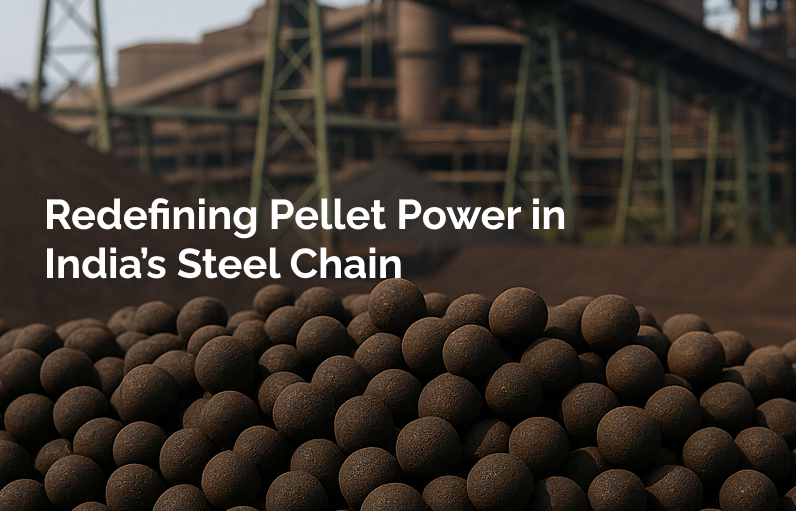
The iron ore pellet industry in India is already in the middle of a structural shift. Capacity has expanded faster than demand, exports have cooled, and domestic producers are grappling with lower utilisation and imported competition.
Against this backdrop, media reports that Tata Steel is likely to acquire a 50.01 percent stake in Thriveni Pellets Private Limited (TPPL), which controls a 4 million tonnes per annum pellet plant in Jajpur, Odisha, are strategically significant for the entire pellet ecosystem.
At the same time, Lloyds Metals and Energy Limited (LMEL) has already secured regulatory approval to acquire 49.99 percent in TPPL, giving it joint control in the same asset cluster.
This is not just another deal. It has the potential to reshape pricing, supply dynamics, and future consolidation in India’s pellet industry.
1. Context: An Industry Growing In Volume But Struggling On Utilisation
India’s pellet story is, on the surface, a growth story:
- Pellet output has risen to around 105 million tonnes in FY 2024–25, up about 5 percent year on year.
-
Production in FY 2024 was about 94 million tonnes compared with 84 million tonnes in FY 2023, a jump of roughly 12 percent.
-
Installed pellet capacity is estimated at about 164 million tonnes per year, up from 148 million tonnes in FY 2024.
Yet, beneath this growth:
-
Export volumes have fallen by about 40 percent compared with earlier peaks, hit by export duties in 2022 and weaker Chinese demand.
-
Government data and market reports point to surplus availability in the domestic pellet market and difficulty in clearing stocks at desired price levels.
-
Industry representatives say pellet plants are running at roughly 69 percent capacity utilisation, while also facing competition from cheaper imported pellets, including those routed via Oman.
In short, India has become a structurally long pellet market, dependent on either exports or strong captive demand from integrated steel producers.
2. Why Thriveni Pellets Matters In This Landscape
Thriveni Pellets, through its subsidiary Brahmani River Pellets Limited (BRPL), operates one of the key merchant pellet assets in Odisha:
-
Beneficiation capacity of about 4.7 million tonnes per year in Barbil.
-
Pellet capacity of about 4 million tonnes per year in Jajpur, linked via a slurry pipeline.
-
Supplies a mix of domestic customers including Tata Steel and other Indian mills, as well as international buyers such as POSCO and Mitsubishi.
With Lloyds Metals taking 49.99 percent and Tata Steel reported to be lining up 50.01 percent, TPPL and BRPL effectively move from being a merchant oriented asset under promoter control to a strategically owned asset for two large steel and iron ore players.
This shifts its primary role from purely merchant play toward integrated raw material security.
3. Impact On Merchant Pellet Supply And Pricing
The most immediate effect will be felt in the eastern cluster, especially Odisha and neighbouring states where BRPL is an important supplier.
Possible outcomes:
-
More captive offtake, less spot availability
With Tata Steel and Lloyds Metals both having long term iron ore and steel expansion plans, a larger share of BRPL’s output is likely to be locked into captive or quasi captive contracts, leaving a smaller pool for purely merchant buyers. -
Support for plant utilisation, pressure on independents
BRPL’s utilisation is likely to rise toward the upper band, supported by secured internal demand. Standalone pellet makers without strong captive or export linkages may face greater difficulty in maintaining volumes and negotiating prices. -
Pricing power shifts to integrated groups
In an oversupplied market, integrated steel plus pellet players can afford thinner pellet margins because they capture value downstream in steel. This can compress margins for pure play merchant pellet producers who depend entirely on pellet pricing for profitability.
For sponge iron producers, secondary steel mills and smaller buyers in the region, this could mean more concentrated supplier options and the need to actively diversify pellet sources.
4. Industry Consolidation And The “Integrated Cluster” Model
The Tata Steel Thriveni Pellets development accelerates a trend already visible in the last few years:
-
Larger steel producers and mining companies are acquiring pellet plants, linking mines, beneficiation and pellets into one integrated value chain.
-
Deals like LMEL’s acquisition of almost half of TPPL and the CCI clearance for that transaction show regulatory comfort with such vertical integration as long as competition concerns are addressed.
If Tata Steel completes the majority stake acquisition, TPPL becomes a template for an “integrated pellet cluster” model in eastern India:
-
Iron ore mining
-
Beneficiation
-
Slurry pipeline
-
Pellet plant
-
Captive and strategic external offtake
This can encourage more such deals, especially in regions where standalone pellet plants struggle with volatility in ore availability, logistics and offtake.
Over time, the industry could split more clearly into:
-
Integrated pellet assets anchored by large steel or mining groups.
-
A smaller pool of merchant pellet players serving niche or regional markets, or acting as swing suppliers.
5. Implications For Trade, Imports And Exports
The timing of this deal is important when seen alongside trade dynamics:
-
India's iron ore imports have hit a six year high, driven by shortage of high grade ore and attractive overseas prices.
-
At the same time, pellet imports routed via Oman and originally produced in Iran have surged, putting additional pressure on domestic producers, who are already running below full capacity.
A stronger, integrated player at BRPL scale has three possible effects on trade:
-
Export resilience
Tata Steel and Lloyds Metals may be better placed to sustain pellet exports during weak price cycles due to integrated margins and stronger balance sheets, helping India remain present in key export markets even when pure merchant players pull back. -
Defense against imports
With the ability to optimise ore sourcing, beneficiation and logistics, integrated pellet units can reduce cost per tonne. That allows them to compete more effectively against cheap imported pellets, particularly in coastal markets. -
Shift in domestic trade flows
If more output is consumed internally, inland buyers may need to look to other pellet clusters such as Karnataka and Chhattisgarh, potentially increasing freight costs and regional price differentials.
6. Role In The Green Steel And CBAM Story
European Union’s Carbon Border Adjustment Mechanism (CBAM) is set to reduce the attractiveness of high emission steel exports from India, especially from blast furnace routes, unless producers can cut emissions intensity.
Pellets, especially from beneficiation plants that deliver consistent high Fe and low impurities, are central to this decarbonisation journey because they:
-
Improve blast furnace productivity.
-
Lower coke rate per tonne of hot metal.
-
Reduce emissions per tonne of steel compared with sinter heavy burdens.
By securing a high grade pellet asset in Odisha, Tata Steel can:
-
Tighten control over the quality of burden material going into its blast furnaces.
-
Build a bridge toward future low carbon pathways such as direct reduced iron plus electric arc furnace routes where pellets are even more critical.
For the pellet industry, this means that:
-
High quality, consistent pellets tied to decarbonisation goals will command a structural premium.
-
Plants that cannot meet these quality and consistency benchmarks may end up competing only on price, further widening the gap within the industry.
7. What Market Participants Should Watch
For steelmakers, pellet producers, traders and policy makers, a few key questions will determine the real impact of this acquisition:
-
How much of BRPL’s volume becomes captive?
The higher the captive share, the tighter regional merchant supply becomes. -
Will there be capacity expansion at BRPL or adjacent assets?
Any debottlenecking or expansion beyond 4 million tonnes per year will change the balance between captive and merchant sales. -
How do smaller pellet producers respond?
Consolidation, alliances with miners, and long term offtake contracts with sponge iron units are likely survival strategies. -
Policy stance on imports and exports
The government response to domestic producers’ concerns on cheap imports and export duties will also shape margins and capacity utilisation for the sector.
Conclusion
Tata Steel’s proposed majority stake in Thriveni Pellets, combined with Lloyds Metals’ nearly equal stake, effectively converts one of India’s important merchant pellet assets into a strategic, integrated raw material hub.
For India’s pellet industry, this is a signal that the next phase of growth will be less about adding standalone capacity and more about deep integration with iron ore, logistics and steelmaking, while aligning with long term decarbonisation and trade realities.
Smaller players and pure merchant pellet producers will need to rethink their positioning in this new landscape or risk being squeezed between integrated giants and cheap imports.