The company has secured approximately ₹2,264 crore in additional orders since late October, strengthening business visibility across its international steel pipe operations.
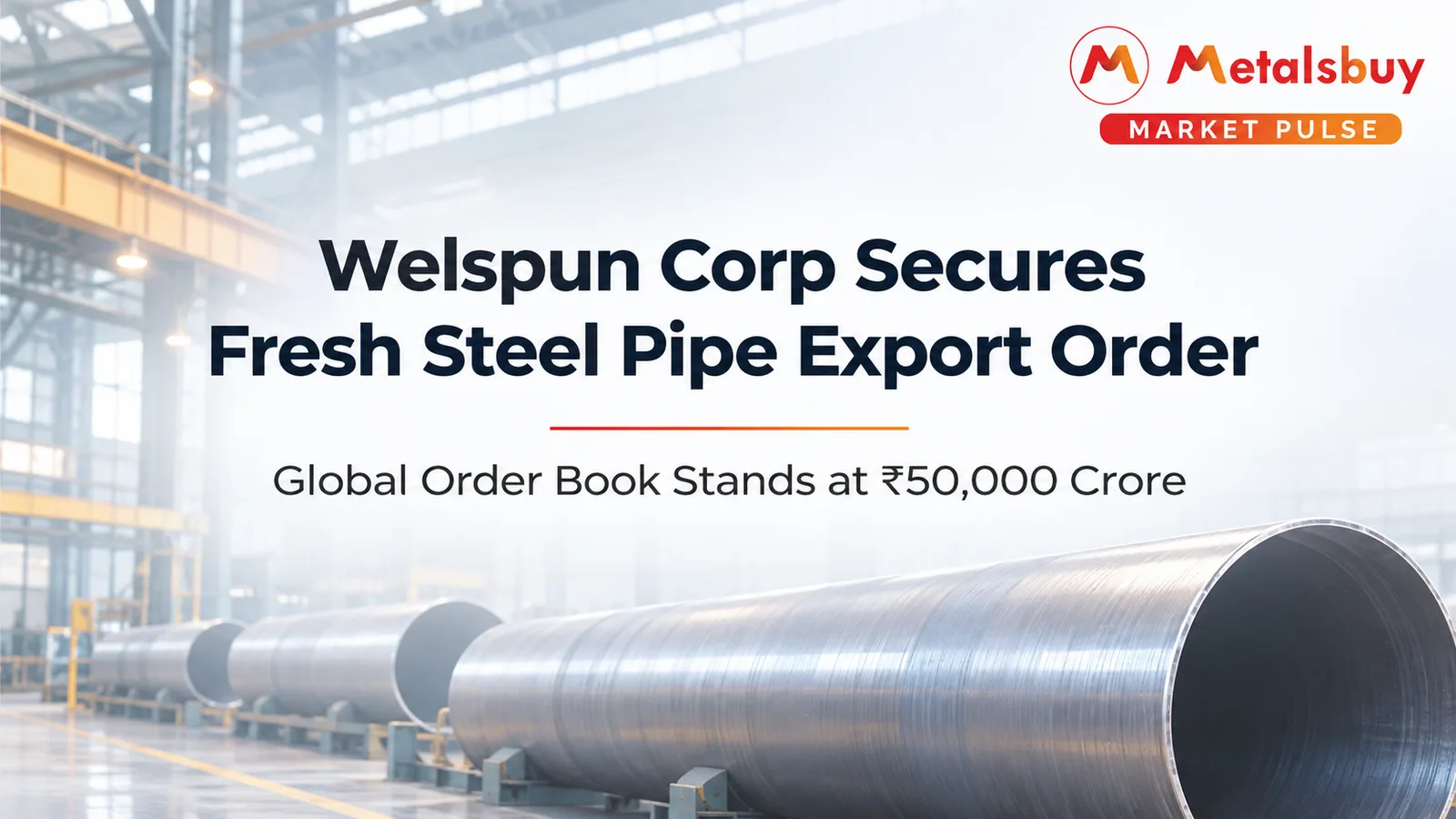
Indian steel pipe manufacturer Welspun Corp Limited has secured a fresh export order for the supply of longitudinal submerged arc welded (LSAW) pipes from its manufacturing operations in India, reinforcing its participation in the international market for specialised steel pipeline products.
In a regulatory disclosure dated November 26, 2026, the company confirmed that the latest export order is scheduled for execution during FY2027–28. It also reported securing additional global orders cumulatively valued at approximately ₹2,264 crore since its previous announcement on October 29, 2026.
Following these order wins, Welspun Corp continues to maintain a consolidated global order book of approximately ₹50,000 crore, with execution scheduled across FY2026–27, FY2027–28 and FY2028–29.
The announcement highlights the company's continuing ability to secure international contracts for specialised steel products. It also underscores the importance of downstream steel manufacturing in India's expanding participation in global infrastructure supply chains.
The company has not disclosed the individual contract value, destination market, customer identity or specific technical requirements of the latest LSAW pipe export order.
Global Order Book Provides Multi-Year Business Visibility
Welspun Corp's consolidated order book represents a substantial pipeline of business across its international operations.
The approximately ₹50,000 crore order-book position, also reported by the company alongside its October financial results, provides visibility into expected project execution over multiple financial years. However, the actual timing of revenue recognition will depend on contractual milestones, manufacturing schedules, delivery commitments and project execution.
The additional ₹2,264 crore in orders secured since October 29 indicates continued commercial activity following the company's previous disclosure.
Importantly, this figure should not be interpreted as the value of the newly announced LSAW export contract alone. The company has described it as the cumulative value of additional orders secured globally during the intervening period.
For steel pipe manufacturers, a substantial order book can support production planning, procurement scheduling and capacity utilisation. However, the profitability of individual contracts depends on raw material costs, execution efficiency, contractual terms and other project-specific considerations.
The announcement is therefore significant not only for its headline order-book value but also for the longer-term business visibility it provides.
Why LSAW Pipes Matter to Global Infrastructure
Longitudinal submerged arc welded pipes are primarily used in applications requiring large-diameter steel pipelines with demanding technical specifications.
These products are particularly relevant to major infrastructure projects involving oil and gas transportation, water transmission and other large-scale pipeline networks.
Manufacturing LSAW pipes involves converting suitable steel plate into a cylindrical structure and welding the longitudinal seam using a submerged arc welding process. Depending on the application, the finished pipes may undergo additional testing, coating and quality certification.
The manufacturing process requires technical expertise, specialised equipment and stringent quality control. As a result, LSAW products belong to a more specialised segment of the downstream steel industry than conventional commodity steel products.
For Indian manufacturers, participation in this segment creates opportunities to serve international infrastructure customers seeking products that comply with demanding project specifications.
However, global pipeline demand depends on several factors, including energy infrastructure investment, water transmission projects, financing conditions and government or private-sector capital expenditure.
The latest Welspun order provides evidence of continued contract activity for the company, although it does not independently establish a broader increase in global pipeline demand.
India's Downstream Steel Industry Gains Importance
Welspun Corp's export order also highlights the expanding role of value-added steel manufacturing within India's broader steel ecosystem.
While crude steel production remains a fundamental indicator of industrial capacity, downstream processing determines how steel is converted into finished products used in construction, engineering, manufacturing and infrastructure.
Products such as steel pipes, tubes, coated sheets and fabricated structural components require additional manufacturing processes, technical capabilities and product certification.
As Indian steel manufacturers expand their capacity, the development of competitive downstream industries will remain important for increasing domestic value addition.
Export-oriented manufacturers face additional requirements relating to international quality standards, testing procedures, logistics management and customer specifications.
Companies capable of meeting these requirements may be positioned to participate in infrastructure projects beyond the domestic market.
Welspun's latest export contract demonstrates the continued relevance of Indian manufacturing operations within the company's international supply network.
Implications for Secondary Steel Producers and Processors
The development also carries broader implications for India's secondary steel and downstream processing industries.
Secondary manufacturers, including rolling mills, structural steel producers and fabrication businesses, participate in different stages of the steel value chain. Their ability to move into specialised products depends on production technology, raw material suitability, investment capacity and market requirements.
Large-diameter LSAW pipes generally require steel plate with specific mechanical properties and quality characteristics. Consequently, the latest order should not be interpreted as an immediate increase in demand for sponge iron, induction furnace billets or conventional secondary TMT products.
Nevertheless, the announcement highlights a broader opportunity for India's steel-processing industry: developing manufacturing capabilities that move beyond relatively standardised products.
For secondary steel producers in regions such as Chhattisgarh, Odisha and West Bengal, this may include exploring specialised structural sections, engineered steel components and improved fabrication capabilities where commercially feasible.
The transition requires investment in equipment, process controls, technical expertise and customer relationships. It cannot be achieved solely through additional production capacity.
Smaller manufacturers may also benefit from stronger links with engineering contractors and infrastructure supply chains, provided they can meet the applicable technical and quality requirements.
Metalsbuy Market Pulse Analysis
Welspun Corp's latest export order reflects the growing commercial importance of specialised steel manufacturing within India's industrial economy.
The company's approximately ₹50,000 crore consolidated global order book provides multi-year business visibility, while the additional ₹2,264 crore in orders secured since late October indicates continued contract acquisition across its operations.
However, the larger significance extends beyond the value of the order book.
As India seeks to strengthen its position in global manufacturing, the ability to export engineered steel products with demanding technical specifications will become an important component of industrial competitiveness.
For downstream steel manufacturers, success in international markets depends on more than competitive raw material costs. Manufacturing consistency, product certification, delivery reliability and project execution capabilities are equally important.
For the secondary steel industry, the development offers a useful indication of how greater value addition can create opportunities beyond conventional commodity products.
At the same time, manufacturers must carefully evaluate the capital requirements and market risks associated with entering specialised product categories.
Welspun Corp's latest export order reinforces the importance of downstream steel processing in India's manufacturing growth story, highlighting how technological capability, product differentiation and international market access can complement the country's expanding steel production base.
— Metalsbuy Market Pulse | Industry Intelligence & Market Analysis