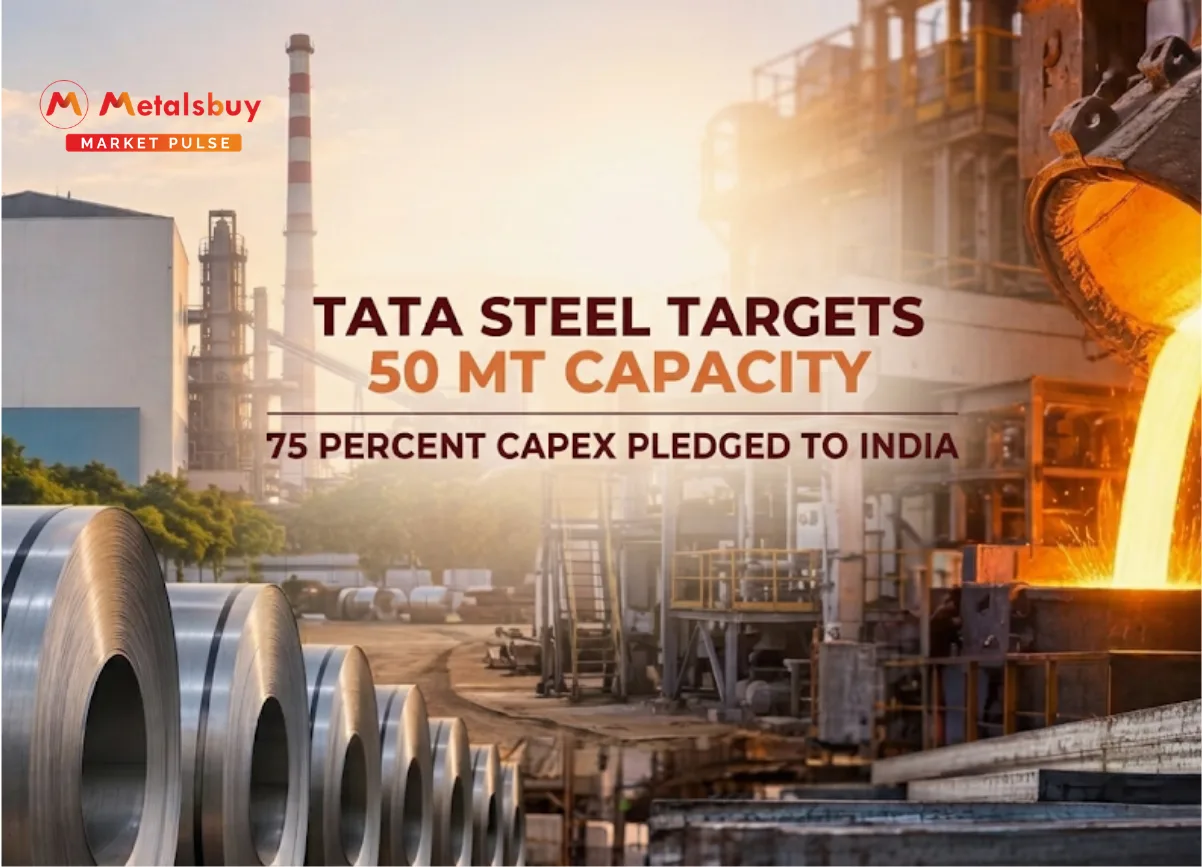
India’s premier private sector steel manufacturer is executing a massive strategic pivot to capitalize on the country's unprecedented infrastructure boom. Tata Steel has officially laid out a highly aggressive corporate roadmap, revealing its intention to rapidly scale its domestic production capabilities to a monumental 50 million metric tonnes per annum. To fuel this ambitious growth trajectory, the corporate management has decided to channel a staggering 75 percent of its total global capital expenditure directly into its Indian operations. This decisive financial allocation highlights the company’s absolute confidence in the localized consumption story, proving that domestic demand remains the most lucrative and reliable growth engine for the multinational enterprise.
Allocating majority capital expenditure to drive domestic expansion
Directing the lion's share of corporate funds toward indigenous assets ensures the company maintains its dominant market share in a rapidly growing economy. The most critical takeaway from the company’s recent strategic disclosures is the heavy financial bias toward the Indian subcontinent. Chief Executive Officer and Managing Director TV Narendran recently confirmed that out of the company’s overall capital expenditure budget, an overwhelming 75 percent will be strictly earmarked for domestic capacity expansion and technological upgrades.
This financial strategy marks a defining moment for Tata Steel, which has historically balanced heavy investments between its Indian base and its massive European subsidiaries. However, the current macroeconomic reality dictates a shift. While global steel markets navigate sluggish demand and margin compressions, the Indian economy is experiencing a massive, multi-year supercycle. By aggressively routing its cash flows into domestic brownfield and greenfield projects, the steelmaker is ensuring that it possesses the physical manufacturing bandwidth required to meet the surging localized demand for high-grade construction and automotive steel, actively protecting its revenue base from international market volatility.
Scaling up brownfield assets to achieve massive production targets
The corporate strategy heavily relies on maximizing the output of existing mega hubs in eastern india to achieve rapid and cost effective capacity additions. The ultimate objective of this concentrated capital deployment is to push Tata Steel's total installed crude steel capacity in India from its current baseline of approximately 21.6 million metric tonnes to an astonishing 50 million metric tonnes. Hitting this target requires flawless execution across the company's major integrated manufacturing sites.
The cornerstone of this volumetric growth is the ongoing Phase II expansion at the Kalinganagar plant in Odisha. The company is currently finalizing upgrades that will elevate the site's capacity from 3 million tonnes to 8 million tonnes per annum. Simultaneously, Tata Steel is heavily focused on unlocking the dormant potential of Neelachal Ispat Nigam Limited, a massive asset acquired recently in the same region. The management intends to scale up the Neelachal Ispat facility from its current 1.1 million tonne capacity to roughly 5 million tonnes in the medium term. By executing these expansions on existing, legally cleared industrial land rather than pursuing entirely new greenfield sites, the company avoids the traditional hurdles of land acquisition and environmental delays, ensuring that fresh steel hits the market much faster.
Balancing international green transitions with localized profitability
While the european operations undergo a complex decarbonization process the highly profitable indian market acts as the primary financial anchor for the conglomerate. The decision to allocate 75 percent of the capital expenditure to India naturally means the remaining 25 percent is reserved for the company's international portfolio. Tata Steel is currently navigating a highly complex and expensive transition in Europe, aiming to align its legacy assets with strict regional environmental mandates.
In the United Kingdom, the company is systematically shutting down its carbon-intensive blast furnaces at Port Talbot, shifting entirely toward a massive Electric Arc Furnace model to produce green steel from recycled scrap. Across the channel in the Netherlands, similar decarbonization pathways are being negotiated. These European green transitions demand significant capital and carry high execution risks due to volatile energy costs and shifting government subsidies. By heavily relying on its highly profitable, expanding Indian operations, Tata Steel effectively cross-subsidizes this global green transition. The massive cash flows generated by selling steel into India's booming infrastructure sector provide the financial stability the company needs to comfortably restructure its European footprint without severely leveraging its core balance sheet.
Securing long term dominance in a booming economic landscape
A massive localized manufacturing base guarantees that the steelmaker remains the undisputed backbone of india's ongoing industrial evolution. From a broader macroeconomic perspective, this capital allocation strategy flawlessly complements the Indian government’s long-term industrial aspirations. The central government is aggressively pushing the domestic industry to achieve 300 million tonnes of annual crude steel capacity by 2030.
By actively chasing a 50 million tonne slice of that national pie, Tata Steel is cementing its position as a critical partner in nation-building. The demand for steel is virtually guaranteed by the government's ₹11.11 lakh crore capital expenditure budget, which is actively funding national highway networks, urban housing, and railway modernization. As the Indian automotive and real estate sectors accelerate into the busy winter quarter, the guaranteed availability of high-volume, domestically produced steel from Tata's expanding facilities ensures that the national supply chain remains completely self-reliant. Ultimately, this strategic domestic focus guarantees that Tata Steel will command highly lucrative order books and maintain exceptional corporate profitability for decades to come.