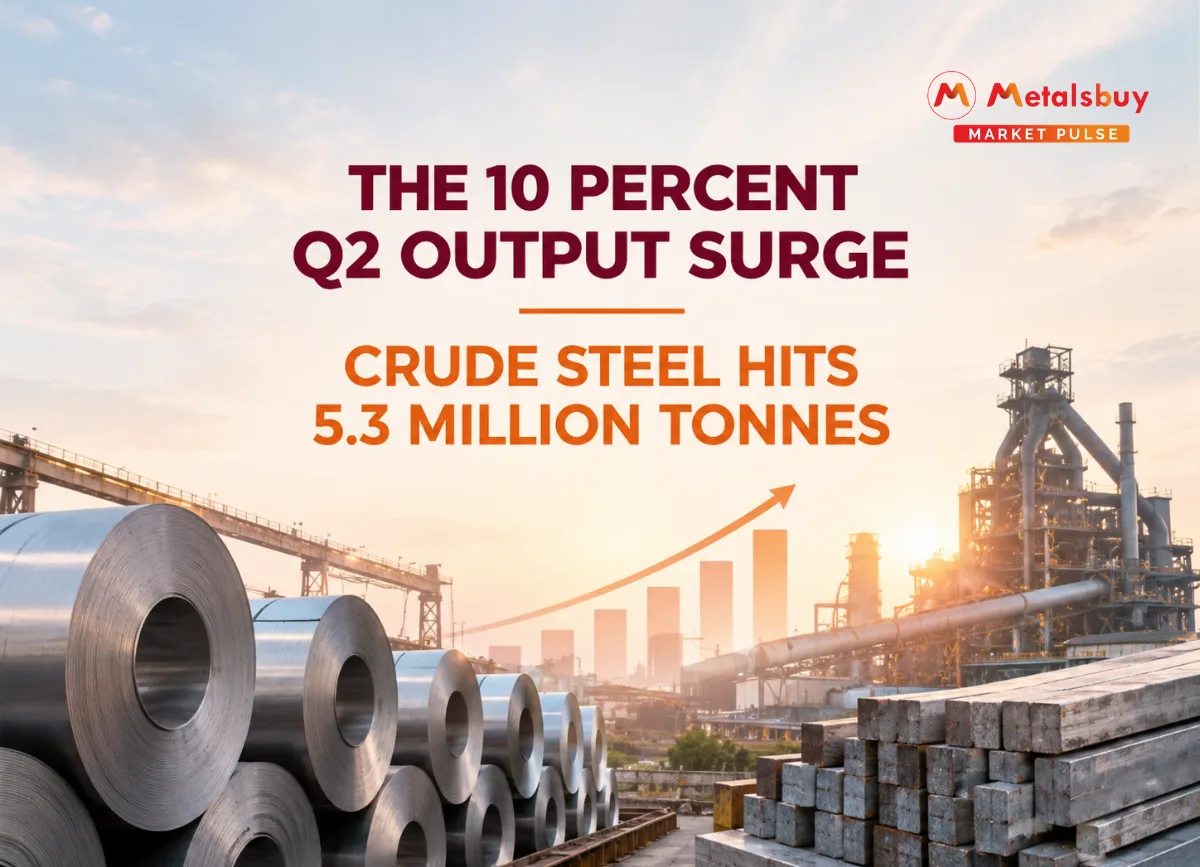
India's premier private sector steel manufacturer is demonstrating exceptional operational momentum as the second quarter of the current financial year concludes. Tata Steel India has officially reported a robust 10 percent year-on-year increase in its crude steel production for the July to September period. This double-digit growth trajectory proves the company’s ability to seamlessly synchronize its expanding manufacturing capabilities with the relentless raw material demand generated by India's booming infrastructure, construction, and automotive sectors. For the broader metals market, this performance solidifies the narrative that domestic consumption remains highly resilient despite ongoing global economic headwinds.
Robust capacity utilization and production milestones
The latest operational data released by the steel giant paints a highly positive picture of its domestic factory-level efficiency. During the second quarter of the 2026-27 financial year, Tata Steel India achieved a crude steel production volume of approximately 5.3 million metric tonnes. This marks a solid 10 percent jump from the output recorded during the corresponding three-month window of the previous fiscal year.
This strong quarterly performance has naturally pushed the company's half-yearly metrics to impressive new highs. For the entire April to September period (H1 FY27), the cumulative crude steel production reached an estimated 10.5 million tonnes. Achieving this level of output required the company's major integrated blast furnaces in Jamshedpur, Kalinganagar, and Meramandali to operate at peak capacity utilization rates. By successfully maintaining these high run-rates through the traditionally challenging monsoon months—when heavy rainfall typically disrupts raw material mining and inbound logistics—the company has showcased exceptional supply chain discipline and operational bandwidth.
Strong delivery volumes across key domestic segments
Producing vast quantities of metal is only half the commercial equation; moving it out to end-users is the true measure of market health. Fortunately, Tata Steel's aggressive production was easily absorbed by a highly active domestic market. The company reported that overall delivery volumes for the second quarter stood strong at around 5.1 million tonnes.
A detailed breakdown of these sales figures reveals diverse and robust consumption across multiple industrial verticals. The automotive and special products segment emerged as a major growth engine, recording significant year-on-year expansion. As Indian automakers aggressively ramped up passenger and commercial vehicle production to build dealer inventory ahead of the festive season, their procurement of high-grade flat steel and cold-rolled coils from Tata Steel saw a corresponding surge.
Simultaneously, the company’s branded products and retail segment maintained a steady off-take, highly supported by sustained rural and semi-urban construction activities. Tata Steel's dedicated e-commerce platform, Aashiyana, which targets individual home builders, also reported robust revenue generation during the quarter. This balanced demand from both heavy B2B manufacturers and direct B2C retail channels ensures that the company's revenue streams remain highly diversified and protected from isolated sector slowdowns.
Kalinganagar expansion to support future supply chains
The 10 percent growth recorded in the second quarter is not merely a short-term operational spike but a reflection of the company's massive, long-term capital expenditure strategy finally coming to fruition. The most critical component of this strategy is the ongoing capacity expansion at the Kalinganagar industrial hub in Odisha.
Just last month, Tata Steel successfully commissioned India's largest blast furnace at the Kalinganagar facility. This monumental engineering achievement is designed to push the specific site's annual crude steel production capacity from 3 million tonnes to a staggering 8 million tonnes. As this new furnace gradually ramps up to its full commercial capacity over the coming quarters, the company’s baseline production volume will structurally shift higher. The seamless integration of this new capacity guarantees that the manufacturer can capture an even larger slice of the domestic market share moving forward, reducing the country's reliance on imported specialty steels.
Positive market outlook and strategic resilience
From a macroeconomic perspective, Tata Steel India’s stellar second-quarter performance acts as a massive confidence booster for the broader manufacturing ecosystem. While the global steel industry is currently grappling with weak demand in China and severe margin compressions across Europe, the Indian market remains an undisputed bright spot.
By focusing heavily on domestic deliveries and executing its brownfield expansions flawlessly, Tata Steel is successfully insulating its domestic balance sheet from international price volatility and trade frictions. As the Indian government continues to pump massive capital into national highway networks, railways, and urban infrastructure, the demand for both flat and long steel products is practically guaranteed for the remainder of the decade. Heading into the busy post-monsoon third quarter, the company’s ability to consistently match record production with high-volume sales ensures that it will remain the dominant, highly profitable backbone of India's ongoing industrial evolution.