KEY HIGHLIGHTS
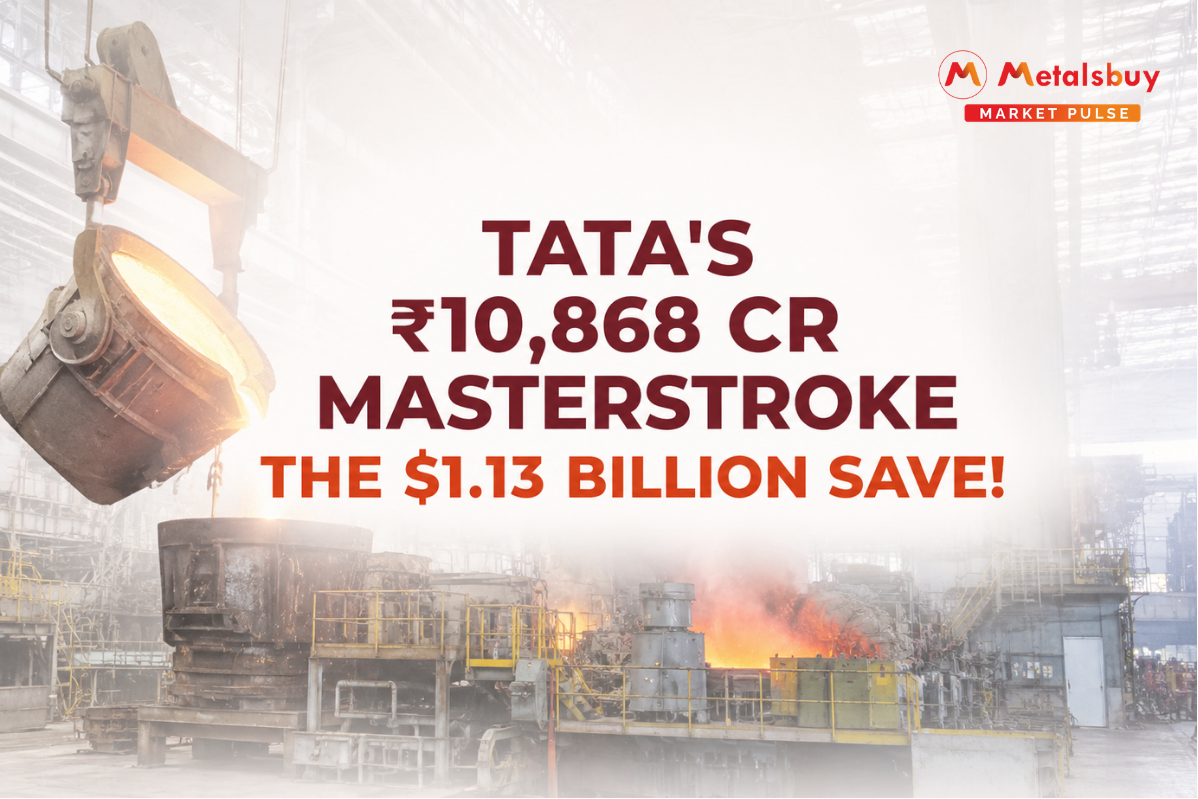
- Financial Triumph: Achieved a staggering $1.13 billion in operational cost savings during the fiscal year 2025-26.
- Margin Expansion: Consolidated EBITDA surged by 35% year-on-year to reach ₹34,848 crores.
- Debt Reduction Strategy: Net debt to EBITDA ratio improved to 2.3x, significantly lowering foreign-currency debt exposure.
- Capacity Augmentation: Major downstream ramp-up at the Kalinganagar facility bolstered domestic production volumes to 31.97 MT.
MARKET ANALYSIS
Tata Steel has firmly established a new benchmark in industrial resilience by successfully executing a massive cost transformation program, culminating in an impressive $1.13 billion (approximately ₹10,868 crores) in operational savings for the fiscal year 2025-26. At a time when the global manufacturing sector grapples with fluctuating raw material costs, supply chain disruptions, and intense international competition, this strategic financial pivot underscores a masterful approach to capital management and operational efficiency. The cost-saving milestone is not merely a temporary balance sheet adjustment; it represents a deep-rooted structural enhancement across the company’s expansive domestic and international operations.
The global steel market has navigated a complex macroeconomic environment recently, characterized by subdued international pricing and the persistent influx of low-cost flat steel from dominant exporting nations. Despite these formidable headwinds, Tata Steel reported a robust 35% year-on-year growth in its consolidated EBITDA, soaring to ₹34,848 crores. This margin expansion was directly catalyzed by targeted efficiency measures rather than relying solely on top-line revenue growth. The company successfully executed its optimization targets by deploying advanced predictive maintenance across its blast furnaces, adopting leaner coal blending techniques, and restructuring its workforce for maximum productivity. These initiatives collectively contributed to a substantial free cash flow generation of approximately ₹10,738 crores, backed by strong operating cash flows of ₹29,254 crores.
Furthermore, domestic operations played a pivotal role in this financial resurgence. The successful ramp-up of the 2-million-tonne downstream facility at Kalinganagar significantly improved domestic net sales realizations, which moved favorably from ₹69,416 per tonne to ₹71,422 per tonne. Concurrently, overall sales volumes experienced a healthy uptick, rising from 30.96 million tonnes (MT) in the previous fiscal to 31.97 MT in FY26. Strategic interventions were not limited to the domestic front; in the United Kingdom, operations managed to drastically reduce PBILDT losses from ₹4,152 crores down to ₹2,566 crores. This aggressive turnaround strategy on an international scale proved highly effective, ultimately driving the consolidated PBILDT per tonne up by 31% to an impressive ₹10,745 per tonne.
WHAT IT MEANS FOR THE STEEL INDUSTRY
The sheer scale and success of this $1.13 billion savings initiative send a powerful and clear signal to the global heavy manufacturing sector. Historically, large-scale steelmakers have relied heavily on favorable pricing cycles and aggressive volume expansion to drive profitability. Tata Steel’s recent performance effectively pivots the industry narrative toward internal process optimization, digital transformation, and technological integration as the primary drivers of sustainable, long-term growth.
For competing firms both domestically and internationally, this development acts as a massive catalyst to accelerate their own digital transformations and cost-efficiency programs. The successful integration of predictive maintenance and leaner resource utilization proves definitively that heavy industries can offset international price dumping and volatile freight costs—which have recently seen dramatic 28-30% increases globally—through rigorous internal controls. It establishes an entirely new standard for operational excellence, dictating that preserving profit margins during low-price market cycles is just as highly valued as capturing market share during economic booms.
Additionally, Tata Steel's remarkable ability to lower its net debt-to-EBITDA ratio to a comfortable 2.3x, while simultaneously funding a robust ₹14,026 crore capital expenditure program, highlights a perfectly balanced approach to deleveraging and aggressive growth. This financial maneuverability allows the company to pursue substantial greenfield and brownfield capacity expansions without over-leveraging its balance sheet. Key future-ready investments, such as the proposed 6 MTPA plant in Gadchirolli and the ongoing 4.8 MTPA integration of Neelachal Ispat Nigam Limited (NINL), are prime examples of this momentum. The broader industry will likely observe and emulate this twin strategy of utilizing aggressive cost rationalization to fund necessary investments, particularly in the urgent transition toward greener, low-emission steel production capabilities.
MARKET OUTLOOK
Looking ahead, the growth trajectory for Tata Steel and the broader domestic steel sector remains highly optimistic and deeply resilient. The company has already committed to an additional ₹7,140 crores in targeted cost savings for the upcoming FY27, signaling an unwavering, ongoing commitment to lean and optimized operations. With domestic aggregate production volumes projected to comfortably reach 34 MT in the coming fiscal year, the strategic focus will increasingly shift toward maximizing value-added downstream capacity and improving product mix.
The continuous strategic emphasis on deleveraging, robustly supported by strong cash and liquid investments hovering around the ₹10,000 crore mark, provides a formidable and reassuring buffer against any future macroeconomic shocks. As the company continues to systematically reduce its foreign-currency debt exposure, its balance sheet will only grow stronger, supporting continuous, uninterrupted investment in sustainable technologies. The ongoing transition toward state-of-the-art electric arc furnaces in the UK and comprehensive green steelmaking initiatives in India will require significant capital, but the massive savings generated internally ensure that these vital projects remain well-funded and on schedule.
Investors, stakeholders, and market analysts can confidently anticipate a period of sustained profitability and market leadership, provided domestic demand continues its current healthy and upward trajectory. By proving that massive operational scale can be successfully coupled with extreme financial and operational agility, Tata Steel is exceptionally well-positioned to dominate the regional market while maintaining a highly competitive and forward-thinking stance on the global stage.