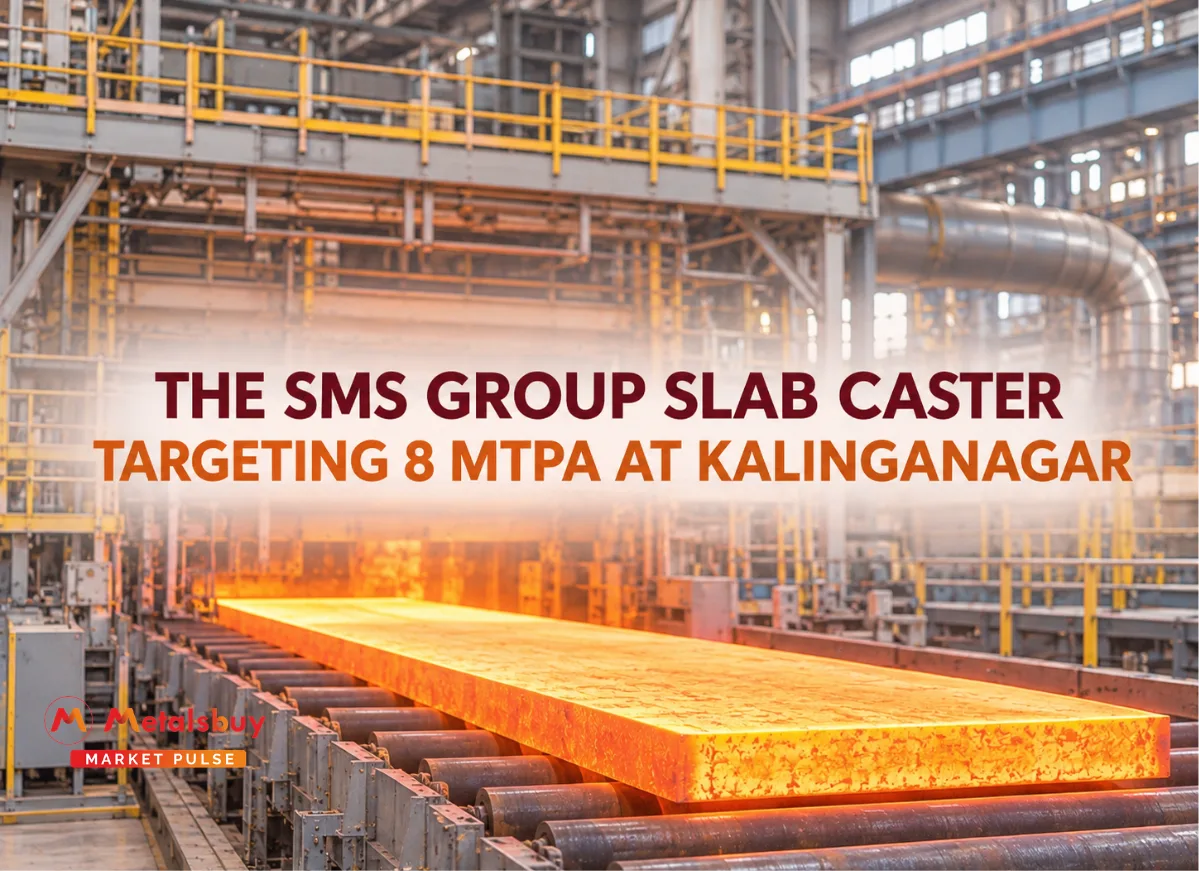
India’s premier private sector steelmaker is aggressively advancing its technological capabilities to dominate the premium metals market. Tata Steel has officially commissioned a state-of-the-art third continuous slab caster at its fully integrated Kalinganagar manufacturing complex in Odisha. Supplied by German metallurgical engineering giant SMS group, this highly sophisticated downstream unit marks a massive operational milestone for the company. By integrating this world-class casting technology, Tata Steel is actively pivoting its product portfolio toward advanced, high-margin steel grades, perfectly positioning itself to fulfill the complex raw material demands of India's rapidly modernizing automotive and energy infrastructure sectors.
Driving advanced metallurgy with state of the art casting technology
Integrating world class German engineering helps the domestic steelmaker seamlessly produce the ultra high strength materials required for modern industrial applications. The fundamental unique selling proposition of this newly commissioned slab caster lies in its exceptional metallurgical precision and sheer processing power. Supplied and engineered by the globally renowned SMS group, the third continuous slab caster at Kalinganagar is specifically designed to handle complex liquid steel compositions that legacy casting machines simply cannot process efficiently.
According to operational blueprints, this advanced unit gives Tata Steel the immediate capability to manufacture highly specialized products, most notably Advanced High-Strength Steel and various high-carbon grades. Furthermore, the caster is equipped to produce American Petroleum Institute standard steel grades, which are strictly mandated for high-pressure applications. The continuous casting process rapidly solidifies molten steel into semi-finished slabs with absolute uniform quality and minimal surface defects. By leveraging the automated controls and optimized cooling systems integrated by the SMS group, plant operators can tightly regulate the metallurgical properties of the steel. This level of factory-floor precision ensures minimal material wastage and guarantees that the resulting slabs are perfectly primed for downstream hot and cold rolling.
Completing the massive kalinganagar phase two expansion
The successful operationalization of this critical downstream unit acts as a major milestone in pushing the site to an eight million tonne capacity. The installation of the third slab caster is not an isolated technical upgrade; it is a highly integrated component of Tata Steel's massive ongoing capital expenditure program. The Kalinganagar facility has been undergoing a monumental Phase II expansion, backed by an estimated investment of ₹27,460 crore, designed to push the site’s total crude steel output from 3 million tonnes to a staggering 8 million tonnes per annum.
Recently, the company successfully lit up India’s largest blast furnace at the same complex, significantly increasing the volume of hot metal generated on-site. However, producing vast quantities of liquid iron is commercially useless if the downstream processing units cannot handle the increased flow. The commissioning of this third slab caster perfectly resolves this potential bottleneck. It provides the exact volumetric capacity required to smoothly absorb the increased molten steel output from the new blast furnace. This perfect synchronization between upstream smelting and downstream casting guarantees that the Kalinganagar plant can sustain continuous, high-volume production cycles without facing internal logistical delays.
Securing domestic supply lines for automotive and energy sectors
Localizing the production of premium steel grades shields Indian original equipment manufacturers from volatile international supply chains and steep import duties. The commercial implications of this technological upgrade are massive, particularly for India's booming heavy manufacturing and transportation ecosystems. The specialized slabs produced by this new caster will be processed into high-end flat products tailored for the most demanding downstream sectors.
The ability to produce Advanced High-Strength Steel domestically is a massive victory for the Indian automotive industry. As car manufacturers rapidly scale up the production of safer passenger vehicles and lightweight electric cars, their reliance on these high-strength, low-weight steel grades is climbing exponentially. Previously, original equipment manufacturers often relied on expensive imports from East Asia to source these specific alloys. By manufacturing them at Kalinganagar, Tata Steel offers local automakers a secure, cost-effective, and highly reliable supply chain. Simultaneously, the production of API-grade steel perfectly supports the national push to expand oil and natural gas pipeline networks. Domestic energy conglomerates can now procure the heavy-duty, corrosion-resistant pipes required for deep-water drilling and cross-country transit directly from a localized source.
Reinforcing corporate profitability through value added products
Pivoting from basic commodity steel to high margin specialized alloys guarantees long term financial resilience for the primary manufacturer. From a broader macroeconomic and corporate finance perspective, the operationalization of the third slab caster represents a masterclass in margin protection. The global steel market is currently saturated with cheap, commercial-grade carbon steel, largely driven by excess exports from slowing Asian economies. Engaging in a price war over basic rebar or standard hot-rolled coils severely compresses corporate profit margins.
Tata Steel is strategically sidestepping this volatile commodity trap. Specialized products like Advanced High-Strength Steel and API pipeline grades command significant price premiums and are characterized by much higher barriers to entry. By utilizing the SMS group's technology to expand its footprint in this lucrative segment, Tata Steel actively insulates its revenue stream. As the Indian government continues to drive domestic infrastructure spending and pushes for absolute industrial self-reliance, having a localized facility capable of producing the world's most advanced steel grades ensures that Tata Steel will remain the highly profitable, undisputed leader of India's manufacturing renaissance.