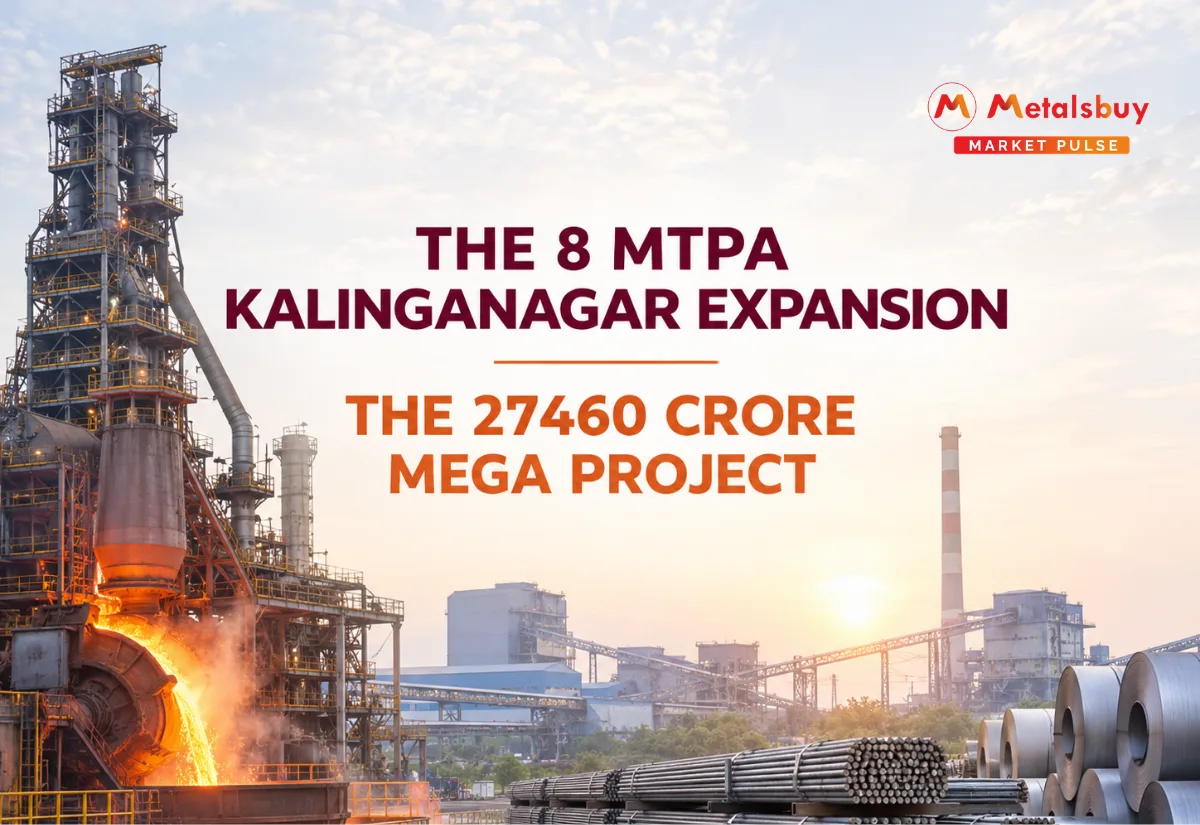
India's premier private sector steel manufacturer has achieved a monumental milestone in its ongoing aggressive growth strategy. Tata Steel has officially commissioned major new production facilities at its fully integrated Kalinganagar manufacturing complex in the mineral-rich state of Odisha. This massive operational upgrade essentially completes the highly anticipated Phase II expansion of the plant, transforming it into one of the largest and most technologically advanced steel manufacturing hubs in the world. For the broader domestic economy, this development guarantees a highly secure, localized supply of premium steel products, directly reducing the nation's reliance on expensive specialized imports.
Boosting domestic capacity through strategic mega expansion
The sheer scale of the Kalinganagar Phase II expansion is a testament to the heavy capital deployment currently driving India's metals sector. Backed by an estimated investment of ₹27,460 crore, this brownfield project was specifically engineered to exponentially increase the site's overall output.
With the successful commissioning of these new downstream and upstream facilities, the total crude steel production capacity of the Kalinganagar plant has surged from its baseline of 3 million tonnes per annum to a staggering 8 million tonnes per annum. A central highlight of this massive capacity addition was the recent lighting up of the plant's new blast furnace. With an inner volume of 5,870 cubic meters, it currently stands as the largest blast furnace operating anywhere in India. The seamless integration of this massive smelting unit, along with its supporting infrastructure, ensures that the facility can maintain continuous, high-volume production cycles to meet the relentless demand generated by the domestic market.
Technological upgrades drive manufacturing efficiency
Beyond sheer volumetric growth, the newly commissioned facilities are heavily focused on producing high-end, value-added steel grades that require exceptional metallurgical precision.
As part of the Phase II rollout, the company has integrated a state-of-the-art Cold Rolling Mill complex with a capacity of 2.2 million tonnes per annum. This sophisticated downstream facility allows Tata Steel to process hot-rolled coils into highly refined, ultra-thin, and high-strength steel sheets. The expansion also includes a modern continuous annealing line and a continuous galvanizing line. By incorporating these advanced processing technologies, the Kalinganagar plant drastically improves its operational efficiency and material yield. The modern layout of the expanded facility is designed to optimize internal logistics, minimize energy wastage between production stages, and significantly lower the overall carbon footprint per tonne of finished steel compared to legacy manufacturing plants.
Securing supply for automotive and infrastructure sectors
The commercial implications of this 5 million tonne capacity addition are massive, particularly for India's booming high-tech manufacturing and construction sectors. The advanced cold-rolled and galvanized steel produced by the new Kalinganagar lines is specifically tailored to meet the exacting standards of the domestic automotive industry. As Indian automakers rapidly scale up the production of passenger vehicles and heavy commercial trucks, their requirement for advanced high-strength steel—which reduces vehicle weight while maintaining crash safety—has skyrocketed. By manufacturing these specialized automotive grades domestically, Tata Steel provides local original equipment manufacturers with a highly reliable supply chain, effectively shielding them from the volatile pricing and delayed delivery timelines associated with international imports from Japan or South Korea. Simultaneously, the increased production of premium structural steel will seamlessly feed into the government's multi-billion dollar capital expenditure programs targeting national highway and railway modernization.
Aligning with national economic and industrial targets
From a macroeconomic perspective, the successful scale-up of the Kalinganagar facility acts as a massive catalyst for regional development in Odisha and aligns flawlessly with broader national ambitions.
Operating an 8 million tonne integrated steelworks requires a vast network of ancillary support, immediately generating thousands of indirect employment opportunities across local logistics, equipment maintenance, and material handling sectors. On a national level, this successful commissioning proves that domestic steelmakers have the technical and financial bandwidth to execute complex mega-projects. As the Indian government aggressively chases its National Steel Policy target of establishing 300 million tonnes of annual domestic capacity by 2030, integrated brownfield expansions like Kalinganagar form the absolute backbone of that vision. As the new facilities gradually ramp up to their full commercial run-rates over the coming quarters, Tata Steel is firmly cementing its position as the dominant force in India's industrial resurgence, ensuring that the country's economic boom is built on a foundation of world-class, locally manufactured steel.