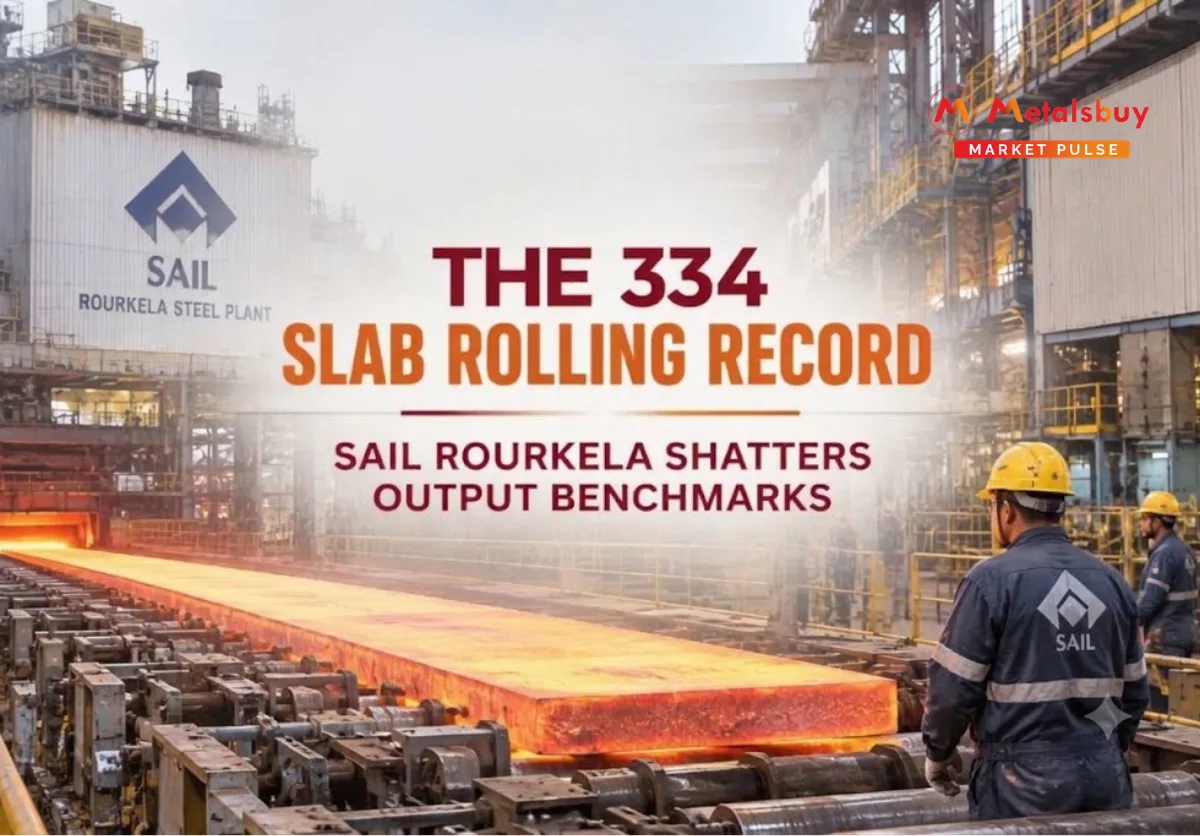
India’s public sector heavy manufacturing ecosystem is demonstrating exceptional operational agility as domestic steel demand continues its rapid upward trajectory. The Rourkela Steel Plant, a premier flagship unit of the state-owned Steel Authority of India Limited, has officially set a new benchmark in industrial efficiency by achieving its highest-ever single-shift production at the New Plate Mill. This historic manufacturing milestone proves that legacy public sector assets possess the technical bandwidth and workforce discipline required to scale up operations seamlessly. For the broader metals market, this aggressive production run-rate ensures a highly secure, localized supply of premium steel plates, directly supporting the nation's ongoing infrastructure, defense, and maritime manufacturing booms.
Operational excellence drives new production milestones at rourkela
The foundation of this manufacturing success rests entirely on flawless shop-floor coordination and the optimized utilization of advanced rolling technology. According to official operational data released by the Rourkela Steel Plant management, the New Plate Mill successfully rolled a staggering 334 slabs during the 'A' shift on a single working day this October. This exceptional output effectively shattered previous internal benchmarks and highlights a highly synchronized effort between the heating, rolling, and finishing departments. Translating this volume into tangible metrics, processing 334 heavy slabs in a standard eight-hour shift requires the mill to maintain a relentless, uninterrupted processing speed, maximizing the thermal efficiency of its reheating furnaces and the mechanical precision of its heavy rolling stands.
The New Plate Mill at Rourkela was specifically commissioned to cater to the high-end segment of the flat steel market. Equipped with cutting-edge automation and advanced metallurgical controls, the facility is capable of rolling ultra-wide and incredibly thick steel plates that generic rolling mills simply cannot handle. Achieving record-breaking output on this sophisticated machinery proves that the operational crews have fully mastered the technological nuances of the plant. The management specifically lauded the cross-functional teamwork, noting that seamless material handling, strict adherence to safety protocols, and real-time maintenance checks were the absolute catalysts that allowed the mill to push past its designated nameplate capacity without experiencing any forced downtime or mechanical fatigue.
Meeting the surging domestic demand for heavy steel plates
Producing record volumes of steel is only commercially effective if the downstream market is capable of absorbing the material immediately. Fortunately, the demand for heavy steel plates in India is currently experiencing a massive, multi-year supercycle. Unlike basic construction rebar or standard cold-rolled coils, the heavy plates produced at the Rourkela Steel Plant are highly specialized products. They form the absolute structural skeleton for some of the country's most critical and demanding industries. The domestic shipbuilding sector, currently undergoing a massive revitalization under the government's maritime expansion initiatives, requires thousands of tonnes of high-tensile, corrosion-resistant steel plates to construct commercial bulk carriers and advanced naval defense vessels. Similarly, the energy sector relies heavily on these ultra-thick plates to fabricate high-pressure boilers, massive wind turbine towers, and robust oil and gas transportation pipelines.
By significantly ramping up the daily output at the New Plate Mill, the Steel Authority of India is directly addressing this surging localized demand. The central government is currently deploying a massive capital expenditure budget of over ₹11.11 lakh crore to modernize national infrastructure. This capital is flowing aggressively into the construction of heavy railway bridges, earth-moving machinery, and customized industrial fabrication. Every additional tonne of premium plate steel rolled at Rourkela guarantees that these strategic national projects will not face any raw material bottlenecks or be forced to rely on expensive, delayed shipments from international suppliers in East Asia or Europe.
Aligning plant efficiency with long term national capacity goals
From a broader macroeconomic perspective, extracting maximum operational efficiency from existing brownfield assets is a vital component of India's long-term industrial strategy. The Indian government has set an overarching National Steel Policy target to push the country's installed crude steel capacity to a staggering 300 million tonnes per annum by the year 2030. Within this national framework, the Steel Authority of India is executing its own aggressive expansion roadmap, aiming to elevate its corporate production capabilities to roughly 35 million tonnes by the 2030-31 financial year. While building entirely new greenfield plants is a part of this vision, achieving immediate volumetric growth requires maximizing the output of existing facilities like the Rourkela Steel Plant.
The record-breaking performance at the New Plate Mill proves that with optimized standard operating procedures, existing production lines can yield significantly higher commercial volumes. This operational efficiency drastically lowers the per-tonne cost of production, directly expanding the corporate profit margins for the state-run steelmaker. As the domestic market heads into the highly active winter construction season, maintaining this elevated production momentum ensures that the Rourkela Steel Plant will remain a dominant, highly profitable, and globally competitive anchor in India's ongoing heavy manufacturing resurgence.