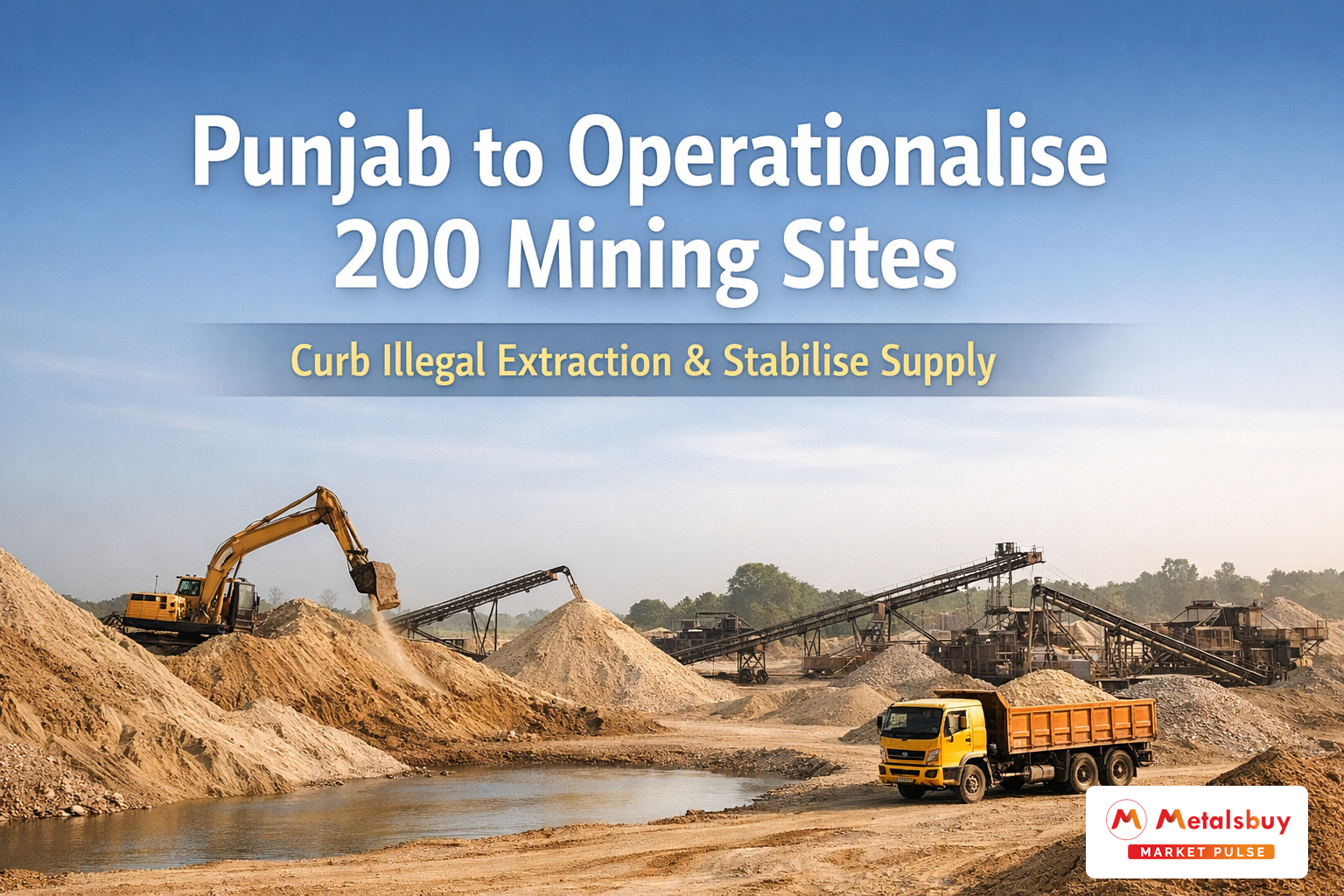
The Punjab Government has announced a major overhaul of its minor minerals ecosystem with plans to operationalise over 200 new mining sites across the state, alongside allowing mining on private land under a reformed policy framework. The move is aimed at curbing illegal mining, improving availability of sand and aggregates, stabilising prices, and strengthening state revenues.
This is one of Punjab’s most significant mining-sector interventions in recent years, designed to address persistent shortages of construction raw materials and the unchecked proliferation of illegal extraction.
Key Highlights of the Announcement
-
200+ government-identified mining sites to be made operational in a phased manner
-
290 proposals received from crusher owners and private landowners for mining under new policy provisions
-
26 Letters of Intent (LoIs) already issued to eligible applicants
-
29 commercial mining sites auctioned online, containing nearly 11.58 crore cubic feet of minor minerals
-
Private-land mining expected to begin by end-March 2026, subject to clearances
Officials stated that district-level surveys have largely been completed and environmental processes are underway, enabling faster execution compared to earlier mining regimes.
Policy Reforms Driving the Expansion
The expansion follows sweeping amendments to Punjab’s Minor Mineral Policy, which introduced two new categories:
1. Crusher Mining Sites (CRMS)
Allows registered crusher owners to extract minor minerals from approved locations upon payment of royalty and compliance with environmental norms.
2. Landowner Mining Sites (LMS)
Enables private landowners to undertake mining on their own land, bringing previously unregulated extraction into the legal framework.
These reforms aim to break supply monopolies, improve transparency, and ensure that local industries are not dependent on illegal or interstate sourcing.
Why the Move Is Significant
Curbing Illegal Mining
Punjab has long struggled with illegal sand and aggregate mining due to supply shortages. By expanding legal mining capacity and simplifying access, the government expects illegal extraction to become economically unviable.
Improving Construction Material Availability
Increased legal supply is expected to ease shortages faced by:
-
Infrastructure projects
-
Housing and real estate developers
-
Local crusher units
This could reduce project delays and cost overruns linked to raw material scarcity.
Revenue and Governance Boost
Online auctions, royalties, and regulated private mining are expected to:
-
Increase state revenue
-
Reduce leakages and cartelisation
-
Improve traceability of mineral movement
The state has also shifted greater responsibility for environmental clearances to bidders, shortening operational timelines.
Sector-Wise Impact Assessment
| Sector | Expected Impact |
|---|---|
| Construction & Infrastructure | Improved availability of sand and aggregates; lower logistics costs |
| Real Estate & Housing | Reduced input cost pressure, especially for affordable housing |
| Crusher Industry | Better access to raw materials; improved capacity utilisation |
| Transport & Logistics | Shorter haul distances reduce freight dependency |
| State Finances | Higher royalty collections and auction revenues |
| Environment & Compliance | Stronger monitoring under formalised mining framework |
Impact on Minor Minerals & Commodities
| Commodity | Current Scenario | Expected Change |
|---|---|---|
| Sand | Acute shortages, illegal extraction prevalent | Legal supply surge; price stabilisation expected |
| Gravel / Aggregates | High dependence on limited sites | Increased local availability via CRMS |
| Other Minor Minerals | Fragmented, unregulated sourcing | Formalised extraction under auctions & LMS |
The auctioned 29 commercial sites alone account for ~11.58 crore cubic feet of reserves, indicating meaningful near-term supply addition.
Timelines and Execution Outlook
-
December 2025 – March 2026: Phased operationalisation of government mining sites
-
End-March 2026: Expected start of private-land mining under LMS and CRMS
-
Enforcement actions, including FIRs and challans, are ongoing to ensure compliance during the transition
The National Green Tribunal (NGT) continues to monitor enforcement and environmental adherence, signalling stricter oversight alongside expansion.
Market Outlook: What to Watch
-
Speed of environmental clearances will determine how quickly sites become productive
-
Conversion of LoIs into active mining operations
-
Local price trends for sand and aggregates over the next 3–6 months
-
Effectiveness of enforcement in eliminating illegal mining
Conclusion
Punjab’s decision to operationalise 200 mining sites marks a structural reset of the state’s minor minerals market. If executed as planned, the initiative could significantly reduce illegal mining, stabilise construction input costs, and create a more transparent, revenue-positive mining ecosystem.
For the construction, infrastructure, and commodities market, this policy shift has the potential to be a game changer in North India’s supply dynamics.