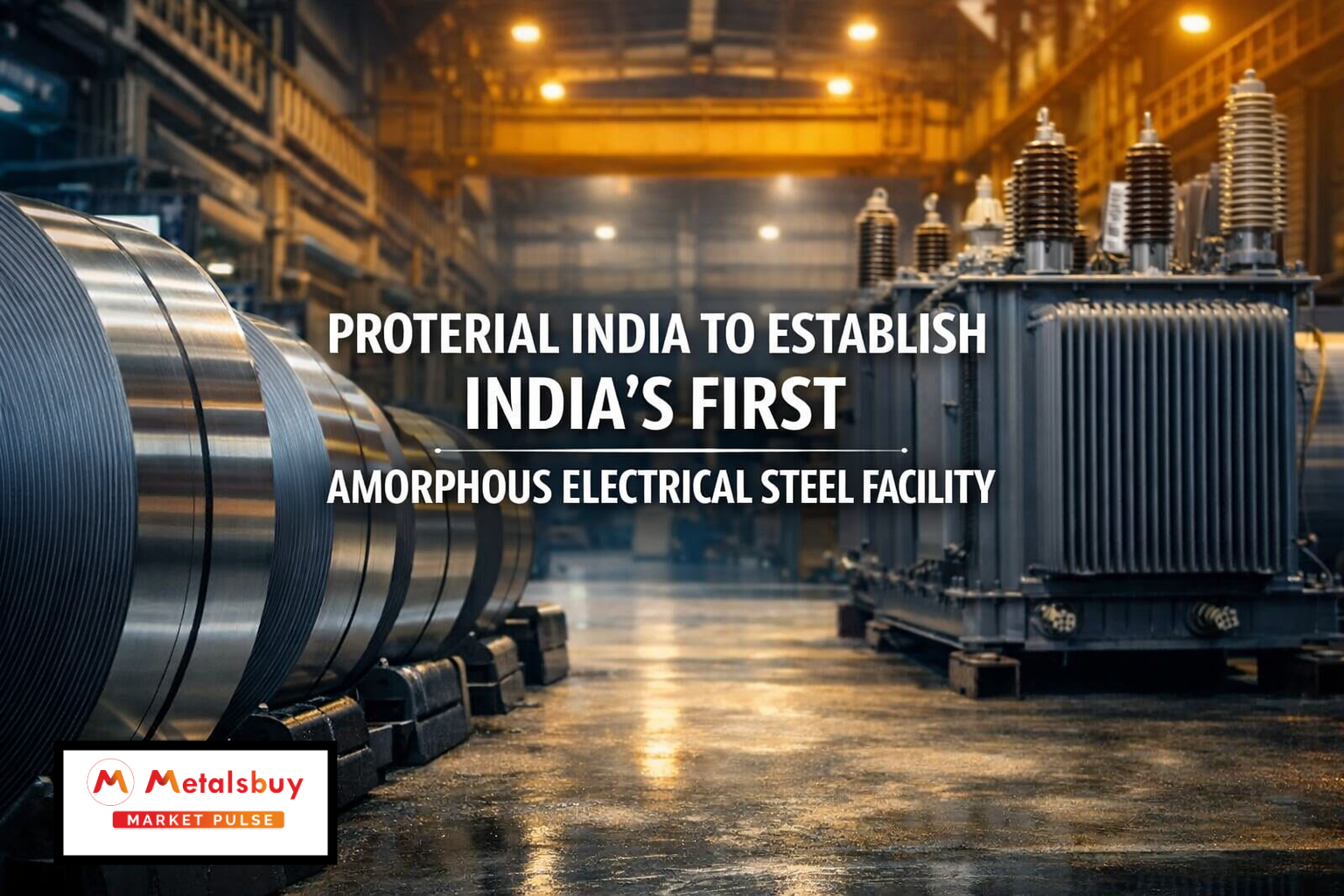
Specialty Steel Investment Signals Structural Shift in Transformer Material Supply Chain
Proterial India has announced an investment of approximately ₹1,350 crore (around $148 million) to establish India’s first manufacturing facility for amorphous electrical steel at Sri City, Andhra Pradesh. The project is being developed under the Government of India’s Production-Linked Incentive (PLI) scheme for specialty steel and represents a strategic step toward localizing high-efficiency electrical steel production.
The development marks a significant milestone for India’s specialty steel ecosystem, particularly in the transformer and power distribution segment, where the country remains heavily import dependent.
1. Strategic Importance of Amorphous Electrical Steel
Amorphous electrical steel differs fundamentally from conventional CRGO (Cold Rolled Grain Oriented) silicon steel due to its non-crystalline atomic structure. This structure significantly reduces magnetic core losses in transformers.
Technical Advantages:
-
Up to 60–70 percent lower core losses compared to conventional CRGO grades
-
Around 30 percent improvement in transformer efficiency
-
Reduced operating temperature, extending transformer lifespan
-
Lower lifecycle carbon emissions
With India’s aggregate transmission and distribution losses estimated at 16–18 percent, efficiency-enhancing materials such as amorphous steel can play a meaningful role in reducing system-wide energy wastage.
2. India’s Electrical Steel Market: Demand and Supply Gap
India currently relies substantially on imports for advanced electrical steels, particularly CRGO and other high-grade materials.
Market Indicators:
-
Electrical steel demand estimated at 1.2–1.4 million tonnes annually
-
Import dependency for CRGO remains around 85–90 percent
-
Market size estimated at $2–3 billion currently
-
Expected to approach $4 billion by 2030
-
Transformer industry projected to grow at 7–9 percent CAGR over the next five years
Rapid expansion of renewable energy capacity, urban infrastructure, and electric mobility is expected to sustain demand for high-efficiency transformers. However, the absence of domestic amorphous steel manufacturing has historically exposed transformer OEMs to import-linked volatility, including currency fluctuations and extended lead times.
The proposed facility addresses this structural gap.
3. Policy Context and Investment Outlook
The Specialty Steel PLI scheme aims to add approximately 25 million tonnes of specialty steel capacity and attract over ₹40,000 crore in fresh investments. The policy framework has been designed to encourage value-added steel production and reduce import dependence.
India’s broader power sector roadmap further strengthens the demand outlook:
-
Target of 500 GW non-fossil fuel capacity by 2030
-
Ongoing grid modernization initiatives
-
Expansion of rural electrification and distribution networks
-
Growth in EV charging infrastructure
Each of these drivers increases the requirement for efficient transformers, indirectly supporting demand for advanced electrical steel grades.
4. Market Implications
For Transformer Manufacturers:
-
Improved supply security
-
Reduced lead time and logistics risk
-
Potential moderation in input cost volatility over the medium term
For the Steel Sector:
-
Entry into higher-margin, technology-intensive segments
-
Enhanced domestic capability in advanced metallurgy
-
Potential positioning as a regional export supplier in South Asia and the Middle East
For Energy Economics:
If amorphous core transformers gradually replace even 10–15 percent of India’s distribution transformer base, the cumulative annual energy savings could be substantial, resulting in meaningful cost savings and emission reductions.
5. Structural Shift Toward Value-Added Steel
This investment reflects a broader transformation underway in India’s steel industry. The growth narrative is gradually shifting from capacity expansion in commodity grades to technology-driven value creation in specialty segments.
Localization of amorphous electrical steel production represents a strategic step toward deeper integration of advanced manufacturing within India’s industrial framework. As grid expansion and clean energy integration accelerate, demand for high-efficiency materials is expected to become structurally stronger.
The project therefore signals not only a new facility, but a recalibration of India’s position within the global electrical steel value chain.