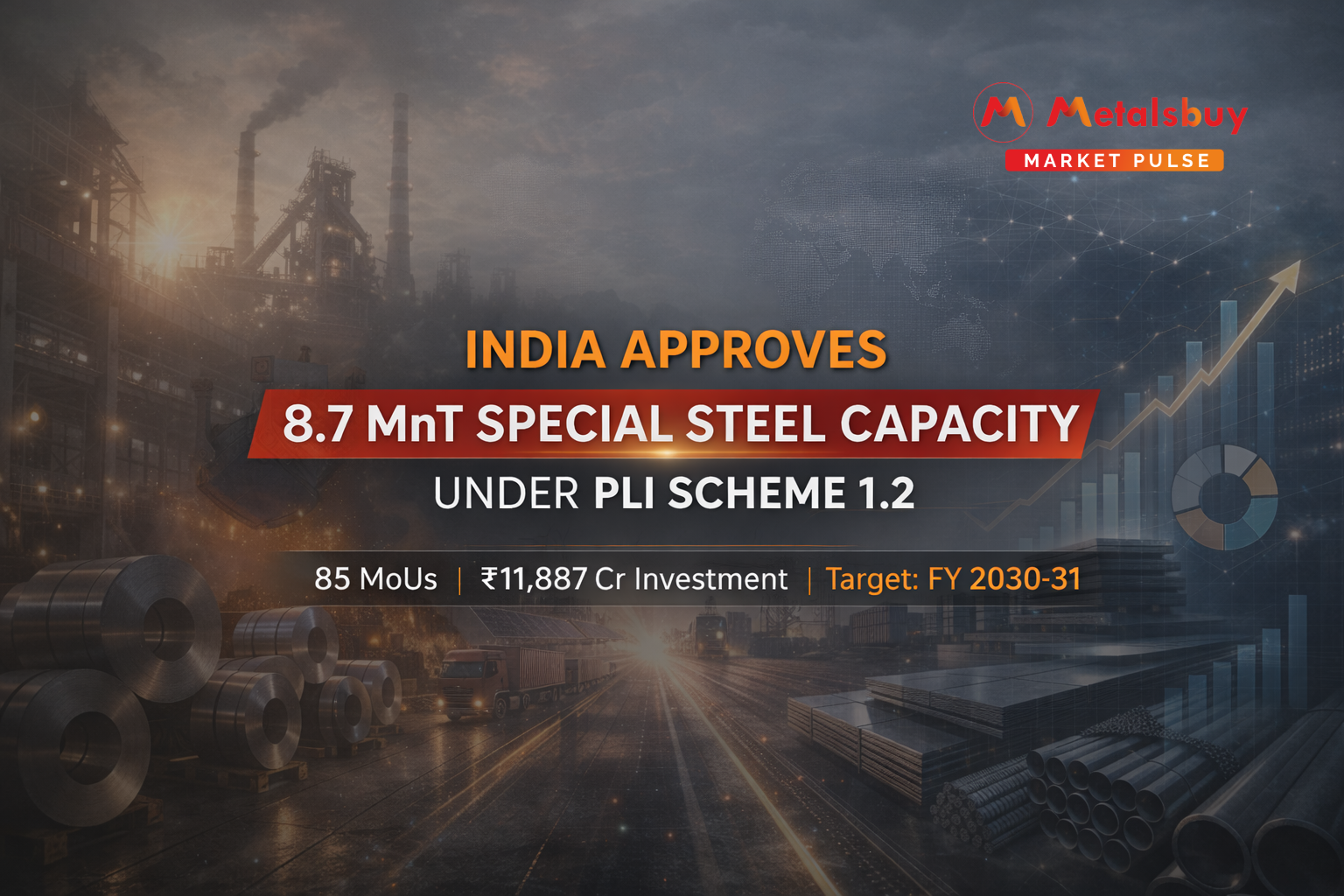
Reinforcing its strategy to deepen domestic manufacturing of high-value steel grades.
Under the latest round, 85 Memorandums of Understanding (MoUs) have been signed with 55 companies, involving a cumulative committed investment of ₹11,887 crore (~USD 1.3 billion). The commissioned capacities are expected to become operational by FY 2030-31.
Investment and Capacity Details
-
Total proposed capacity addition: 8.7 MnTPA
-
Participating companies: 55
-
MoUs signed: 85
-
Committed investment: ₹11,887 crore
-
Implementation timeline: By FY 2030-31
The scheme aims to incentivize domestic production of value-added steel grades that are currently imported or have limited domestic penetration.
Strategic Context
India’s installed crude steel capacity currently stands at approximately 205 MnTPA, with a national target of reaching 300 MnTPA by FY 2030-31. While the announced 8.7 MnT represents roughly 4–5% of the existing installed base, its strategic relevance is significant because it focuses on specialized, higher-margin steel categories rather than commodity grades.
Special steel categories covered under the scheme include:
-
Coated and plated steel products
-
High-strength automotive steel
-
Electrical steel
-
Alloy and engineering steel
-
Specialty stainless steel grades
These grades are critical for sectors such as automotive manufacturing, renewable energy, railways, defense, and heavy engineering.
Market Implications
Structural Considerations
Despite policy support, several structural challenges remain:
-
High dependence on imported coking coal
-
Technology intensity in high-grade electrical steel production
-
Scrap availability constraints
-
Global price competition from Asian producers
Execution timelines, technology partnerships, and cost competitiveness will determine the effectiveness of the announced capacity pipeline.
Metalsbuy Assessment
The 8.7 MnTPA special steel expansion under PLI 1.2 reflects a targeted industrial strategy focused on quality over quantity. While modest in scale relative to India’s overall crude steel capacity ambitions, the initiative is positioned to materially alter the domestic steel mix by FY 2030-31.
Progress on project commissioning, capital deployment, and product-grade diversification will remain key indicators to track over the next five years.