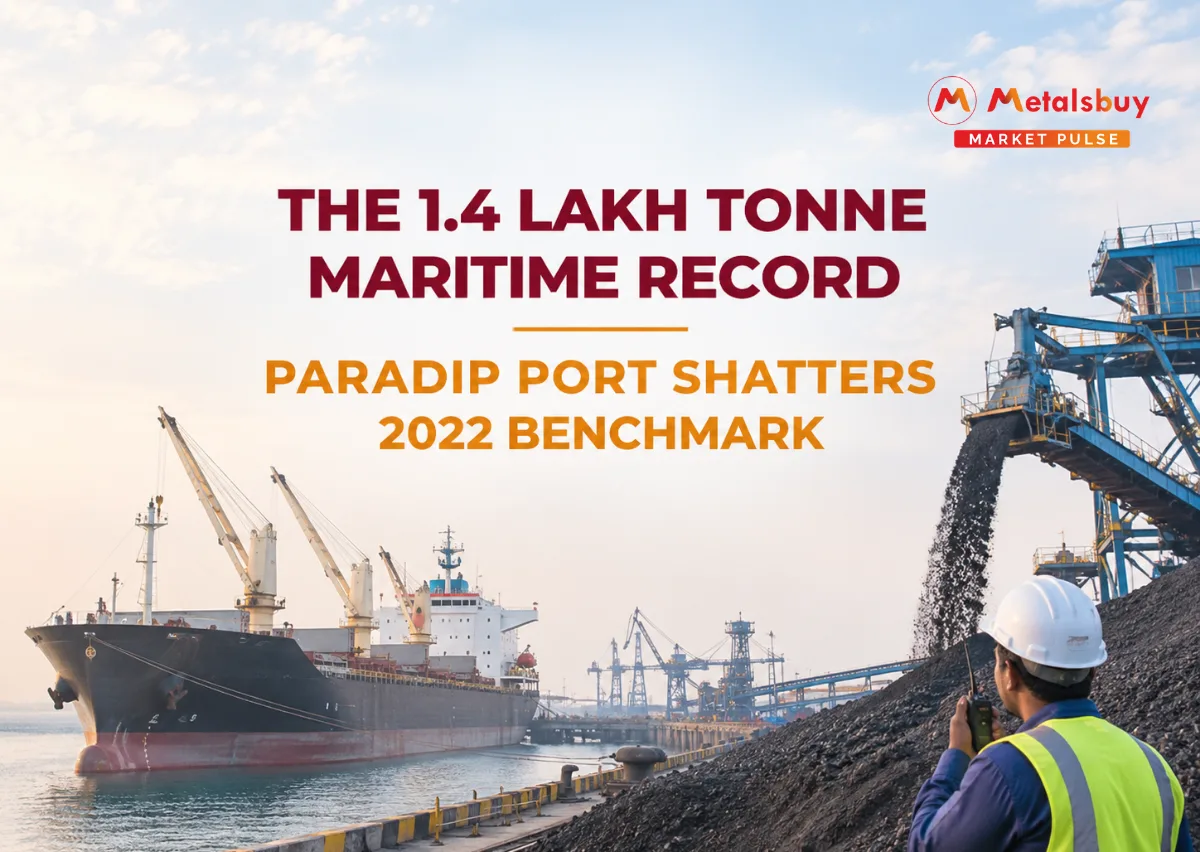
The Indian maritime and logistics sector is celebrating a massive operational milestone this week as the country's eastern coastal infrastructure flexes its heavy cargo capabilities. Paradip Port Authority has officially set a new single-day loading record at its Mechanised Coal Handling Plant. This unprecedented volume of bulk cargo movement is a powerful indicator of the port’s growing efficiency and its highly critical role in stabilizing the domestic energy supply chain. As thermal power plants across the country aggressively build their fuel inventories ahead of the winter months, the proven ability of eastern maritime hubs to rapidly evacuate and load coal guarantees that the national power grid remains heavily insulated from potential raw material supply shocks.
Shattering previous loading benchmarks to power domestic energy grids
The recent milestone highlights a significant leap in operational capacity and efficiency at one of India's most critical maritime hubs. Operational data from October 10, 2026, confirms a staggering achievement at the mechanized facility. During a single 24-hour cycle, the Mechanised Coal Handling Plant successfully loaded exactly 1,40,022 metric tonnes of thermal coal. This massive bulk volume was efficiently distributed across two large vessels, the M.V. APJ Indrani and the M.V. Ripley Pinnacle. By confidently crossing the 1.4 lakh tonne mark, the port authority effectively eclipsed its previous operational best.
The former single-day loading record stood at 1,37,500 metric tonnes, a benchmark that had remained unbroken since May 29, 2022, during the simultaneous loading operations of the M.V. Arethousa and the M.V. ISL Star. Breaking a four-year-old record by an additional 2,522 metric tonnes proves that the port's continuous investments in heavy infrastructure, high-speed conveyors, and workforce training are currently yielding tangible, high-volume results for the bulk shipping industry.
Modernizing port logistics through advanced mechanization
The continued optimization of the coal handling plant is proving essential for the rapid turnaround of massive bulk carrier vessels. Moving over 1.4 lakh tonnes of a dusty, heavy bulk commodity in a single day is a complex engineering and logistical challenge. It requires absolute synchronization between the railway rakes bringing the coal into the port from inland mines, the massive stacker-reclaimers operating in the stockyards, and the high-capacity ship loaders positioned at the berths. Paradip Port Authority Chairperson Susanta Kumar Purohit publicly recognized the workforce, officers, and technical personnel associated with the plant for flawlessly executing this massive operation.
Purohit noted that the milestone heavily underscores the operational capabilities of the mechanized facility and the coordinated efforts required to ensure vessels are loaded and dispatched without costly demurrage delays. In the highly competitive global maritime trade, minimizing the turnaround time for bulk carriers like Panamax and Capesize vessels directly translates to massive freight savings for the charterers and the end-users. By running an ultra-efficient loading cycle, the port is actively lowering the landed cost of thermal coal.
Strengthening the coastal shipping network for thermal coal
Coastal shipping remains a highly cost-effective and environmentally friendly method to transport bulk fuel to southern and western power plants. The real-world impact of this loading record extends far beyond the port's immediate boundaries. Paradip Port functions as the primary maritime gateway for the mineral-rich eastern states, serving as the main evacuation route for coal mined by Mahanadi Coalfields Limited in Odisha. The thermal coal loaded at this mechanized facility is predominantly destined for coastal power generation companies located in southern and western India, including major utilities across Tamil Nadu, Andhra Pradesh, and Maharashtra.
By accelerating the loading process, the port is actively strengthening India's coastal shipping network. Coastal shipping is heavily promoted by the Ministry of Ports, Shipping and Waterways because it significantly decongests the overburdened domestic railway network and provides a greener, cheaper alternative for long-haul bulk transport. When ports load vessels at record speeds, domestic power plants receive their fuel cheaper and faster, which structurally lowers the cost of electricity generation and ensures uninterrupted power for major industrial manufacturing belts.
Aligning with national maritime and economic targets
The port's consistent capacity augmentation directly supports the country's vision for a robust and highly efficient maritime infrastructure. From a broader macroeconomic perspective, this daily loading record is part of a larger, sustained growth trajectory at the facility. Recent operational data reveals that Paradip Port Authority has been aggressively scaling its throughput across multiple bulk commodities. For instance, in August 2026, the port recorded a massive 209.74 percent year-on-year growth in non-coking coal handling, moving 49,559 metric tonnes compared to just 16,000 metric tonnes in the same month of the previous fiscal year.
This relentless volume expansion firmly aligns with the central government's vision to transform Paradip into a leading mega port capable of handling next-generation cargo volumes. By consistently optimizing infrastructure utilization and facilitating faster cargo movement, the port ensures that the logistics sector does not become a bottleneck for India's economic expansion. As the nation's industrial output accelerates into the busy fourth quarter, the proven ability of Paradip Port to handle unprecedented cargo volumes guarantees a highly resilient and reliable raw material supply chain for the broader manufacturing and energy ecosystem.