Key Highlights:
- NMDC Limited revises iron ore prices effective April 05, 2026
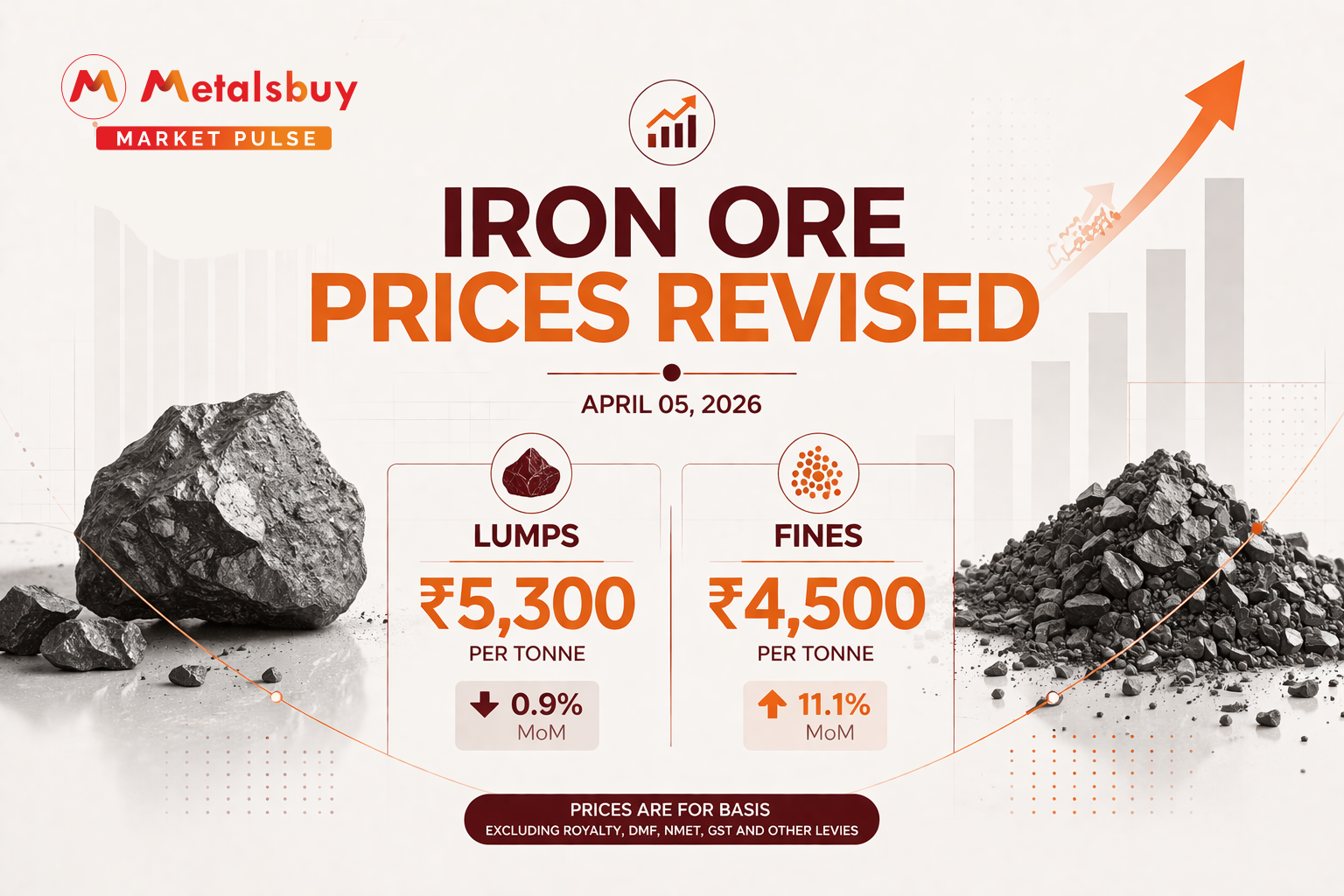
- Baila Lump (65.5% Fe): ₹5,300/t
- Baila Fines (64% Fe): ₹4,500/t
- Lump prices down ~0.9% MoM (₹5,350 → ₹5,300)
- Fines prices up ~11.1% MoM (₹4,050 → ₹4,500)
- Overall price increase across grades by ₹450–₹550/t (~6–10%) in some categories
- Prices are FOR basis, excluding royalty, DMF, NMET, GST and other levies
Divergent Price Trend Signals Strength in Fines Demand Amid Stable Lump Market
India’s largest iron ore producer, NMDC Limited, has announced a fresh revision in its iron ore prices effective April 05, 2026, setting Baila Lump prices at ₹5,300 per tonne and Baila Fines at ₹4,500 per tonne. The revision reflects a mixed pricing trend, with marginal correction in lump ore prices and a sharp upward movement in fines, indicating evolving demand-supply dynamics in the domestic steel ecosystem. As NMDC continues to act as a benchmark setter for iron ore pricing in India, this revision is expected to have a direct bearing on input cost structures for steel manufacturers across the country.
A closer analysis of the price movement highlights a contrasting trend between lumps and fines. While lump prices have been reduced by ₹50 per tonne compared to the previous revision in March 2026, translating into a marginal decline of approximately 0.9%, fines have witnessed a significant increase of ₹450 per tonne over the same period, reflecting a strong 11.1% month-on-month rise. This divergence suggests a stronger demand pull for fines, which are widely used in sinter plants and pelletization processes, especially amid rising steel production activity in the domestic market.
From a broader pricing perspective, NMDC’s latest revision also aligns with an overall increase of ₹450–₹550 per tonne across various grades as indicated by market sources, implying a generalized firming trend in iron ore prices despite selective corrections. This upward momentum can be attributed to improved steel prices toward the end of FY26, along with steady consumption from domestic steel mills that continue to operate at relatively high capacity utilization levels.
The pricing structure remains on a Free on Rail (FOR) basis, which excludes statutory charges such as royalty, District Mineral Foundation (DMF) contributions, National Mineral Exploration Trust (NMET) fees, GST, and other levies. As a result, the effective landed cost for steel producers is significantly higher than the announced base price, further amplifying the impact of price revisions on overall production economics.
From an industry standpoint, the sharp increase in fines prices is particularly noteworthy. Steel plants in India are increasingly optimized to utilize higher proportions of fines, either through sintering or pelletization routes, making fines a critical input material. The 11% jump in fines prices is therefore expected to exert upward pressure on raw material costs for non-integrated steel producers, who rely heavily on merchant iron ore supply. This could potentially lead to margin compression unless supported by corresponding increases in finished steel prices.
On the other hand, the marginal correction in lump prices indicates relatively stable demand conditions for this segment. Lump ore, which can be directly used in blast furnaces without additional processing, typically commands a premium due to lower processing requirements. However, the slight price decline suggests either adequate availability or a temporary balancing of demand within this segment.
Looking at the broader trend, NMDC’s pricing over the past few months reflects a recovery trajectory from the lows seen earlier in 2026. Iron ore prices had dropped significantly in January and February due to subdued demand and inventory corrections but have since rebounded on the back of improved market sentiment and stronger steel production levels. The current pricing therefore represents a stabilization phase, with selective upward adjustments driven by segment-specific demand.
For the Indian steel industry, NMDC’s price revisions continue to serve as a critical indicator of raw material cost trends. Any sustained increase in iron ore prices, particularly fines, is likely to influence procurement strategies, cost management decisions, and ultimately the pricing of finished steel products in the domestic market. Additionally, with India targeting a significant expansion in steel capacity over the coming years, the stability and predictability of iron ore pricing will remain a key factor in ensuring long-term competitiveness.
In conclusion, NMDC’s latest price revision underscores a nuanced market scenario where demand for fines is gaining strength while lump prices remain relatively stable. As steel demand continues to hold firm and production levels remain elevated, iron ore pricing is expected to stay resilient in the near term, with further adjustments likely to be driven by both domestic consumption patterns and global commodity trends.