India’s largest state-owned iron ore miner is demonstrating exceptional operational momentum as the domestic heavy manufacturing sector prepares for a massive seasonal demand surge. National Mineral Development Corporation has officially reported a stellar 18 percent year-on-year increase in its provisional iron ore production for the month of October 2026. While the company simultaneously navigated a temporary 12 percent decline in immediate dispatch volumes, industry analysts and macroeconomic watchers view this dynamic as a highly positive, strategic market phase. By accelerating extraction rates and accumulating high-grade inventories at the pitheads, the public sector enterprise is effectively building a massive raw material safety net, perfectly positioning the domestic steel supply chain to capture the upcoming post-monsoon infrastructure boom.
Driving massive extraction growth across key mining hubs
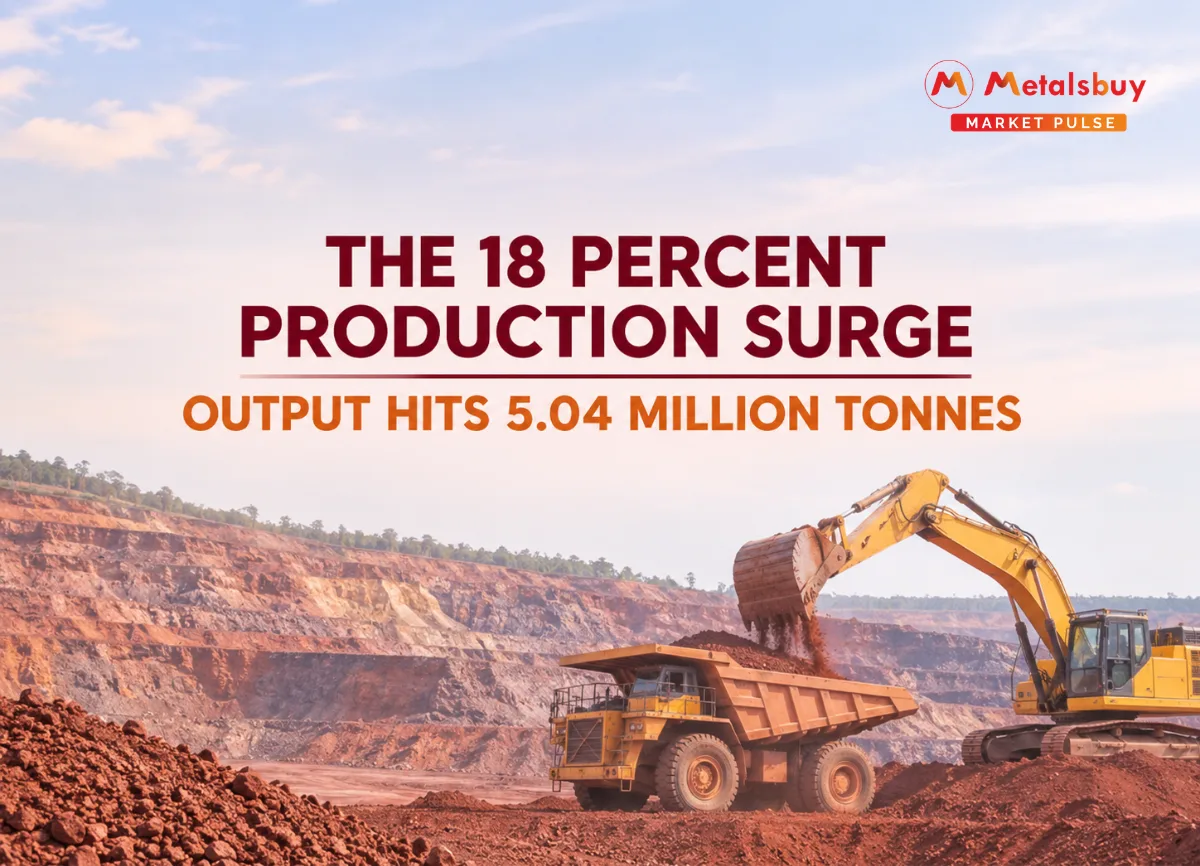
The absolute core of this operational update is the sheer speed and efficiency with which the mining major scaled its factory-level output as the monsoon season officially retreated. According to provisional operational data released by the enterprise, National Mineral Development Corporation successfully expanded its raw iron ore extraction to 5.04 million metric tonnes during October 2026. This marks a staggering 18 percent growth when compared directly to the 4.27 million tonnes produced in the exact same month of the previous fiscal year. This double-digit growth trajectory is incredibly significant given the geographic realities of the company’s primary assets.
A closer look at the regional breakdown highlights strong performances across all major mining leases. Operations in Chhattisgarh contributed the lion's share, generating 3.36 million tonnes of the October output, up from 3.06 million tonnes a year ago. Simultaneously, the Karnataka mining blocks demonstrated massive proportional growth, churning out 1.68 million tonnes compared to 1.21 million tonnes in October 2025. To overcome traditional post-monsoon operational bottlenecks, the state-run miner proactively deployed its modernized, high-capacity earth-moving machinery and optimized its mechanized screening plants. By pushing its workforce and capital equipment to maximum capacity utilization, the company ensured that the raw material pipeline remained exceptionally active. This relentless production momentum proves that the enterprise has completely decoupled its baseline extraction capabilities from unpredictable weather disruptions.
Navigating temporary sales moderation to build strategic inventory
Generating massive volumes of raw material is a major victory, and the accompanying moderation in immediate sales acts as a vital stabilizing mechanism for the broader market. Alongside the production surge, the company reported total sales of 3.44 million tonnes for October, reflecting a 12 percent year-on-year contraction from the 3.89 million tonnes dispatched previously. Rather than indicating any fundamental weakness in downstream demand, this temporary dip in off-take is a standard byproduct of the Indian festive calendar. October 2026 was heavily dominated by major cultural celebrations, including Dussehra and Diwali. During this peak festive window, large-scale civil engineering projects, regional logistics networks, and secondary steel mills naturally experience a temporary slowdown due to the reverse migration of the industrial workforce.
Because downstream contractors paused their immediate bulk procurement, dispatch volumes from the mines naturally moderated. Sales from Chhattisgarh stood at 1.90 million tonnes, while Karnataka recorded 1.54 million tonnes. However, this overall sales drop allowed National Mineral Development Corporation to accumulate a highly valuable, high-grade inventory buffer directly at its stockyards. Building these massive raw material reserves is absolutely crucial right now. When the festive season concludes and the construction workforce returns to maximum strength in November, the demand for primary steel will violently accelerate. Having an abundant stockpile of ready-to-ship iron ore ensures that the miner can immediately service this explosive demand without facing any sudden supply-side constraints.
Cumulative volume expansion supports national steel capacity targets
From a broader macroeconomic perspective, this robust production strategy serves as the ultimate financial shield for India's integrated primary steelmakers. The cumulative performance for the current financial year paints a picture of aggressive and sustained expansion. For the period stretching from April through October, NMDC achieved a cumulative production of 32.32 million tonnes. This is a massive leap from the 26.47 million tonnes extracted during the corresponding period in 2025. Cumulative sales over these seven months stood firm at 25.67 million tonnes. This high-volume localized availability of iron ore acts as a massive financial shield for the domestic steel industry.
The central government is currently deploying a massive capital expenditure budget to modernize national highway networks, expand urban mass transit systems, and upgrade railway freight corridors. To supply the structural beams and TMT rebars required for these mega-projects, domestic steelmakers are running their blast furnaces at near-peak capacity. Guaranteeing an uninterrupted, high-volume flow of domestic iron ore is essential to protect the operational margins of these steel producers. By maintaining this rapid extraction pace, National Mineral Development Corporation effectively neutralizes the risk of localized raw material shortages, ensuring that Indian steelmakers are completely insulated from the severe pricing volatility of the international seaborne commodities market. This reliable domestic supply chain allows Indian steelmakers to maintain highly competitive pricing for finished construction materials, directly subsidizing the cost of the government's ambitious infrastructure rollout.