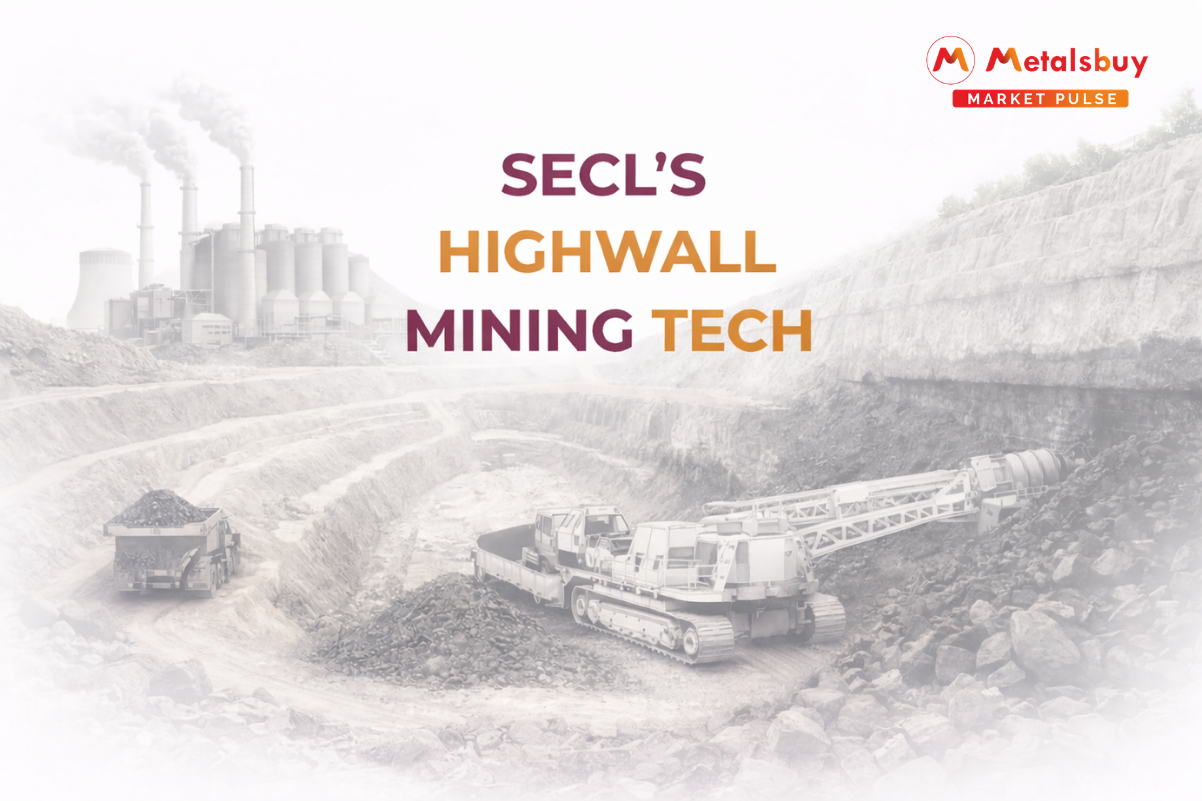
South Eastern Coalfields Limited (SECL) marked a decisive turning point in India's energy extraction capabilities by officially launching a state-of-the-art Highwall Mining Machine at the Sharda Open Cast Mine. Located in the Sohagpur Area of Madhya Pradesh within the Burhar-Amlai sub-basin, the deployment is far more than a routine hardware upgrade. Attended by Regional General Manager B. K. Jena and General Manager of Operations Manish Kumar Srivastava, the inauguration represents a sophisticated strategy to extract previously trapped fuel reserves while simultaneously driving down the immense costs and environmental footprint associated with traditional surface mining.
Overcoming the Opencast Bottleneck
To grasp the unique selling proposition of this launch, one must look closely at the operational realities of the Indian coal sector. Historically, opencast mining has been the backbone of domestic energy, but as these massive surface pits age, they reach physical and economic limits. Reaching deeper coal requires stripping away millions of cubic meters of earth, known as overburden. During the recently concluded 2025–26 financial year, SECL achieved an all-time high by removing an astonishing 364.3 million cubic meters of this overburden just to maintain and expand access to coal faces across its network.
The new Highwall Mining Machine elegantly bypasses this monumental earth-moving effort. Operating as a hybrid of surface and underground techniques, the remote-controlled continuous miner is positioned at the base of an exposed pit wall. Pushed by a sophisticated hydraulic beam mechanism, the cutter head can penetrate 300 to 400 meters horizontally straight into the exposed coal seam.
Crucially, the technology is highly specialized for extracting coal from incredibly thin seams measuring just 0.9 meters to 1.5 meters thick. Under normal circumstances, excavating such thin layers through standard opencast or traditional underground methods would be financially unviable and structurally hazardous. However, the highwall miner works with surgical precision, leaving stable pillars of coal intact to support the earth above, preventing surface subsidence while safely harvesting the targeted resource.
Fueling the One Billion Tonne Ambition
The integration of this advanced machinery at the Sharda project comes at a time when SECL is posting record-breaking growth. As the most vital subsidiary of Coal India Limited (CIL), SECL ended the 2025–26 financial year with a total coal production of 176.2 million tonnes, registering a robust 5.26 percent growth over the previous year. Furthermore, the company’s coal off-take soared to 178.6 million tonnes.
The Sharda Open Cast Mine is structurally integral to maintaining this momentum. With the new highwall equipment fully operational, the project is designed to deliver a steady, uninterrupted extraction volume for the next nine years. Mining industry data indicates that this specific highwall setup has the capacity to recover roughly 800,000 tonnes of high-grade coal annually from the Sharda site alone. By unlocking these narrow seams without the corresponding expenditure of moving heavy overburden, SECL effectively lowers its per-ton capital cost, directly boosting the operational profit margin and providing a highly predictable fuel supply for the nation's thermal power grids.
A Three-Pillar Victory for Modern Mining
Beyond raw production volume, the Sharda highwall project delivers a critical, balanced victory across three modern industrial pillars: human safety, financial efficiency, and environmental stewardship.
Because the highwall miner is essentially unmanned at the cutting face, it removes human workers from the most dangerous zones of extraction. Operators control the continuous miner remotely from a technologically equipped, air-conditioned cabin on the surface, utilizing advanced sensors and cameras to navigate the machinery deep into the seam. This entirely mitigates the risks of catastrophic roof falls and trench collapses that have historically plagued underground operations.
Environmentally, the method is quietly revolutionary. Because the surface topography, topsoil, and local dwellings located directly above the extracted seams remain completely undisturbed, the massive ecological degradation typically seen in expanding strip mines is halted.
This low-impact extraction philosophy aligns seamlessly with SECL’s recent, aggressive push toward corporate sustainability. Over the last fiscal year, the company executed unprecedented green initiatives, successfully planting 13.96 lakh saplings—including dense afforestation using the specialized Miyawaki method. Concurrently, SECL commissioned 43.78 megawatts of solar power capacity, which is projected to reduce overall carbon dioxide emissions by 41,200 tonnes annually. Furthermore, the company successfully repurposed 408 lakh kiloliters of discharged mine water, utilizing it to safely irrigate over 3,800 hectares of neighboring agricultural land. Highwall mining complements these green statistics by proving that fossil fuel extraction can coexist with strict environmental conservation targets.
The Blueprint for Future Energy Security
As India’s manufacturing and industrial sectors accelerate, the appetite for reliable baseline energy shows no signs of slowing. Coal India Limited has explicitly mapped out a trajectory toward an annual production rate of one billion tonnes, a goal that requires maximizing the lifespan and output of every available asset.
The successful launch at the Sohagpur Area proves that the twilight years of an opencast mine can actually be transformed into a highly productive era. As shallower reserves naturally deplete across the country, adapting existing infrastructure with highwall continuous miners is rapidly shifting from an experimental luxury to an operational necessity. SECL’s proactive embrace of this technology at the Sharda project sets a definitive industry benchmark, demonstrating a robust, future-proof strategy that secures India's energy demands while rigorously protecting its workforce and natural landscapes.