Key Numbers
| Indicator | Recent Trend |
|---|---|
| Crude Oil Price | Increased from ~USD 70/bbl to ~USD 90/bbl |
| Global Oil Supply Through Hormuz | ~20% of global seaborne oil trade |
| Freight Rate Movement | Estimated increase of up to ~40% in recent weeks |
| LNG and Energy Prices | Rising amid geopolitical tensions |
| Potential Impact | Higher input costs for steel producers globally |
Source: Industry reports, commodity market observations, and global trade data
Escalating Middle East Tensions Disrupt Global Commodity Markets
Rising geopolitical tensions in the Middle East have begun to influence global commodity markets, with energy and logistics costs moving sharply higher. The conflict involving Iran, the United States, and Israel has disrupted critical shipping routes and increased uncertainty across international trade corridors. One of the most strategically important regions affected by these tensions is the Strait of Hormuz, a narrow maritime passage that facilitates roughly 20 percent of the world’s seaborne oil trade. Disruptions or threats to traffic through this corridor have immediate consequences for energy markets and freight costs. As shipping companies adjust routes and risk premiums increase, global supply chains experience rising transportation costs and longer delivery timelines. These developments are beginning to transmit cost pressures across multiple commodity markets, including the global steel industry.
Energy Price Surge Adds Pressure on Steel Production Economics
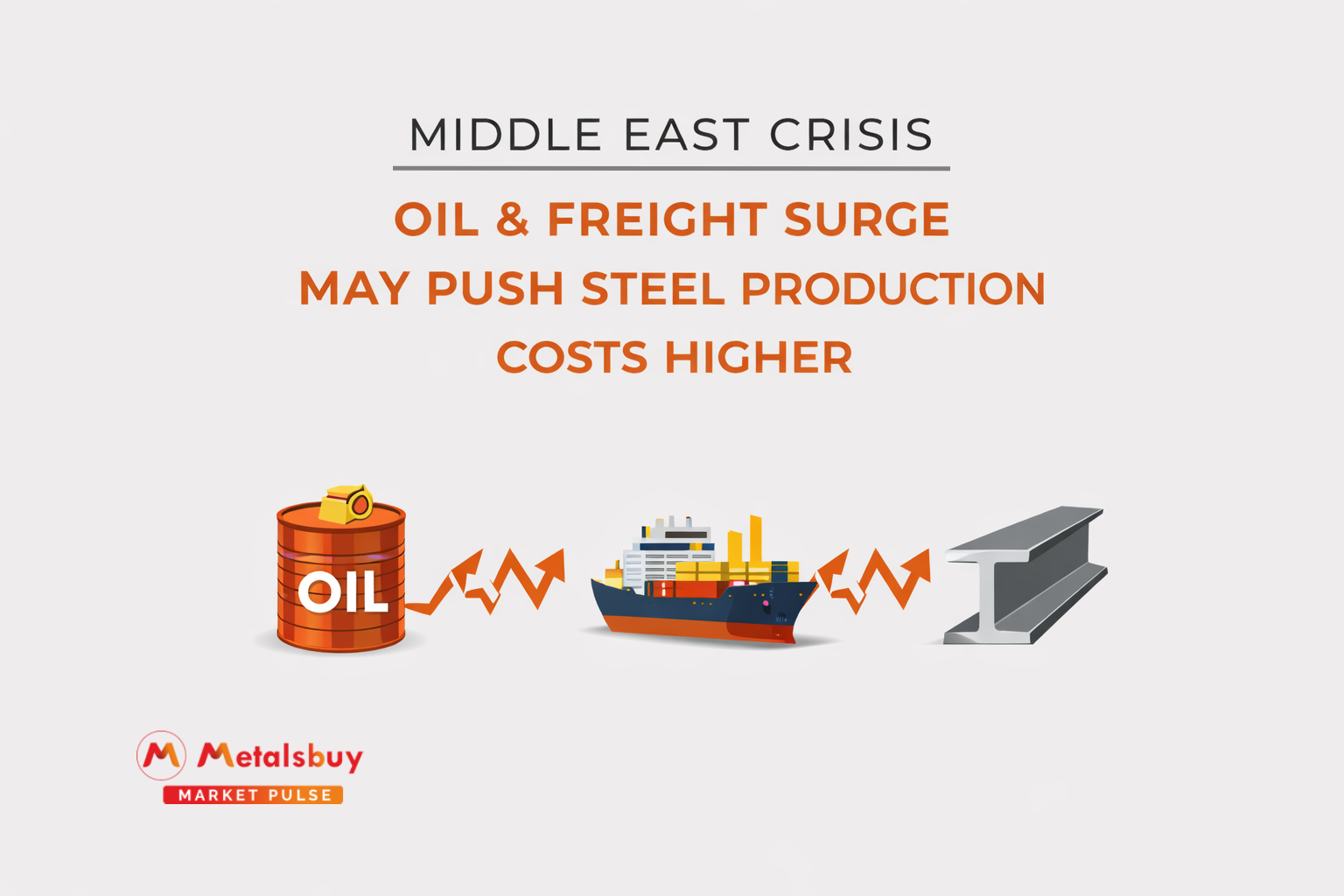
Energy remains one of the most important cost components in steelmaking, particularly for blast furnace operations that rely heavily on coal, natural gas, and electricity. The ongoing crisis has pushed crude oil prices significantly higher, rising from around USD 70 per barrel prior to the conflict to roughly USD 90 per barrel in recent trading sessions. Higher energy prices increase operating costs across the entire steel value chain, including mining, pelletisation, transportation, and steel production itself. Rising LNG prices have also intensified cost pressures for regions that rely on gas-based direct reduced iron (DRI) production. As energy markets remain volatile, steel producers may face sustained input cost inflation over the coming months. These developments illustrate how geopolitical events in energy-producing regions can rapidly influence industrial production costs worldwide.
Freight Costs Surge Amid Shipping Disruptions
Shipping and logistics costs have also climbed sharply as maritime trade routes face disruptions linked to the ongoing conflict. Reports indicate that freight rates for bulk commodities have increased by nearly 40 percent in recent weeks, reflecting higher insurance premiums, longer transit routes, and reduced vessel availability. Shipping companies are also factoring in additional security risks when operating near conflict zones, which further raises transportation expenses. In some cases, marine operators have begun quoting freight rates that are non-negotiable due to vessel shortages and heightened security concerns. For steel producers and raw material traders, higher freight costs directly increase the landed price of critical inputs such as iron ore, coking coal, and scrap. The combined effect of energy and freight inflation is therefore amplifying cost pressures throughout the global metals supply chain.
Input Cost Inflation Could Affect Steel Prices
The steel industry is particularly sensitive to fluctuations in raw material and logistics costs because steelmaking requires large volumes of energy-intensive inputs. Rising prices for oil, LNG, and freight are expected to influence the cost structure of steel producers across multiple regions, including India. In addition to energy and logistics, prices for coal, iron ore, and scrap may also experience upward pressure as supply chains adjust to geopolitical risks. If cost pressures persist, steel manufacturers may attempt to pass on higher production costs to downstream industries through incremental price adjustments. However, the ability to transfer these costs will depend on prevailing steel demand conditions and the competitive environment within regional markets. As a result, the evolving geopolitical landscape could gradually reshape pricing dynamics across the global steel industry.
Industry Impact
For steel producers, rising energy and freight costs could translate into higher operating expenses, particularly for companies dependent on imported raw materials. Increased logistics costs may also influence procurement strategies, with mills potentially seeking alternative suppliers or adjusting shipment schedules to manage volatility. Commodity traders and shipping companies may experience higher margins as freight rates rise, though increased risk exposure may also elevate operational costs. For downstream industries such as construction, infrastructure, and manufacturing, sustained increases in steel production costs could eventually translate into higher material prices. The situation underscores how geopolitical disruptions can cascade across industrial supply chains, affecting both upstream producers and downstream consumers.
Metalsbuy Market Pulse View
The escalating crisis in the Middle East highlights the growing interconnectedness between geopolitical events, energy markets, and industrial commodities. As oil prices, LNG costs, and freight rates rise simultaneously, steel producers around the world may face a period of sustained input cost inflation. While the immediate impact will likely be felt through higher logistics and energy expenses, prolonged disruptions could also influence raw material trade flows and steel pricing trends. Market participants across the metals sector will therefore need to closely monitor developments in global shipping routes and energy markets in order to anticipate potential shifts in steel production economics.