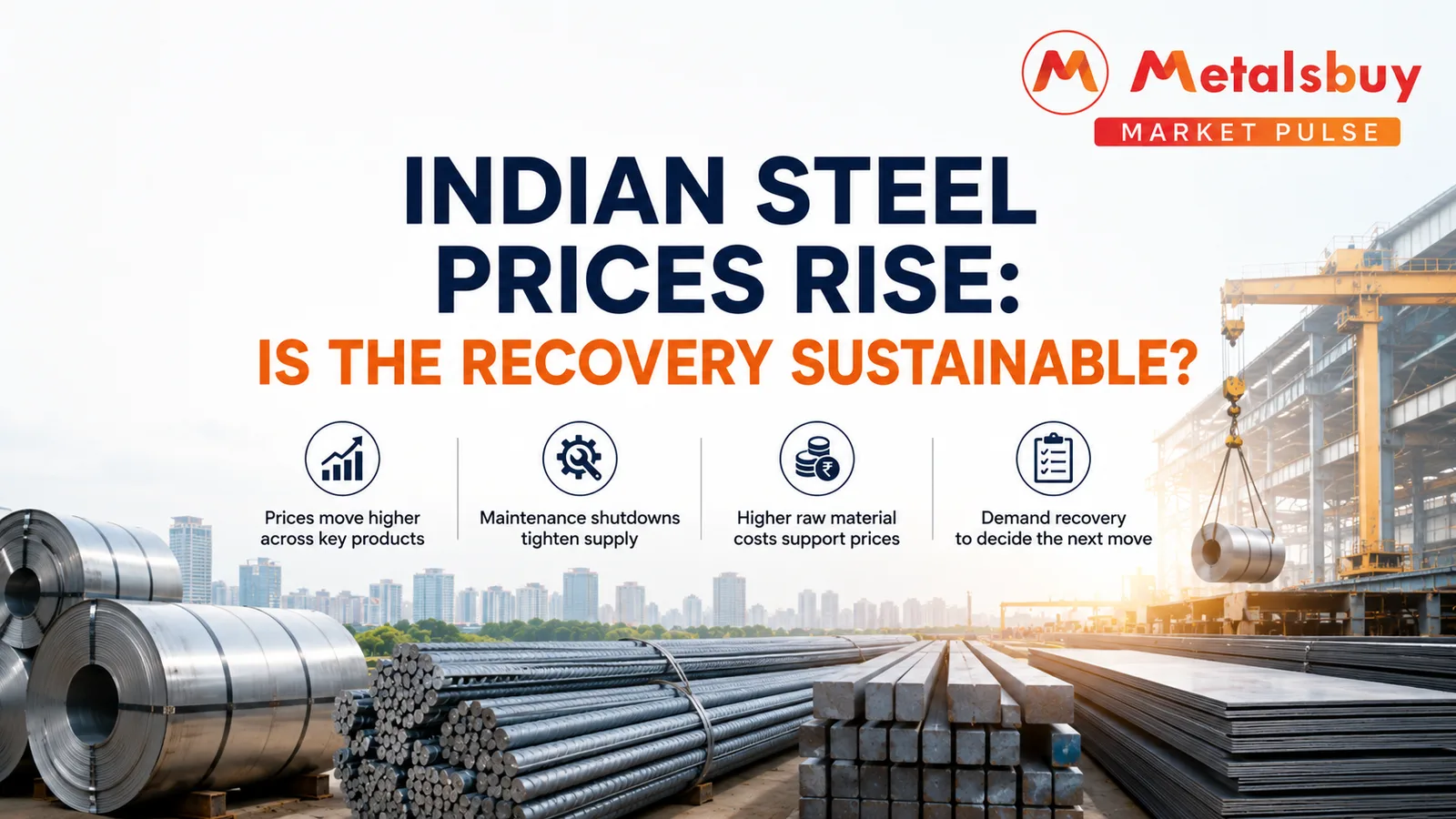
Key Numbers
-
Indian domestic steel prices have moved higher through August after a correction during June and July.
-
India's HRC price was around ₹58,100/t ex-Mumbai on August 14.
-
Rebar prices reached around ₹47,900/t ex-Mumbai during the week ended August 21.
-
Mandi Gobindgarh billet increased to around ₹43,500/t delivered during the same week.
-
India's steel market is seeing tighter spot availability as several mills undertake maintenance shutdowns.
-
Industry bodies have called for a regulatory mechanism to improve steel price stability amid the recent increase in prices.
Indian Steel Prices Begin to Recover
Indian steel prices have started to recover after a difficult period during the early part of the monsoon season. Prices of rebar, billet and other long steel products have moved higher in recent weeks, while flat steel prices have also shown a gradual improvement. The recovery is being supported by tighter supply, better buying activity and the withdrawal of discounts by some major mills.
The improvement is important because the domestic steel market had gone through a correction during June and July. Monsoon-related slowdown in construction activity had reduced buying interest and increased inventories across parts of the supply chain. By late July, however, the market began to show signs of stabilisation, with maintenance shutdowns and improving project bookings helping to reduce the pressure on prices.
The question now is whether this recovery can continue once construction activity picks up more strongly after the monsoon. Steel producers have already increased list prices in several cases, but buyers remain cautious about paying significantly higher prices unless there is a clear improvement in end-user demand. The next few weeks could therefore be important for determining whether the current price movement is the beginning of a stronger recovery or simply a short-term correction.
Rebar Is Leading the Recovery
Long steel products, particularly rebar, have shown some of the clearest improvement in the domestic market. During the week of August 17–21, SMM reported that Mumbai rebar prices increased by around ₹600/t to approximately ₹47,900/t ex-works. Billet prices also moved higher in major markets, indicating that the improvement was not limited to finished steel alone.
The recovery in rebar is closely linked to construction and infrastructure activity. While the monsoon has kept some projects slower than normal, project bookings have started improving and mills are seeing better order visibility in several regions. This has helped reduce the pressure created by high inventories earlier in the season.
Another factor supporting rebar prices is tighter availability. Several integrated steel plants have scheduled maintenance shutdowns during August, temporarily reducing spot supplies. At the same time, lower inventories at some mills have reduced the need for aggressive discounting, giving producers more room to maintain their prices.
HRC Market Is More Stable
The recovery in flat steel has been more measured than in rebar. BigMint's assessment put HRC at around ₹58,100/t ex-Mumbai on August 14, up ₹100/t from the previous week. The increase was modest, but it showed that the market had moved away from the sharp correction seen during the earlier part of the monsoon period.
One of the important changes has been the withdrawal of discounts offered by major mills during July. When these discounts were removed, effective transaction prices increased even though headline list prices did not move dramatically. Buyers also began increasing inquiries and bookings as expectations of stable August prices reduced the benefit of waiting for lower offers.
Export demand, however, remains less supportive. Indian HRC offers to Vietnam were recently around $520–525/t CFR, while buyer indications were closer to $505–510/t CFR. This gap shows that overseas buyers are still cautious, meaning the domestic market remains the more important source of support for Indian flat steel prices at present.
Supply Tightness Is Supporting Prices
The current price recovery cannot be explained by demand alone. Supply-side factors are playing an equally important role, particularly the maintenance shutdowns at major steel plants. When production is temporarily reduced, availability in the spot market becomes tighter, giving mills greater pricing power even if overall demand has not yet become particularly strong.
This is one reason why the current market needs to be watched carefully. If shutdowns continue and project activity improves after the monsoon, the combination could provide a stronger base for steel prices. But if mills return to normal production before demand improves sufficiently, the additional supply could once again put pressure on prices.
The inventory position will therefore remain important. During July, higher inventories were one of the reasons for the weakness in steel prices. A sustained reduction in inventories would indicate that the market is moving towards a healthier demand-supply balance. If inventories start increasing again, the recent price recovery could lose momentum.
Raw Material Costs Are Creating a Price Floor
Steel producers are also receiving some support from the cost side. Prices of several raw materials, including scrap, pellets and sponge iron, have remained firm in recent weeks. Higher input costs make it more difficult for mills to reduce finished steel prices significantly, particularly when their margins are already under pressure.
Coking coal is an even bigger concern for blast furnace-based producers. Global coking coal prices have risen sharply this year, while India imports around 95% of its coking coal requirements. Higher coal prices therefore have a direct impact on the cost of producing steel in India and could encourage mills to maintain higher selling prices.
This creates an interesting situation for the domestic market. Even if steel demand remains only moderate, mills may have limited room to reduce prices because production costs are elevated. In such an environment, the cost of production can create a floor below which steel prices become increasingly difficult for producers to sustain.
Can Domestic Demand Support Higher Prices?
The biggest test for the market will come from actual consumption. Infrastructure and construction activity remain important sources of steel demand in India, and project execution should gradually improve as the impact of the monsoon reduces. If buyers return to the market in larger numbers, mills could maintain the current upward trend without relying heavily on supply restrictions.
There are already signs of better buying interest. SMM reported active buying across major Indian markets during August 17–21, with buyers replenishing stocks as prices of billet, rebar and scrap increased. The movement suggests that some buyers are becoming less comfortable with waiting for further price reductions.
However, it is still too early to call this a broad-based demand boom. Mid-monsoon demand has remained moderate in several markets, and some buyers continue to purchase only for immediate requirements. A stronger recovery will require project activity to translate into sustained consumption rather than short-term restocking.
Industry Calls for Greater Price Stability
The recent increase in steel prices has also brought renewed discussion about price stability within the industry. Industry representatives have called for a regulatory panel that could monitor steel prices and help address concerns around sharp price movements. The proposal reflects the wider concern that sudden changes in steel prices can affect manufacturers, fabricators, infrastructure companies and end consumers.
Steel prices have a wide impact across the Indian economy because the material is used in construction, infrastructure, engineering, automobiles and manufacturing. A sharp increase can raise project costs, while a sudden fall can put pressure on producers and discourage investment. This makes price stability an important issue for the wider steel value chain.
At the same time, steel prices are ultimately determined by market conditions. Production costs, demand, inventories, imports, exports and global commodity prices all influence the final price. Any regulatory mechanism would therefore have to balance the interests of producers and consumers without interfering with normal market forces.
Imports and Exports Remain Important
International trade will also influence the domestic market in the coming months. Indian steel producers continue to compete with imported material, while export opportunities depend on prices and demand in overseas markets. The current gap between Indian HRC offers and buyer indications in Vietnam shows that exporters are still facing resistance in some markets.
The domestic market is therefore likely to remain the main support for prices in the near term. If Indian consumption improves while imports remain less competitive, local mills could retain stronger pricing power. But a sudden increase in cheaper imports or weaker export demand could limit the ability of producers to raise prices further.
This is particularly relevant for flat steel, where international price movements can have a faster impact on domestic sentiment. Long steel is more closely connected to construction and infrastructure demand, giving rebar somewhat different fundamentals from HRC.
Is the Current Recovery Sustainable?
The answer will depend on whether demand begins to take over from supply-side support. At present, tighter availability and maintenance shutdowns are helping steel prices, while better buying interest is providing additional support. But a sustainable recovery requires mills to see stronger order books and buyers to continue replenishing inventories even after the immediate supply tightness disappears.
The next few weeks could therefore be decisive. If construction activity improves after the monsoon and project execution gathers pace, rebar could continue to lead the recovery. HRC may move more gradually, with domestic manufacturing demand and import competition determining how much further prices can rise.
There is also a possibility that the market settles into a period of relatively stable prices rather than a sharp rally. This may actually be healthier for the industry because producers can protect margins while downstream users have greater visibility over project costs. Stability could also encourage buyers who had been delaying purchases during the earlier correction to return to the market.
Outlook
Indian steel prices appear to have moved past the worst part of the recent correction, but the recovery is still developing. Rebar and billet are showing stronger momentum, while HRC is moving higher at a slower pace. Supply restrictions, reduced inventories, higher input costs and improving project activity are currently providing support.
The key question is what happens when more steelmaking capacity becomes available after maintenance shutdowns. If demand has strengthened by then, the additional production should be absorbed without creating significant downward pressure. If demand remains moderate, however, the market could once again face excess availability and renewed price competition.
For now, the outlook is cautiously positive rather than strongly bullish. The domestic market has improved, but sustained price increases will require stronger consumption. Buyers, mills and traders will be watching project activity, inventories, raw material costs and mill price announcements closely as the market moves towards the post-monsoon period.
Indian steel prices are showing clear signs of recovery after the weakness seen during the monsoon months. The improvement has been supported by tighter supply, maintenance shutdowns, reduced inventories, firmer raw material prices and better buying activity. Rebar has shown particularly strong momentum, while HRC has remained more stable.
The recovery, however, is not yet guaranteed to become a sustained rally. The real test will come when construction activity improves and mills gradually return to normal production levels. If demand grows at the same time, steel prices could remain firm; if supply rises faster than consumption, the market could see another period of correction.
For India's steel industry, a period of stable and sustainable pricing may ultimately be more important than a sharp price spike. Producers need sufficient prices to cover rising costs and invest in capacity, while downstream industries need predictability to manage project and manufacturing costs. The balance between these two requirements will shape the Indian steel market through the rest of 2026.
Disclaimer: This article is for information and market discussion purposes only. The information has been compiled from publicly available industry and market sources and should not be considered investment or trading advice. Market conditions can change rapidly, and readers should conduct their own analysis before making any commercial decisions.