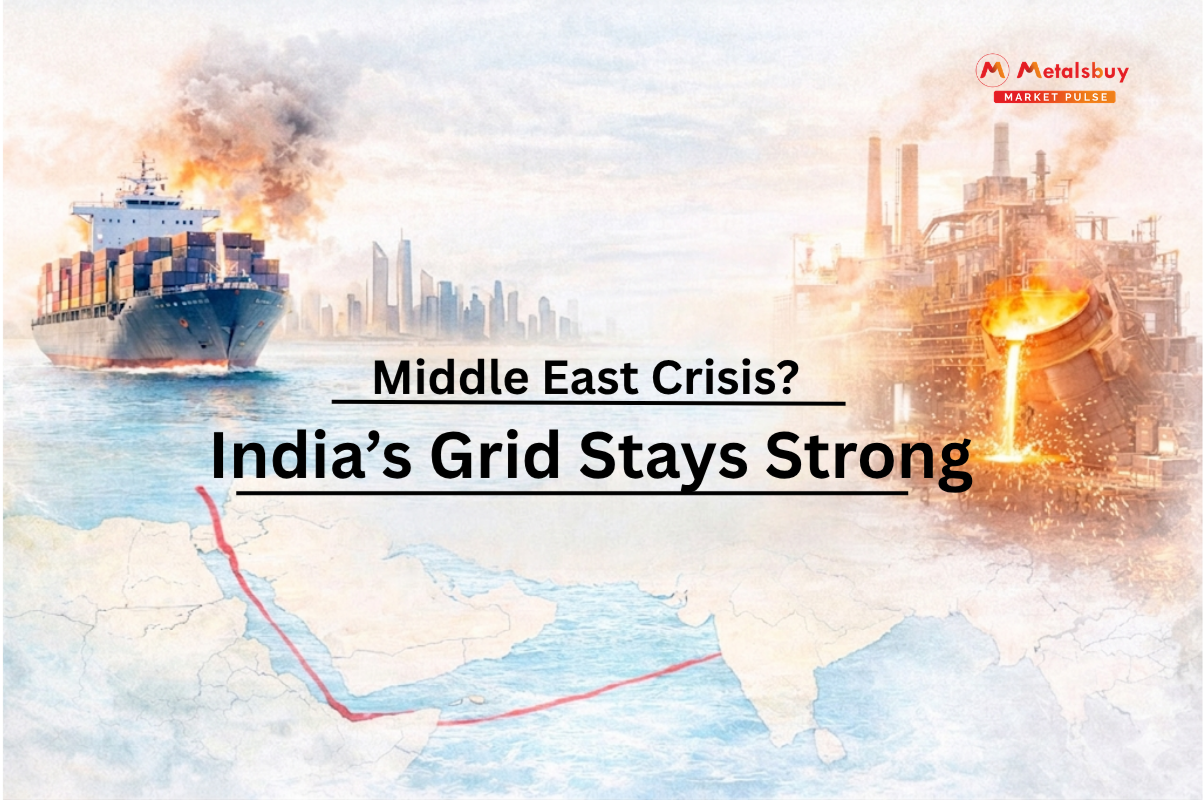
When geopolitical fault lines rupture, global commodity markets are invariably the first to bear the brunt. The escalating conflict in West Asia has recently bottlenecked vital maritime routes like the Strait of Hormuz, disrupting roughly 20 percent of global gas flows and 10 to 12 percent of international oil movements. Yet, while import-dependent nations are currently bracing for severe supply shocks and inflationary spikes, India’s power grid remains remarkably insulated.
Addressing industry leaders at the Bharat Electricity Summit in March 2026, Power Secretary Pankaj Agarwal delivered a decisive market assurance: the Middle East turmoil will have virtually zero impact on India’s domestic power supply. This projection of absolute economic calm is not merely rhetorical; it is anchored by a heavily diversified power mix, record-breaking domestic fuel production, and proactive capacity additions that serve as a structural buffer against global volatility.
The Structural Buffer: Why the Grid Remains Unbroken
India’s primary defense against the Middle East gas shock lies in its sheer scale and deliberate fuel diversification. Out of a massive national installed power generation capacity that reached a record 520.51 gigawatts (GW) as of early 2026, natural gas accounts for a statistically insignificant fraction of base-load generation.
As Agarwal detailed, while India possesses gas infrastructure, the grid is practically immune to international LNG spot-price fluctuations. Currently, only about 2.5 GW of gas-based capacity operates consistently, and crucially, this is maintained off-grid. Another 8 GW is strictly held in reserve as a peaker plant buffer, deployed almost exclusively during extreme summer heatwaves.
To ensure grid stability during these upcoming high-demand periods without resorting to expensive spot-market gas, the government has executed a masterstroke of tactical fuel substitution. The power ministry is rapidly reactivating the imported coal-based plant in Mundra, Gujarat. This single facility will inject a critical 4,000 megawatts (MW) of backup thermal capacity directly into the national grid, acting as an immediate shock absorber.
This backup is fortified by phenomenal domestic resource mobilization. Just days ago, on March 20, 2026, India successfully surpassed 1 billion tonnes in domestic coal production for the second consecutive year. Captive and commercial mines alone contributed over 200 million tonnes to this total. Consequently, the nation’s reliance on seaborne coal has visibly softened, with overall coal imports dropping by 4.2 percent to 213.10 million tonnes in the April-January period. By dynamically managing this massive domestic coal fleet—dialing it down during sunny hours to save fuel and rapidly ramping it up to meet evening demand—the grid completely bypasses international gas volatility.
The Green Vanguard: Future Outlook and Accelerated Storage
Looking beyond the immediate horizon, India’s long-term energy security is heavily anchored in aggressive renewable expansion and cutting-edge storage logistics. The nation has successfully crossed the structural tipping point, with non-fossil fuel sources now comprising 52.3 percent (271.97 GW) of the total installed capacity.
Driven by solar capacity that has ballooned from just 2.8 GW a decade ago to over 143 GW today, the grid comfortably commands peak daytime capabilities exceeding 270 GW without facing any gas constraints. India's transmission network, the world's largest synchronous national grid, has also crossed the landmark of 5 lakh circuit kilometers, ensuring power can be routed wherever it is needed.
To conquer the critical evening hours when solar output inevitably drops, the government is moving rapidly to commercialize utility-scale storage. Roughly 2.5 gigawatt-hours (GWh) of battery energy storage systems are already in the commissioning phase. State-run energy giant NTPC is also slated to roll out its highly anticipated maiden battery storage project by June 2026, marking a pivotal shift away from fossil-fuel peaker plants.
The broader industry is actively preparing for a projected 30 percent surge in overall electricity demand by 2030, driven largely by the proliferation of AI data centers and electric mobility. To meet this macroeconomic shift, domestic manufacturers have already outlined an estimated ₹32,000 crore capital expenditure pipeline for power sector infrastructure.
Simultaneously, India is translating its domestic resilience into robust global energy diplomacy. Capitalizing on its stable operating environment, the country has attracted strategic business-to-business arrangements with Russian entities to co-manufacture heavy electrical equipment locally. On the outbound front, the state-owned Power Grid Corporation recently cemented India's role as a net exporter of infrastructure expertise by finalizing a $311 million transmission project in Kenya.
The current geopolitical storm has exposed the inherent fragility of global energy supply chains, but it has equally highlighted the structural brilliance of India's policies. By leveraging 1 billion tonnes of domestic coal, fast-tracking 4,000 MW of backup thermal capacity, and aggressively scaling 2.5 GWh of battery storage, New Delhi has completely insulated its economy from external turbulence. India's power sector is not just navigating the crisis; it is setting a definitive global standard for macroeconomic resilience and sustainable self-reliance.