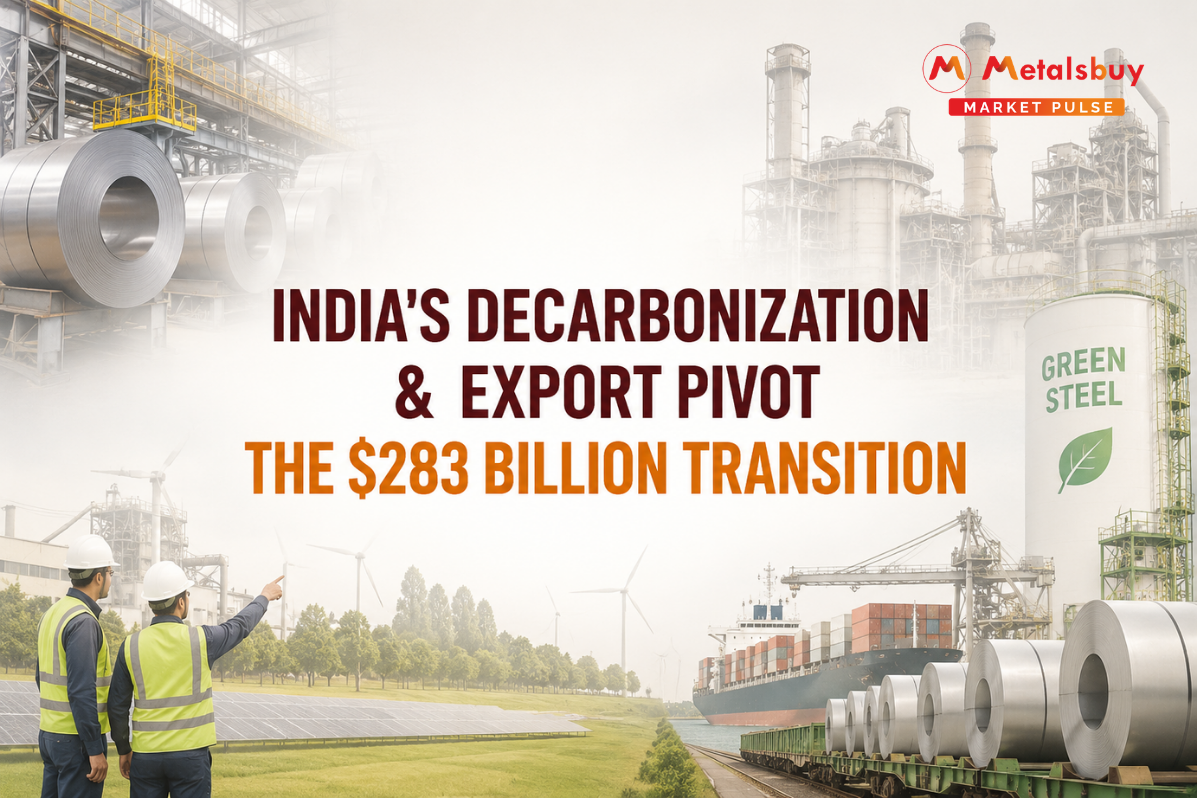
India’s steel sector stands at a critical juncture where accelerating decarbonisation and diversifying export markets are no longer optional but essential for survival in a rapidly changing global trade landscape. With protective tariff measures and strict environmental regulations like the EU's Carbon Border Adjustment Mechanism (CBAM) coming into play, industry leaders are pressing for technological modernisation to maintain India’s standing as the world's second-largest steel producer.
KEY HIGHLIGHTS
- Production Milestone: India's crude steel output reached 168.4 million tonnes (MT) in FY26, with an installed capacity of approximately 220 MT.
- High Emission Intensity: The Indian steel industry currently emits around 2.55 tonnes of CO2 per tonne of crude steel, significantly higher than the global average of 1.85 tonnes.
- CBAM Threat: India's steel exports to the EU (over €6 billion in 2023) are heavily exposed, with non-compliance potentially triggering penalties of €250-300 per tonne under default values.
- Domestic Advantage: Robust infrastructure spending of ₹12.2 lakh crore planned for FY27 provides a strong domestic consumption buffer, currently at 163.7 MT.
- Export Diversification: Identifying new markets in the Middle East and Africa is crucial to offset the expected 35% contraction in EU-bound exports.
- Investment Needs: Transitioning to green steel will require an estimated $283 billion for existing plants and $251 billion for planned capacity additions by 2030.
MARKET ANALYSIS
The global steel trade landscape is undergoing a tectonic shift, heavily influenced by climate-centric policies and protectionist tariffs. Speaking at the ASSOCHAM India Steel Conclave 2026, Ashwini Kumar, Economic Advisor to the Ministry of Steel, outlined the stark reality facing Indian producers. The US invocation of Section 232 and the impending full implementation of the EU’s CBAM in 2026 mean that market access in high-value Western destinations will increasingly hinge on the carbon intensity of the production process, not just price and quality.
Currently, India's heavy reliance on coal-based blast furnaces and direct reduced iron (DRI) processes puts it at a distinct disadvantage. The emissions gap is quantifiable; while the EU benchmark sits at roughly 1.37 tCO2 per tonne, Indian installations often exceed 2.1 tCO2. This gap translates directly into tangible costs, threatening the viability of exports to Europe, which historically account for a significant portion of India's high-value steel trade. Without robust monitoring, reporting, and verification (MRV) systems to prove emission reductions, exporters risk facing punitive default carbon values that could effectively price them out of the European market.
However, this regulatory pressure also acts as a catalyst for much-needed modernisation. The situation presents a strategic opportunity for Indian steelmakers to leapfrog legacy technologies. By investing in energy efficiency, scaling up electric arc furnace (EAF) capacity utilizing domestic scrap, and aggressively exploring green hydrogen integration, the sector can future-proof its operations. Furthermore, the robust domestic demand—fuelled by massive government outlays for infrastructure, urbanisation, and the automotive sector—provides a sturdy safety net while the industry navigates this complex green transition.
WHAT IT MEANS FOR THE STEEL INDUSTRY
For the Indian steel value chain, the mandate is clear: adapt or lose market share. The immediate priority is the implementation of stringent, EU-accredited carbon measurement and reporting systems. The market is already bifurcating; low-emission producers are capturing premium pricing and securing long-term contracts, while high-emission laggards are experiencing margin compression and shrinking order books.
Simultaneously, the industry must pivot its export strategy. Over-reliance on the EU market is now a strategic vulnerability. Producers need to aggressively cultivate alternative markets in regions with high GDP growth but less stringent immediate carbon regulations, such as the Middle East, North Africa, and Latin America. Recent data indicates a healthy growth in engineering and steel exports to the West Asia and North Africa (WANA) region, suggesting a viable pathway for diversification. Ultimately, the integration of green technologies will necessitate deep collaboration across the supply chain, from securing high-grade iron ore suitable for gas-based DRI to establishing a more organised and efficient domestic scrap collection ecosystem.
MARKET OUTLOOK
Despite the daunting financial and technological hurdles, the long-term outlook for the Indian steel sector remains fundamentally positive, underpinned by resilient domestic consumption and proactive policy frameworks. The transition towards green steel will undoubtedly require massive capital expenditure, but it aligns seamlessly with India's broader macroeconomic goal of achieving net-zero emissions by 2070.
If the industry successfully leverages government support initiatives, such as the National Green Hydrogen Mission and evolving carbon credit markets, it can transform the CBAM challenge into a competitive advantage. By establishing itself as a reliable supplier of verified low-carbon steel, India can not only retain its footing in traditional Western markets but also capture new, environmentally conscious market segments globally. The next few years will be defined by intensive R&D, pilot projects in breakthrough technologies like Carbon Capture, Utilisation, and Storage (CCUS), and a strategic realignment of global trade partnerships.