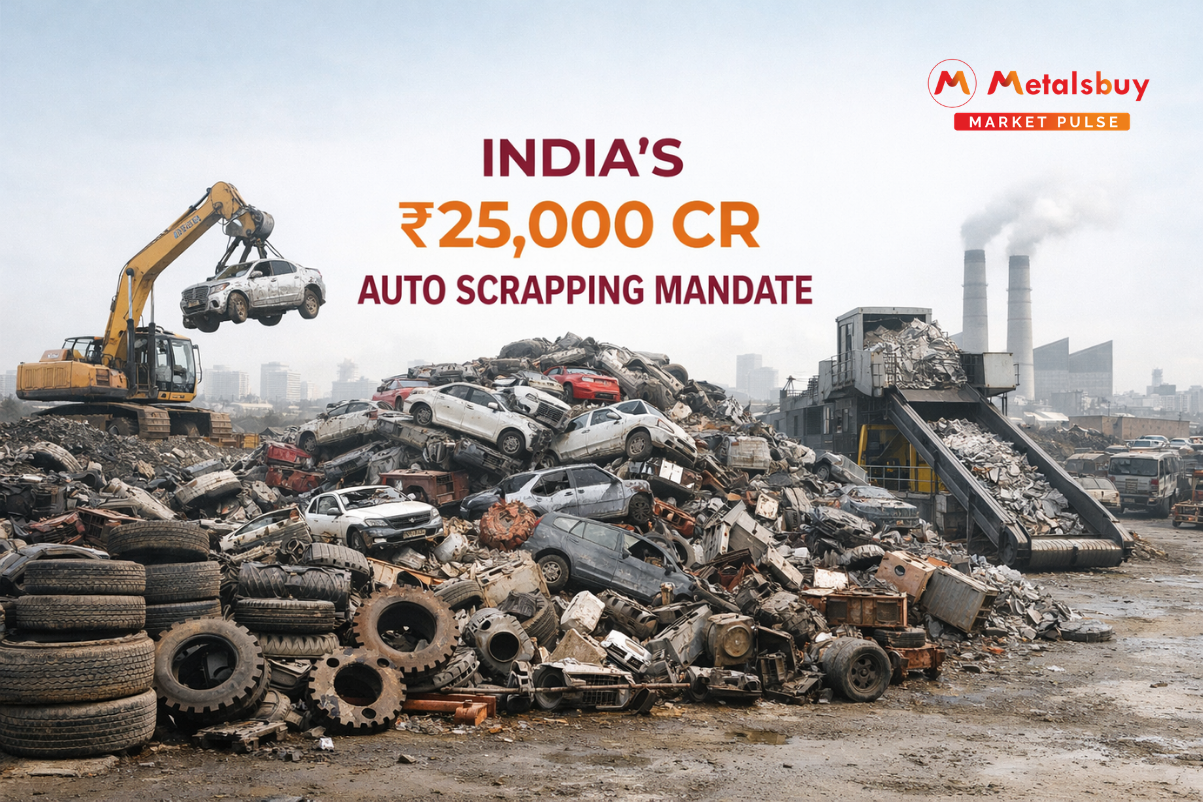
India’s automotive industry is facing an unprecedented financial realignment as stricter environmental laws take root. With automakers finalizing their fiscal strategies for FY26, a sweeping regulatory change concerning end-of-life vehicle recycling is poised to dramatically reshape corporate balance sheets. Industry estimates reveal that the sector is preparing to absorb a staggering ₹25,000 crore accounting charge.
While market reactions have been predictably cautious about the immediate strain on profitability, an in-depth analysis indicates this is a calculated structural shift. The mandate forces a transition from a linear manufacturing model to a fully formalized circular economy. By internalizing the lifecycle costs of every vehicle produced, Indian manufacturers are charting a pioneering, albeit expensive, path toward long-term environmental sustainability.
The Regulatory Trigger and Accounting Mechanics
The catalyst for this sector-wide financial provisioning is the Environment Protection (End-of-Life Vehicles) Rules, 2025, originally notified by the Ministry of Environment, Forest and Climate Change (MoEFCC) in January 2025. The core mechanism is Extended Producer Responsibility (EPR), which holds manufacturers accountable for the recycling and safe disposal of their products long after they have been sold.
The specific financial trigger stems from Rule 4(6) of the notification. This clause mandates that producers are liable for the environmental compensation of vehicles already operating on the road, even if a company ceases operations. Despite lobbying efforts by the Society of Indian Automobile Manufacturers (SIAM) for a phased approach, a government amendment on March 27, 2026, upheld this retrospective liability.
This regulatory rigidity immediately invokes the Indian Accounting Standard (IND AS) 37, which governs provisions and contingent liabilities. Because the obligation is now legally formalized, auditors require automakers to create upfront budgetary provisions for future environmental compensation. Manufacturers are legally on the hook for private vehicles sold over the past 20 years and commercial vehicles sold over the last 15 years, a retroactive sweep that brings decades of industrial output onto today's balance sheets.
A Deep Dive into the Numeric Financial Impact
The financial implications of this sustainability drive are massive but distributed proportionally across the sector based on historical sales and vehicle mass.
The overarching gross impact across the Indian automotive sector is calculated at approximately ₹25,000 crore. However, financial experts point out that on a discounted, present-value basis, the actual capital impact rests closer to ₹9,000 crore for FY26.
Breaking this down further reveals how different segments will share the burden. Manufacturers of passenger cars and heavy commercial vehicles face the heaviest compliance load, driven by the resource-intensive nature of their products. This four-wheeler and commercial segment is projected to earmark an estimated ₹14,623 crore. Meanwhile, the high-volume but lower-mass segment encompassing motorcycles, scooters, and three-wheelers will account for a cumulative provision of roughly ₹9,650 crore.
The targets are highly specific. For the initial FY 2025-26 cycle, automakers must ensure the recycling of a minimum of 8% of the steel weight used in vehicles manufactured back in 2005-06. This target aggressively scales up, moving to 13% between 2030 and 2035, and eventually demanding an 18% material recovery rate from 2035 onwards.
Infrastructure Realities and the Circular Economy
The unique value of this regulation lies in its ability to single-handedly formalize India’s historically unorganized scrapping sector. Environmental estimates suggest there is a monumental load of over 20 million (2 crore) aging, highly polluting vehicles nearing their end of life on Indian roads.
To process this immense volume, the industry requires a massive expansion of physical infrastructure. Current data reveals that India operates around 156 Automated Testing Stations (ATS) and 117 operational Registered Vehicle Scrapping Facilities (RVSFs). Projections indicate the country will need at least 227 fully functional RVSFs by 2027 just to meet the baseline demand.
For automakers and investors, this presents a guaranteed domestic market for scrap infrastructure. Setting up a standard RVSF capable of safely depolluting and dismantling 20,000 vehicles annually requires a capital expenditure of approximately ₹14 crore. By tying automakers to EPR certificates, the government is funneling corporate capital directly into these high-tech recycling centers, ensuring that valuable materials like steel, aluminum, and plastics are recovered and fed back into domestic manufacturing.
A Positive Outlook for Sustainable Mobility
Undoubtedly, the ₹25,000 crore provision places immediate pressure on FY26 corporate earnings, potentially causing short-term friction for capital allocated to electric vehicle (EV) research and new technology investments. However, the broader trajectory remains overwhelmingly positive.
This mandate levels the playing field globally, ensuring that environmental costs are accurately reflected rather than deferred. More importantly, it is fundamentally altering automotive engineering. Knowing they hold the financial responsibility for end-of-life disposal, manufacturers will pivot toward modular designs and highly recyclable materials.
The new scrapping rules are not a penalty, but a foundational investment. By accelerating the phase-out of millions of clunkers and ensuring their raw materials are reclaimed, the Indian auto industry is actively building a cleaner, self-reliant, and highly advanced manufacturing ecosystem for the decades ahead.