The heavy manufacturing landscape in India is undergoing a rigorous structural transition, driven by the dual mandates of industrial expansion and climate resilience. In a definitive move toward sustainable production, INOX Air Products has successfully operationalized a high-capacity cryogenic Air Separation Unit at Tata Steel’s newly inaugurated Electric Arc Furnace facility in Ludhiana, Punjab.
Backed by a massive ₹3,200 crore capital investment from Tata Steel, this development is far more than a localized manufacturing upgrade. It represents a mathematically grounded blueprint for decoupling rapid industrial growth from severe environmental degradation, establishing a highly efficient circular economy for the world’s second-largest steel producer.
The Engineering and Capital Blueprint
At the operational core of this alliance is a fully automated cryogenic gas facility engineered to produce 280 tonnes per day of extreme-purity oxygen, nitrogen, and argon. In modern metallurgy, these elements act as the lifeblood of the smelting process. Oxygen drives the intense thermal dynamics required for rapid steel melting, nitrogen is deployed to forge protective atmospheric conditions that secure the metal’s mechanical integrity, and argon serves as an irreplaceable shielding gas during complex decarburization phases.
By integrating this 280 tonnes-per-day gas infrastructure directly onto the Ludhiana premises, INOX Air Products eliminates the severe logistical vulnerabilities associated with transporting industrial gases. This continuous, on-site feed is precisely what allows Tata Steel’s new 0.75 million tonnes per annum facility to operate at peak efficiency.
Crunching the Decarbonization Data
To fully grasp the magnitude of this technological shift, one must examine the stark contrast in carbon accounting. Historically, the Indian steel sector has been a heavyweight emitter, responsible for roughly 10% to 12% of the nation’s total greenhouse gases. Globally, traditional blast furnaces that rely on coking coal generate an average of 2.33 tonnes of carbon dioxide for every single tonne of steel manufactured. Even older electric furnaces relying on coal-based direct reduced iron often emit upwards of 1.37 tonnes of CO2 per tonne.
The Ludhiana facility radically rewrites this equation. By entirely bypassing the blast furnace route, the plant is designed to slash emissions to less than 0.3 tonnes of CO2 per tonne of crude steel. This translates to an extraordinary emissions reduction of nearly 87% compared to legacy global benchmarks.
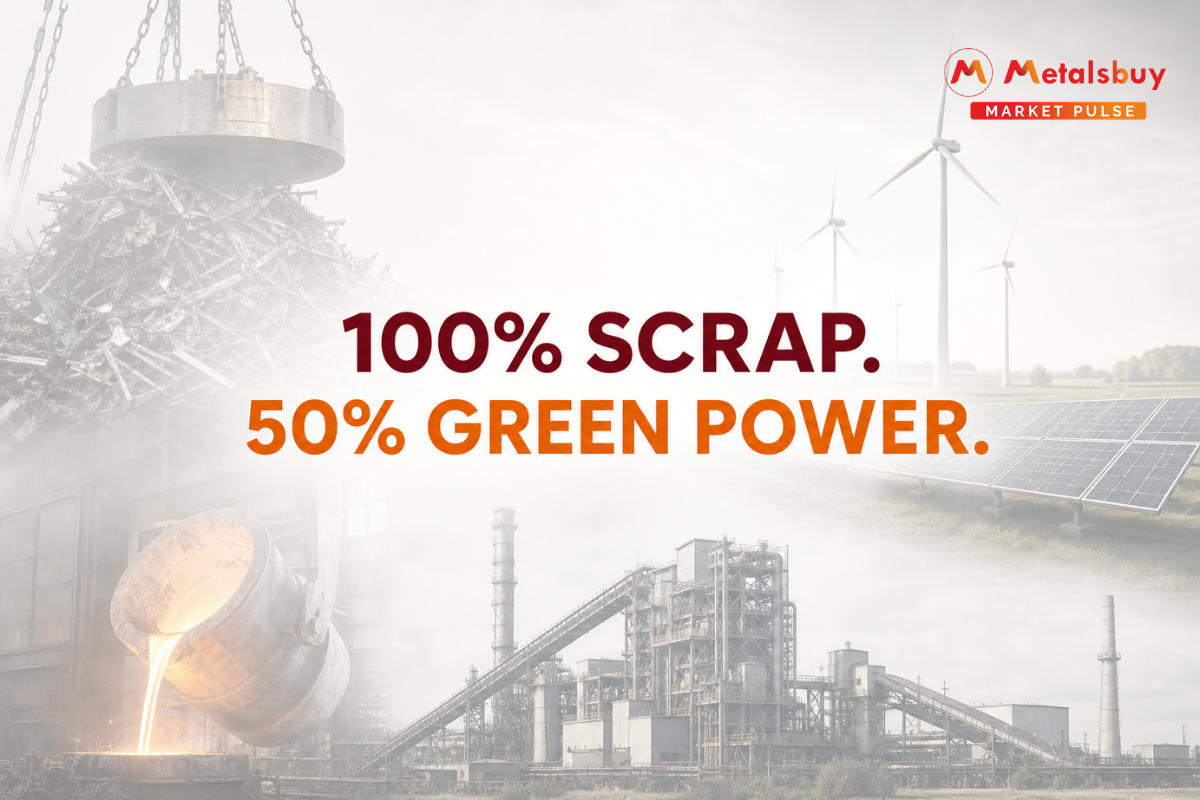
This drastic drop is achieved through a strict adherence to a circular raw material model. The Ludhiana plant operates exclusively on a 100% steel scrap feed. To sustain this, approximately 40% of the required scrap is routed directly from Tata Steel’s specialized recycling hub in Rohtak, Haryana. Furthermore, the facility’s carbon footprint is further suppressed by drawing nearly 50% of its operational power from renewable energy grids. Together, these metrics allow the company to produce premium construction-grade rebar under the 'Tata Tiscon' brand with a fraction of the traditional environmental toll.
Regional Economics and Supply Chain Resilience
While Tata Steel utilizes the direct output to feed its furnaces, the strategic value of this development extends deep into the regional economy of Northern India. INOX Air Products, which currently manages a sprawling national portfolio exceeding 4,200 tonnes per day of liquid gas manufacturing capacity across more than 48 locations, specifically designed the Ludhiana unit to function as a merchant distribution gateway.
By leveraging the surplus capacity of this 280 tonnes-per-day plant, INOX Air Products is establishing a robust, localized liquid gas supply chain. This means that regional manufacturing ecosystems—ranging from the pharmaceutical corridors of Himachal Pradesh to the automotive belts in Punjab and Haryana—now have immediate access to tanker-supplied industrial gases. This proximity drastically cuts down delivery lead times, shields local businesses from supply chain shocks, and stimulates broader economic predictability across multiple industrial sectors.
Future Outlook and Global Compliance
Looking forward, the financial and regulatory pressures on the global steel industry are tightening rapidly. With the European Union preparing to enforce its Carbon Border Adjustment Mechanism, high-emission exports will soon face severe financial penalties. Consequently, the transition to low-carbon production is no longer just an environmental aspiration; it is a strict prerequisite for remaining globally competitive.
India is currently charging toward an aggressive national target of achieving 300 million tonnes of overall steel production capacity by the year 2030. Simultaneously, Tata Steel is managing a total global capacity of 35 million tonnes while rigidly pursuing a corporate mandate to achieve absolute net-zero emissions by 2045.
The commissioning of the Ludhiana Air Separation Unit perfectly bridges these two realities. By successfully marrying cutting-edge cryogenic gas technology with 100% scrap-based electric steelmaking, Tata Steel and INOX Air Products are demonstrating that deep decarbonization is not only technologically feasible but economically viable. For investors and market analysts, this ₹3,200 crore alliance serves as a highly optimistic indicator. It provides hard, numeric proof that India’s core infrastructure sectors are successfully pivoting toward a future where rapid industrial output and stringent climate responsibility operate in total alignment.