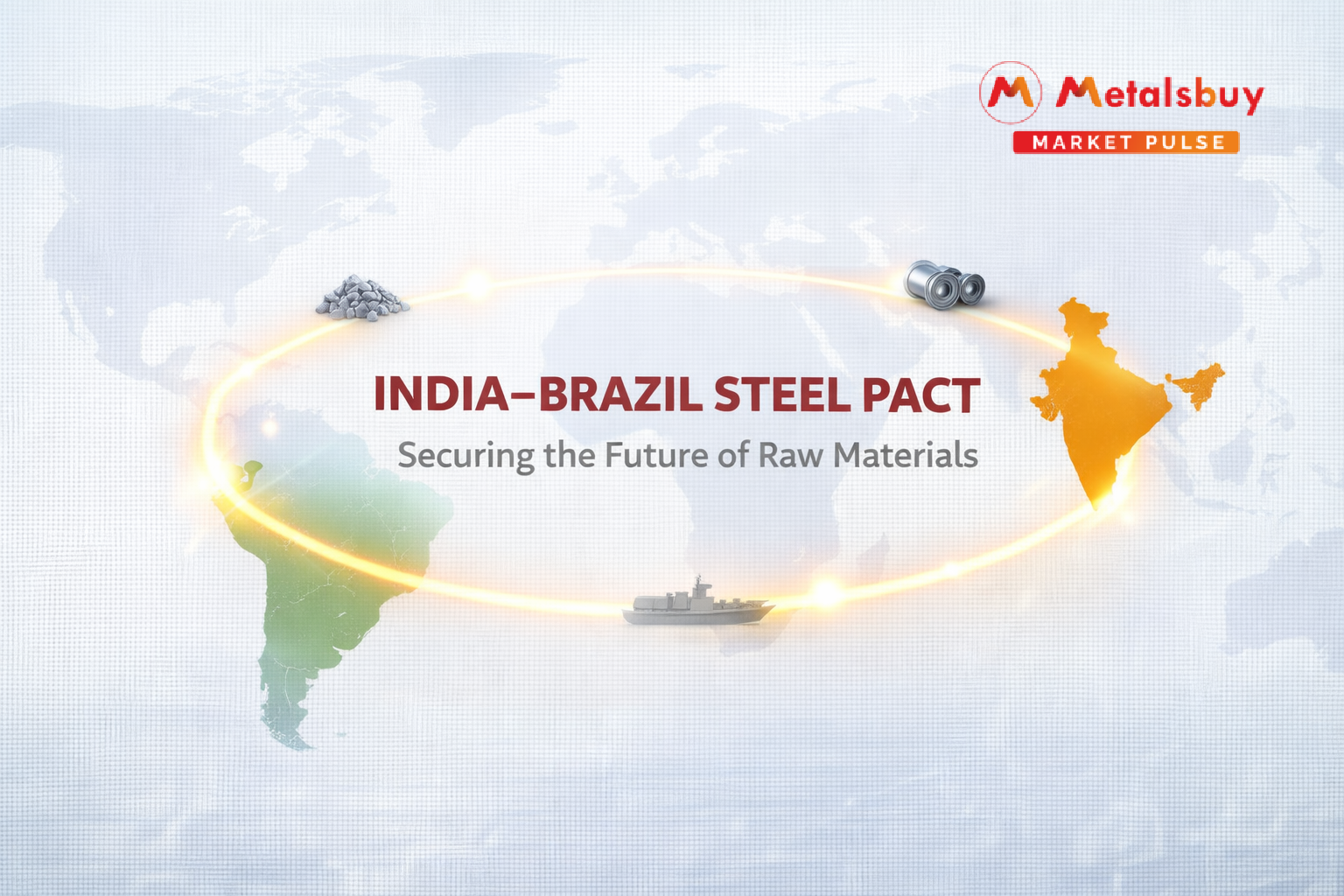
Key Highlights
-
India and Brazil signed an MoU to strengthen steel supply chain cooperation
-
Focus on critical minerals: iron ore, manganese, nickel, niobium
-
Coverage spans mining, processing, recycling, and advanced technologies
-
Market implication: Long-term supply security with strategic upside
Market Analysis
1. From Trade to Strategy: India Secures Its Raw Material Backbone
India’s agreement with Brazil is not just another bilateral MoU, it marks a shift toward resource security as a strategic priority.
-
The partnership creates a framework for stable access to key steelmaking inputs
-
Brazil, being a leading producer of iron ore and critical minerals, becomes a reliable long-term supplier
-
The agreement comes at a time when India is aggressively expanding steel capacity
India currently operates at around 218 million tonnes of steelmaking capacity, with further expansion underway to meet infrastructure-led demand.
Insight:
This move signals a transition from market-dependent sourcing → strategic sourcing. In a world where raw material volatility is rising, securing supply through partnerships reduces exposure to price shocks and geopolitical disruptions.
2. Critical Minerals Move to the Center of Steel Economics
The MoU highlights minerals like manganese, nickel, and niobium — not just iron ore.
-
These minerals are essential for alloy strength, durability, and advanced steel applications
-
Demand for such materials is rising with infrastructure, EV, and energy transition sectors
-
Brazil’s reserves position it as a multi-mineral partner, not just an iron ore supplier
Insight:
Steel is no longer just about iron ore and coal. The focus on multi-mineral security indicates that future competitiveness will depend on access to a broader raw material basket, especially for high-performance and specialty steels.
3. Technology Collaboration Becomes a Differentiator
The agreement goes beyond raw materials into technology integration:
-
AI-driven exploration and geoscientific analysis
-
Advanced mining and beneficiation techniques
-
Recycling and sustainable processing practices
Insight:
This is where the real long-term advantage lies. Countries that combine resource access + technological capability will dominate the next phase of steelmaking. This partnership positions India to move up the value chain, not just scale production.
4. Supply Chain Resilience Gains Priority Over Cost Optimization
-
The MoU emphasizes reliable and sustainable supply chains
-
Investment in mining infrastructure and logistics is a key component
-
Focus is shifting from cheapest sourcing to most dependable sourcing
Insight:
The global steel industry is entering a phase where resilience > cost efficiency. Post disruptions in recent years, buyers and producers are prioritizing continuity of supply over marginal cost savings. This changes how procurement strategies will evolve going forward.
5. Global Trade Realignment: India Strengthening Its Position
-
India and Brazil aim to expand bilateral trade significantly in the coming years
-
Brazil is already India’s largest trading partner in Latin America
-
The partnership strengthens India’s position in the global steel and raw material ecosystem
Insight:
This is part of a larger global shift where countries are building resource alliances instead of relying on open markets. India is positioning itself not just as a steel producer, but as a strategically integrated player in global supply chains.
Industry Impact
For Steel Producers
-
Improved long-term raw material visibility
-
Reduced risk from global supply disruptions
-
Opportunity to scale capacity with confidence
For Ferro Alloy & Raw Material Players
-
Increased demand visibility for manganese, nickel, and related inputs
-
Potential for new trade flows and sourcing patterns
For Traders
-
Shift toward long-term contracts may reduce spot volatility
-
New arbitrage opportunities between Latin America and Asia
Conclusion
The India–Brazil steel supply chain partnership marks a structural shift in how India approaches raw material security. By combining resource access, technological collaboration, and long-term trade alignment, the agreement lays the foundation for a more resilient and globally competitive steel ecosystem.
As India pushes toward higher steel capacity and deeper industrialisation, such partnerships will play a critical role in ensuring that growth is not constrained by raw material uncertainty — but powered by strategic resource alliances.