KEY NUMBERS
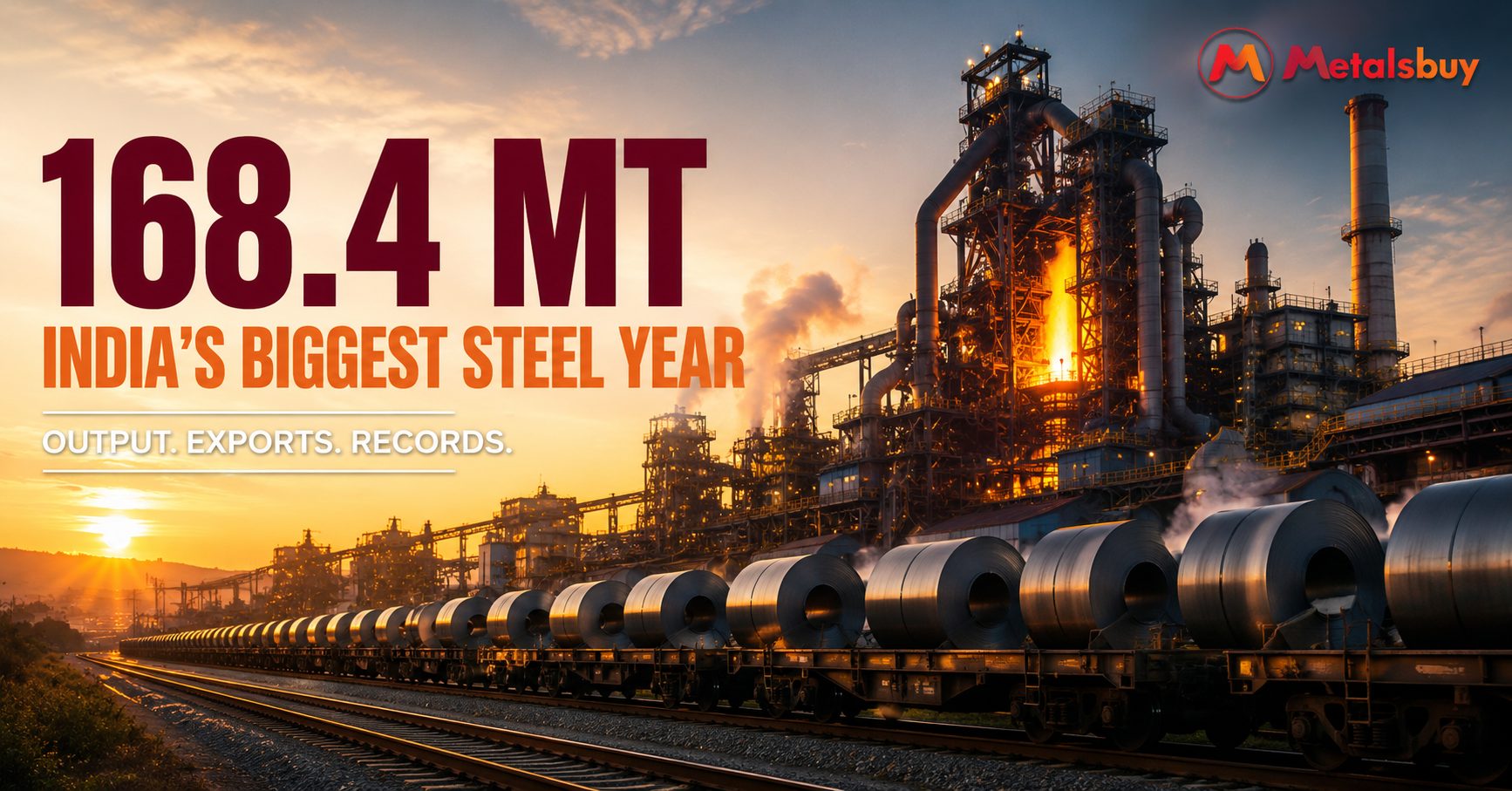
168.4 Million Tonnes : India’s crude steel production in FY26
10.7% : Growth in crude steel production year on year
164 Million Tonnes : Finished steel consumption in FY26
7 To 8% : Growth in finished steel consumption
29.1% : Increase in steel exports during March 2026
30.14 Million Tonnes : Highest annual production ever achieved by JSW Steel
23.48 Million Tonnes : Highest India production ever achieved by Tata Steel
9.25 Million Tonnes : Record annual production by Jindal Steel
85% : Current coking coal import dependency
65% : Mission Coking Coal target by FY30
⸻
MARKET ANALYSIS
A decade ago, India’s steel story was built around potential.
Today, it is increasingly built around output.
The country produced a record 168.4 million tonnes of crude steel during FY26, the highest level in its history. Consumption reached 164 million tonnes. Exports accelerated sharply. Major steelmakers reported their strongest production years on record.
Those numbers matter individually.
Together, they tell a bigger story.
India’s steel industry is beginning to achieve something policymakers have spent years trying to build: scale without dependence.
For decades, India’s growth narrative was straightforward. Demand was rising faster than domestic capacity. Imports filled the gap. Raw material dependency remained high. The country consumed more steel than it comfortably produced.
That equation is changing.
March exports surged 29.1 percent compared with the previous year. JSW Steel reported record annual production of 30.14 million tonnes. Tata Steel achieved its highest ever India output at 23.48 million tonnes. Jindal Steel crossed 9 million tonnes for the first time. Capacity additions announced across Odisha, Maharashtra and Chhattisgarh suggest these figures may not represent a peak but rather the beginning of a larger expansion cycle.
The significance extends beyond steel itself.
Every additional tonne of steel produced requires ferro alloys. Silico manganese, ferro manganese and ferrochrome consumption rise alongside crude steel output. The relationship is mechanical. More steel means more alloy demand. Record production therefore becomes a direct signal for producers and traders operating further upstream in the value chain.
The export numbers deserve particular attention.
For years, India was viewed primarily as a domestic consumption story. The latest data suggests it is becoming an export story as well. That shift changes how international buyers view Indian steelmakers. It also changes how Indian producers think about competitiveness, efficiency and long term investment.
There is still work to do.
Coking coal imports remain high. Infrastructure bottlenecks have not disappeared. Global demand remains uneven. Yet the direction of travel is increasingly clear.
India is no longer simply catching up.
It is becoming one of the defining steel growth stories anywhere in the world.
⸻
INDUSTRY IMPACT
Record steel production creates a powerful tailwind for the ferro alloy sector.
Silico manganese producers across Raipur and eastern India are already benefiting from rising steel output. Ferrochrome demand continues expanding alongside stainless steel growth. Producers who spent years waiting for capacity utilisation to improve are now operating in a much stronger environment.
The export surge is equally important.
Export competitiveness generally requires stable raw material access, efficient logistics and predictable production costs. Those same factors strengthen the wider metals ecosystem supporting steel production.
The market is also becoming more diversified.
Infrastructure remains a major demand driver, but manufacturing, automotive production and engineering sectors are contributing a larger share of steel consumption than in previous cycles.
That broadens the demand base and reduces dependence on any single sector.
⸻
WHAT TO WATCH NEXT
Mission Coking Coal may become one of the most important policy initiatives in the industry.
Reducing import dependency from 85 percent to 65 percent would significantly improve input security for domestic steelmakers.
Watch capacity additions carefully as well.
Projects under development across Odisha, Maharashtra and Chhattisgarh are expected to add millions of tonnes of additional production over the next decade.
Export performance will provide another important signal.
If India continues gaining share in international markets while maintaining strong domestic demand, the industry’s growth story becomes even more compelling.
⸻
MARKET OUTLOOK
India’s record steel production is not simply a milestone.
It is evidence that the country’s industrial strategy is beginning to produce measurable results.
Output is rising. Consumption is rising. Exports are rising.
The industry still faces challenges around raw materials, logistics and global competition. Those issues are real.
But they no longer define the story.
The defining story is scale.
And at 168.4 million tonnes, India is producing steel at a level that would have seemed ambitious not long ago.
For steelmakers, ferro alloy producers and industrial suppliers alike, that matters.
Because the next record may arrive sooner than many expect.
India Produced More Steel Than Ever Before. The Self Reliance Story Is Starting To Look Real.