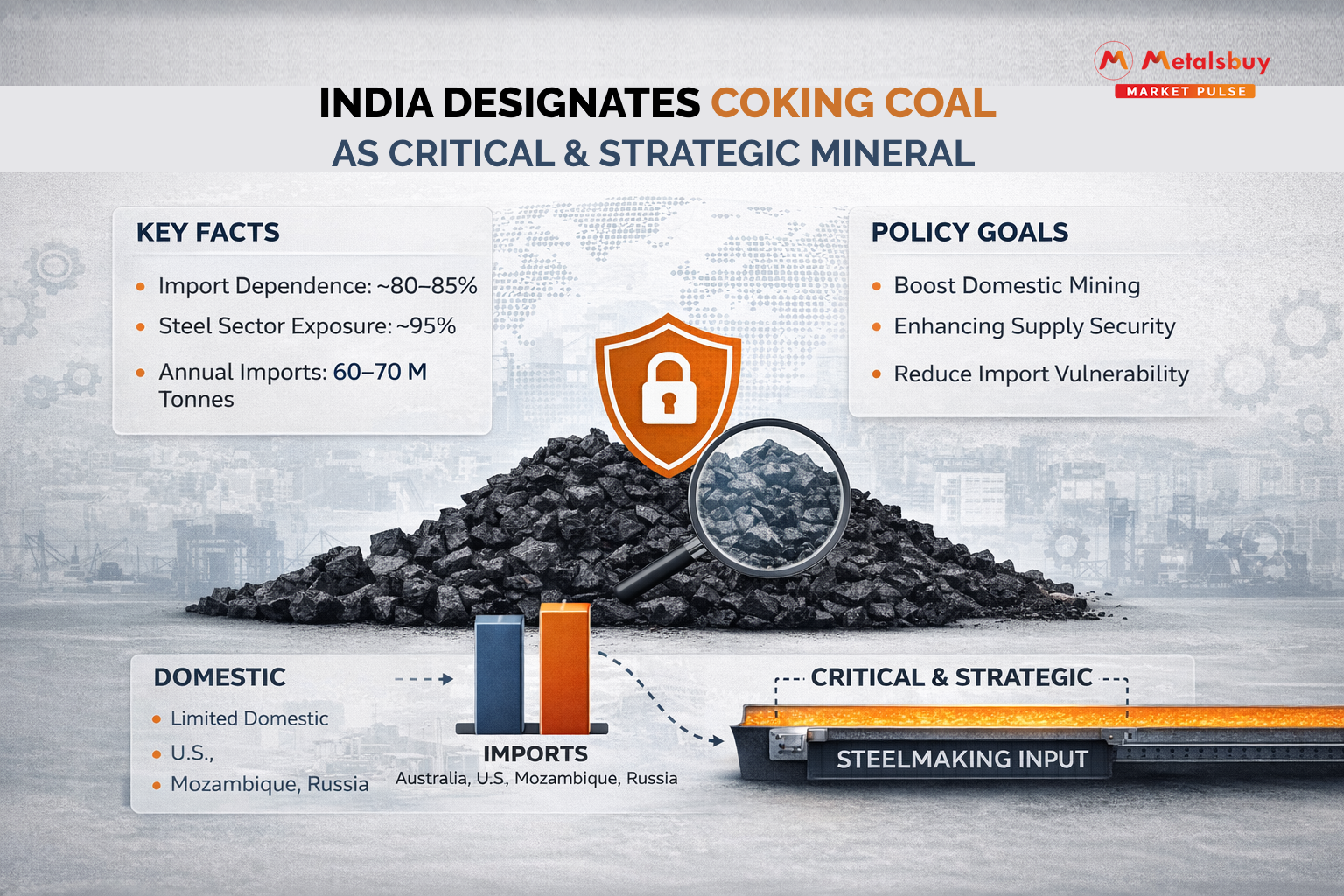
India has formally designated coking coal as a critical and strategic mineral, marking a significant policy shift aimed at strengthening long-term resource security for its steel industry and broader manufacturing ecosystem. The move reflects growing concern over the country’s high dependence on imports for a raw material that is indispensable to primary steelmaking.
The new classification elevates coking coal to a priority resource category, allowing the government to introduce faster approvals, coordinated policymaking and targeted incentives to boost domestic exploration, mining and supply reliability.
Why Coking Coal Matters
Coking coal, also referred to as metallurgical coal, is a specialised grade of coal used to produce coke, which acts as both a fuel and a reducing agent in blast furnaces. Unlike thermal coal, coking coal must meet strict chemical and physical parameters, including low ash and strong coking properties, making it geologically scarce.
India’s steel sector remains heavily dependent on this input:
- Import dependence: ~80–85% of India’s coking coal requirement is met through imports
- Steel sector exposure: ~95% of coking coal consumption is linked directly to steelmaking
- Annual import volumes: Estimated at 60–70 million tonnes
- Major suppliers: Australia, the United States, Mozambique, Russia
Despite having one of the world’s largest coal reserves overall, India possesses limited reserves of high-quality coking coal, with most domestic deposits characterised by high ash content and complex geology.
Strategic Rationale Behind the Decision
The designation reflects multiple structural and strategic considerations:
1. Steel Expansion Goals
India is pursuing aggressive capacity expansion in steel production to support infrastructure growth, urbanisation and manufacturing competitiveness. Blast furnace-based steelmaking will continue to dominate output in the medium term, keeping coking coal demand structurally high.
2. Import Vulnerability
Heavy reliance on overseas supply exposes Indian steelmakers to global price volatility, freight disruptions and geopolitical risk. Past supply shocks and sharp price swings have underlined the fragility of import-led sourcing.
3. Investment and Policy Coordination
By classifying coking coal as strategic, the government can:
- Prioritise exploration of deep-seated reserves
- Accelerate environmental and mining clearances
- Enable longer-tenure leases and policy stability
- Encourage investment in beneficiation and washing technologies
This approach aims to improve domestic availability while reducing cost inefficiencies across the value chain.
Implications for the Steel and Mining Sectors
The announcement has been viewed positively by industry stakeholders and investors, as it signals sustained policy backing for upstream resource security. Coal producers with exposure to metallurgical coal are expected to benefit from clearer regulatory pathways and improved project viability.
For steelmakers, the move offers a longer-term framework to stabilise raw material supply, although import dependence is expected to remain structurally high due to geological constraints.
Broader Global Context
India’s decision aligns with a wider global trend where countries are increasingly identifying and protecting critical raw materials essential to economic resilience and industrial continuity. While much of the global focus has been on energy-transition minerals such as lithium, cobalt and rare earths, coking coal remains a foundational input for traditional heavy industry, particularly steel.
Key Challenges Remain
Despite the policy upgrade, several hurdles persist:
- Quality limitations of domestic coking coal
- High capital costs for deep mining and beneficiation
- Environmental and land-use constraints
- Continued exposure to global pricing cycles
As a result, overseas asset acquisition and long-term supply contracts are expected to remain a parallel strategy for Indian steelmakers.
Outlook
The designation of coking coal as a critical and strategic mineral underscores India’s intent to secure its industrial raw material base amid rising demand and global uncertainty. While the move may not immediately reduce import dependence, it lays the groundwork for improved domestic capability, policy alignment and long-term resilience of the steel value chain.