A proposal by the central government to remove statutory caps on the maximum area that a single company can hold under mining leases has triggered strong opposition from smaller steelmakers and allied industry bodies. Industry representatives warn that the move could significantly accelerate the concentration of iron ore resources, further shrinking merchant market availability at a time when captive consumption already dominates India’s iron ore supply.
The proposed reform is part of a broader push to accelerate mineral development, improve auction outcomes, and attract large scale capital investment into mining. Policymakers argue that allowing companies to hold larger contiguous mining areas would enable faster development of complex deposits and help eliminate underperforming or idle blocks.
However, smaller steel producers and pellet manufacturers argue that removing mining lease area caps could structurally disadvantage the secondary steel sector by allowing large integrated players to consolidate control over key iron ore producing regions.
Captive consumption already dominates iron ore supply
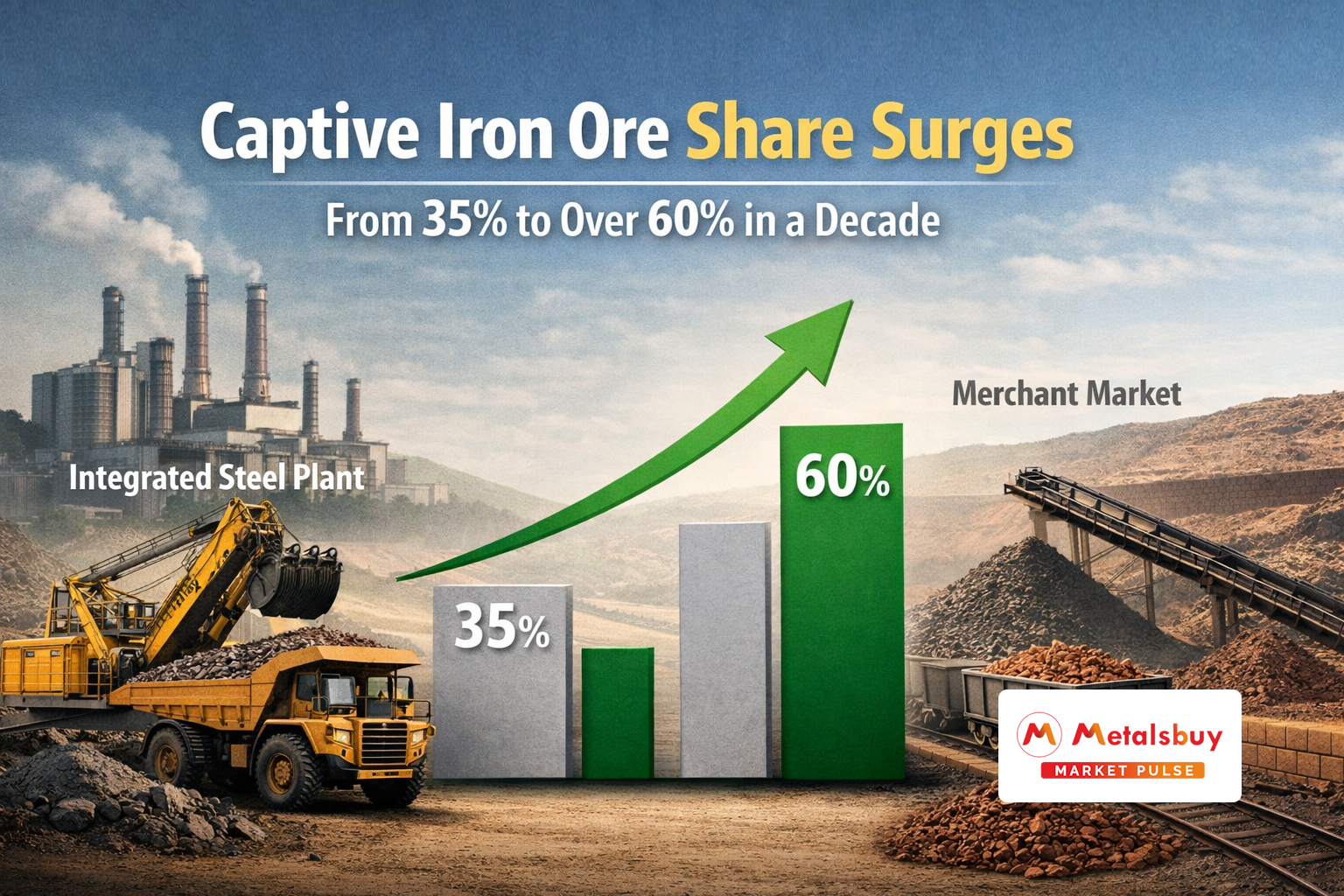
Historical production data shows that India’s iron ore market has steadily shifted away from merchant availability towards captive usage by integrated steel producers. This trend has accelerated since the introduction of the mining auction regime and the expansion of captive mining linkages by large steelmakers.
Merchant versus captive iron ore supply trend in India
| Fiscal Year | Total Iron Ore Production (Million tonnes) | Captive Consumption Share (%) | Merchant Market Share (%) | Market Insight |
|---|---|---|---|---|
| FY15 | ~129 | 35 | 65 | Merchant market dominant after easing of mining restrictions |
| FY18 | ~205 | 42 | 58 | Rising captive linkage with steel capacity expansion |
| FY20 | ~246 | 48 | 52 | Auction regime begins reshaping supply ownership |
| FY22 | ~255 | 53 | 47 | Increased consolidation among large steel producers |
| FY24 | ~275 | 58 | 42 | Merchant supply tightens for secondary steel sector |
| FY25E | ~285 | 60 to 62 | 38 to 40 | Captive dominance strengthens amid lease consolidation |
Over the past decade, captive iron ore consumption has increased by nearly 25 percentage points. As a result, the volume of iron ore available to the open merchant market has steadily declined, increasing dependence of secondary steelmakers and pellet producers on a smaller pool of suppliers.
Why smaller steelmakers oppose removal of area caps
Industry bodies representing smaller steel producers argue that mining lease area caps were originally designed to prevent monopolisation of mineral resources and ensure equitable access across the steel value chain. Removing these limits, they warn, would allow financially stronger players to acquire very large contiguous leases, effectively controlling regional supply corridors.
Such concentration could lead to prioritisation of captive consumption over merchant sales, tightening availability of iron ore and pellets in the open market. Smaller mills fear this would expose them to higher raw material price volatility, reduced negotiating power, and supply uncertainty during demand upcycles.
Independent pellet manufacturers are particularly vulnerable, as their operations rely heavily on consistent merchant ore availability rather than captive mining linkages.
Government rationale and counter arguments
From the government’s perspective, the proposed reform is aimed at improving mining efficiency and accountability. Policy discussions have included stricter timelines for commencement of mining operations and provisions to cancel leases if production does not begin within a defined period. Officials believe that allowing larger lease areas, combined with tighter performance obligations, could reduce speculative hoarding and improve overall mineral output.
Supporters of the reform argue that larger projects attract higher investment, better technology, and faster execution, which could eventually lead to higher iron ore production and improved long term supply stability.
Market impact and risk assessment
Market participants note that the impact of removing mining lease area caps will depend heavily on accompanying safeguards. In the short to medium term, further consolidation of mining assets is likely to tighten merchant iron ore supply, particularly in regions dominated by integrated steel producers. This could amplify price volatility and cost pressure for standalone steel mills.
Over the longer term, supply constraints could ease only if new mining capacity results in surplus production that is made available to the merchant market rather than absorbed entirely through captive consumption.
There are also concerns that policy changes perceived as enabling excessive resource concentration could invite legal challenges or state level resistance, delaying implementation and creating regulatory uncertainty.
Possible policy middle ground
Industry participants suggest that if mining lease area caps are removed, the framework should include safeguards such as mandatory merchant sale obligations, strict production timelines backed by financial guarantees, and transparent monitoring of captive versus merchant offtake. These measures could help balance investment objectives with fair access to raw materials.
Outlook
The next phase of mining policy announcements will be closely watched by steelmakers across the value chain. For smaller producers, the issue is not merely regulatory but existential, as shrinking merchant iron ore availability directly impacts cost stability and operational viability.
The data already indicates a clear structural shift toward captive dominance in iron ore supply. Any policy move that accelerates this trend without adequate safeguards risks deepening resource concentration and weakening the competitive foundation of India’s secondary steel ecosystem.