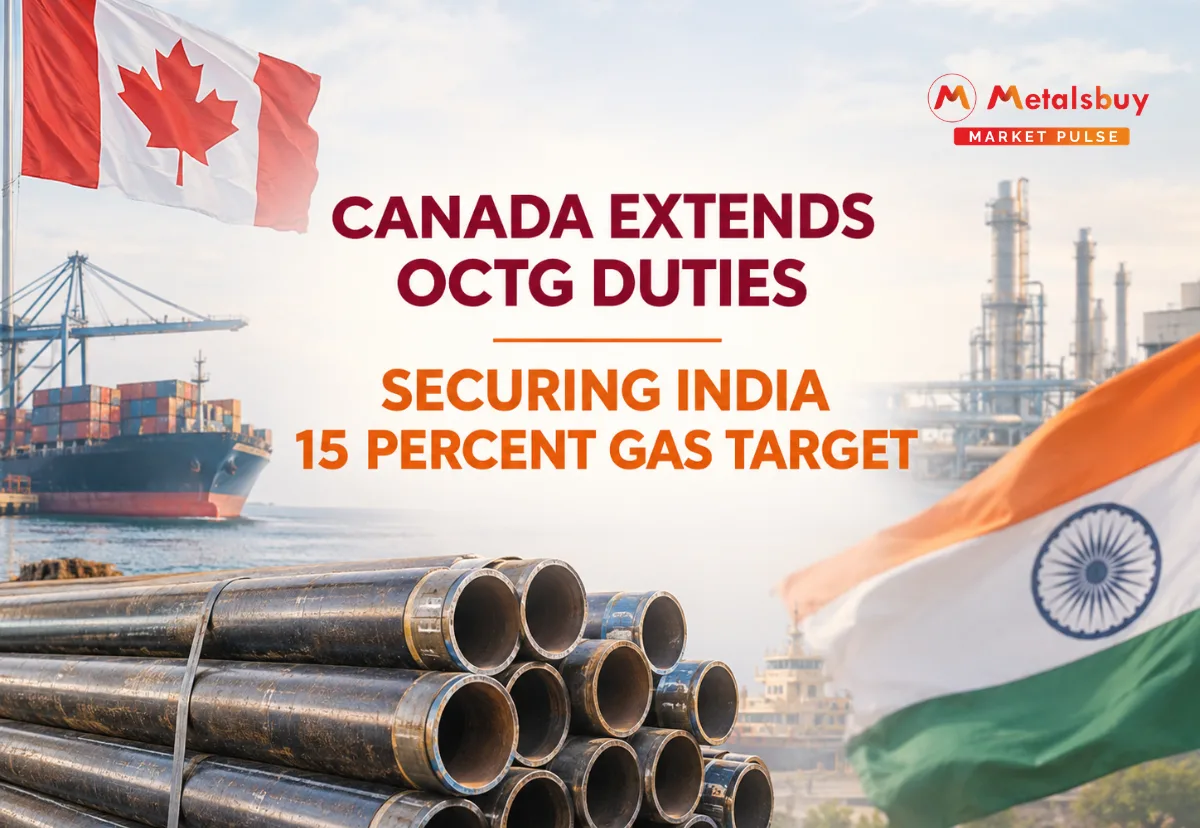
Canada Extends Anti Dumping Duties on Indian Tubular Goods as Domestic Mills Pivot to Booming Alternative Markets
The global energy pipeline supply chain is witnessing another major regulatory shift as Western nations continue to tighten their trade borders. The Canadian International Trade Tribunal has officially decided to extend existing anti-dumping and countervailing duties on Oil Country Tubular Goods originating from seven major manufacturing nations, including India. While the tribunal opted to revoke these specific tariffs for Ukraine amidst ongoing geopolitical developments, the continuation of trade barriers for Indian manufacturers highlights the rising tide of resource protectionism. However, backed by a booming domestic energy exploration sector and aggressive expansion into alternative global corridors, Indian pipe and tube manufacturers remain highly resilient, treating this extension as a minor detour rather than a structural roadblock.
Navigating international trade barriers and export recalibration
The recent ruling by the Canadian trade authorities is part of a standard expiry review process designed to protect domestic North American steel producers from foreign competition.
According to the official mandate, the anti-dumping and countervailing duties will remain in full force for seamless and welded Oil Country Tubular Goods (OCTG) imported from India, Taiwan, Indonesia, South Korea, Thailand, Turkey, and Vietnam. These specialized high-strength pipes are the absolute backbone of the oil and gas drilling industry, utilized heavily in casing and tubing applications deep underground. For Indian manufacturers, who have spent decades perfecting the metallurgy required for these high-stress environments, the Canadian market has historically been a viable export destination.
However, the continuation of these steep duties makes the landed cost of Indian OCTG financially uncompetitive for Canadian energy firms. While the revocation of duties for Ukraine is viewed largely as a sympathetic geopolitical maneuver, Indian mills are responding with calculated commercial agility. Rather than engaging in prolonged legal disputes over tariff margins, major domestic pipe manufacturers are actively recalibrating their export ledgers, redirecting their high-grade tubular products away from highly protected North American borders toward much more lucrative and open trading zones.
Robust domestic energy infrastructure provides a massive safety net
The primary reason Indian steel pipe manufacturers remain largely unfazed by the Canadian duty extension is the sheer scale and rapid acceleration of domestic energy exploration.
India is currently executing a massive national mandate to transform into a gas-based economy. The central government has set a firm target to increase the share of natural gas in the country's primary energy mix from the current 6 percent to a robust 15 percent by the year 2030. Achieving this ambitious goal requires unprecedented capital deployment in domestic hydrocarbon exploration. State-owned giants like the Oil and Natural Gas Corporation (ONGC) and Oil India Limited are actively executing multi-billion dollar capital expenditure programs, opening up new deep-water drilling blocks in the Krishna-Godavari basin and expanding Coal Bed Methane extraction in central India.
Every new drilling rig and extraction well requires thousands of tonnes of premium OCTG casing and tubing. Because this localized demand is accelerating at an unprecedented pace, Indian pipe manufacturers find their domestic order books completely full. By supplying these critical materials to national energy companies, domestic mills are securing highly profitable, long-term contracts that comfortably offset any marginal volume lost in the Canadian export market.
Exploring new global corridors amidst resource protectionism
Beyond the massive domestic safety net, Indian steelmakers are proving their global competitiveness by capturing massive market share in alternative international corridors. While Canada builds tariff walls, the Middle East and North Africa (MENA) region is rolling out the red carpet for Indian engineering. Major energy conglomerates in the Gulf are currently undertaking massive capacity expansions to maximize their crude oil output over the next decade. Indian pipe manufacturers have successfully positioned themselves as the absolute preferred tier-one suppliers for these Middle Eastern mega-projects. Recent industry data highlights that Indian firms are consistently winning multi-million dollar supply contracts for high-frequency induction welded pipes and seamless OCTG from state-run energy giants in Saudi Arabia and the United Arab Emirates.
By pivoting their export focus toward the MENA region and strategic pockets in South America, Indian manufacturers are successfully bypassing Western protectionism. These emerging markets offer massive volume absorption without the constant threat of unpredictable anti-dumping investigations, providing a highly stable and lucrative revenue stream for domestic exporters.
Long term outlook for the indian specialized pipe sector
From a broader macroeconomic perspective, the Canadian tariff extension serves as a clear indicator that global trade dynamics are permanently shifting. Relying on traditional Western export markets is becoming increasingly complex for Asian manufacturers.
However, the Indian steel pipe sector is perfectly equipped to navigate this new reality. Domestic manufacturers are no longer just competing on cost; they are competing on superior metallurgical quality and absolute supply chain reliability. By heavily investing in localized research and development to produce sour-service and highly corrosion-resistant OCTG grades, Indian mills are climbing the global value chain. As the domestic energy sector demands massive volumes of these premium pipes, and alternative global markets eagerly absorb the surplus, the Indian specialized steel tube industry guarantees a highly profitable, deeply resilient, and globally dominant future for the remainder of the decade.