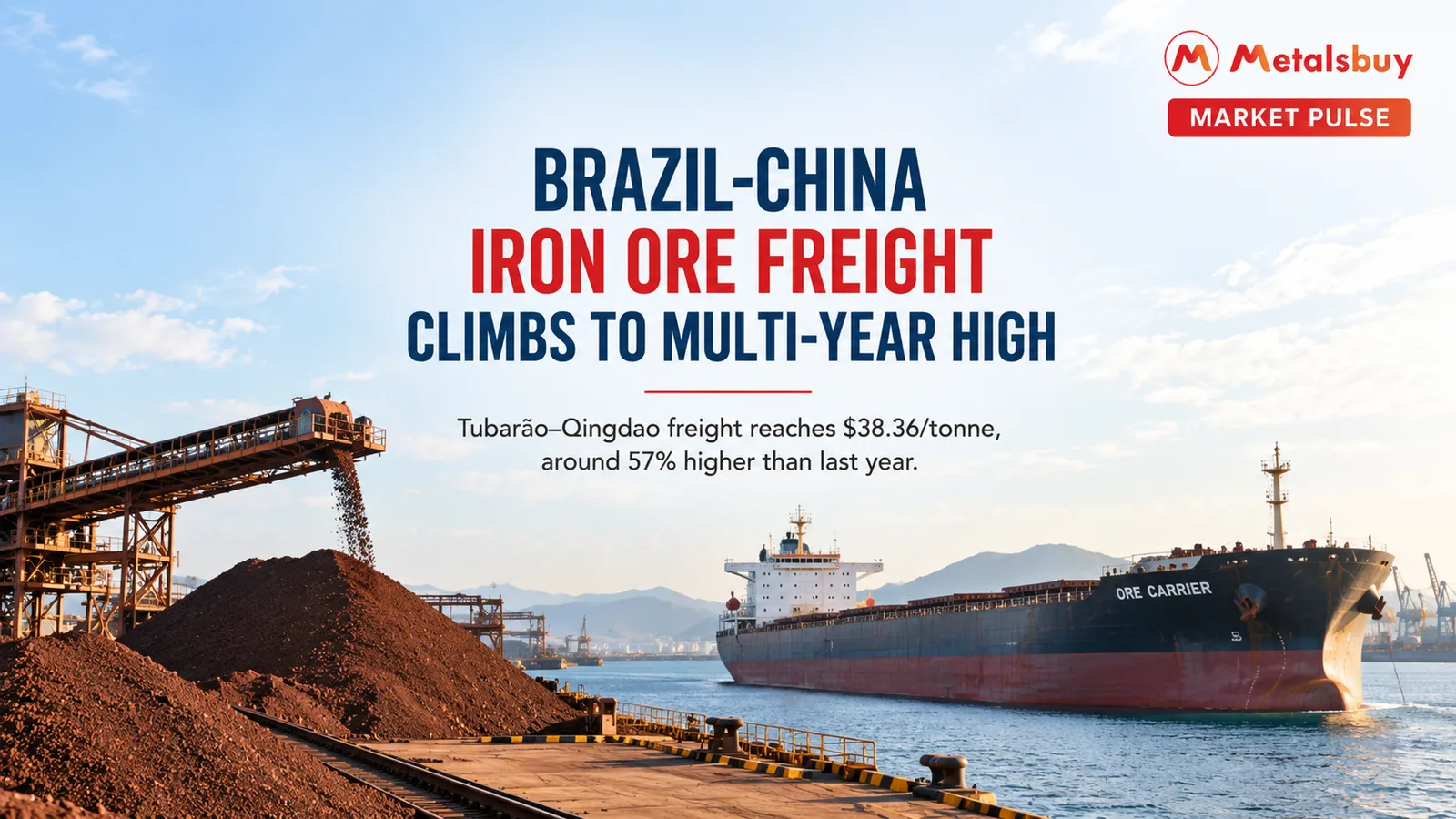
Moving iron ore from Brazil to China has become significantly more expensive.
The freight rate on the Tubarão-Qingdao route, one of the key benchmarks for long-haul iron ore shipments, has climbed to $38.36 per tonne this week. That is around 57% higher than the same period last year and a sharp increase from the levels seen at the beginning of 2026, when the rate was still close to $20 per tonne.
Freight is sometimes treated as a side number in the iron ore market. But on a route as long as Brazil to China, it can materially change the delivered cost of ore. The latest rise is therefore something both miners and steelmakers will be watching.
A long route has become even more expensive
Brazil is one of China's most important iron ore suppliers, but it has one obvious disadvantage compared with Australia: distance.
Australian ore reaches China relatively quickly. Brazilian cargoes travel much longer distances and depend heavily on the availability and cost of large bulk carriers. When Capesize freight rates move up, Brazilian shipments feel the impact much more directly.
The Tubarão-Qingdao benchmark had already strengthened earlier this year. In late March, the route was reported at around $30.65 per tonne, which was then a two-year high. The latest level of $38.36 per tonne shows that the rally has continued rather than fading away.
For a 170,000-tonne cargo, even a relatively small movement in freight rates can translate into a substantial additional cost for the shipment.
Why are rates rising?
There is no single reason behind the latest jump.
Higher bunker fuel costs have been one contributing factor, particularly against the backdrop of the conflict in the Middle East. Fuel is a major operating cost for dry bulk shipping, and higher bunker prices eventually find their way into freight calculations.
At the same time, seasonal improvement in Chinese steel demand has supported iron ore buying. The market has also seen tighter vessel availability, while a volatile week in the Pacific iron ore trade reportedly pushed more attention towards long-haul South Atlantic cargoes.
That combination matters. Freight markets can move quickly when cargo demand increases at the same time as available vessels become tighter.
What does this mean for Brazilian iron ore?
Higher freight creates a challenge for Brazilian miners because it increases the landed cost of their ore in China.
That does not necessarily mean Brazilian shipments become uncompetitive. Brazilian ore, particularly higher-grade material, has its own advantages for steelmakers. But the freight gap with Australian material becomes more important when shipping costs rise.
For Chinese buyers, the comparison is always about the final delivered cost rather than just the mine's FOB price.
An Australian cargo may have a different ore price, quality and freight component compared with Brazilian material. Steel mills and traders constantly compare these combinations before deciding what to buy.
This is why freight rates can influence trade flows without changing the underlying iron ore price itself.
The $40 per tonne mark is now being discussed
Market indications suggest that the Brazil-China freight rate could move closer to $40 per tonne for October laycan cargoes if current conditions continue. Whether it actually reaches that level will depend on vessel availability, fuel costs and how Chinese iron ore demand develops over the next few weeks.
The increase is particularly notable considering where the market started the year. Freight was close to $20 per tonne in January. It crossed $30 by March and has now moved above $38. That is a sizeable change in less than nine months.
Freight is becoming an important part of the iron ore equation
The iron ore market is usually discussed in terms of Chinese steel production, port inventories and mine supply. But shipping costs can quietly change the economics of the trade. A higher freight bill does not change how much iron is contained in a tonne of ore. What it changes is the cost of getting that tonne to the customer.
For Brazilian suppliers, the latest rally is therefore not just a shipping market story. It has a direct connection with competitiveness in China, the world's largest iron ore market.
For now, freight remains firm and the Tubarão-Qingdao route is trading at levels not seen in recent years. If rates continue towards $40 per tonne, the delivered-cost gap between different iron ore origins could become an even bigger talking point in the months ahead.