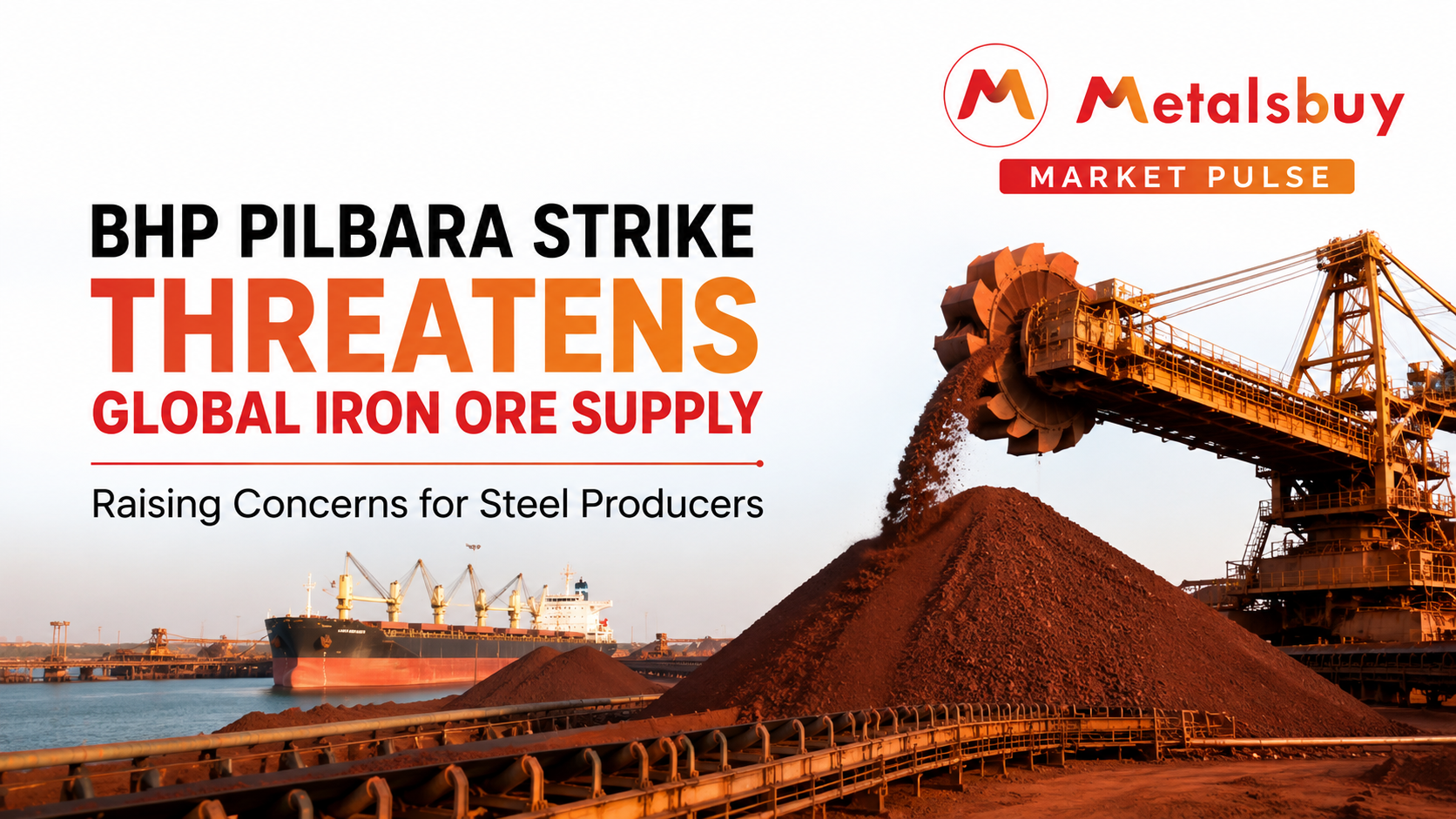
Fresh labour unrest at BHP's Pilbara iron ore operations in Western Australia has triggered concerns across the global steel industry, as workers prepare for potential industrial action that could disrupt one of the world's largest iron ore producing regions. Pilbara accounts for a significant share of global seaborne iron ore exports, making any prolonged disruption a closely watched event for miners, steelmakers and commodity traders worldwide. While negotiations between BHP and employee representatives continue, the possibility of supply interruptions has already started influencing market sentiment.
Key Highlights
- Industrial action threatens operations at BHP's Pilbara iron ore mines in Western Australia.
- Pilbara contributes a substantial share of the global seaborne iron ore trade.
- Any prolonged disruption could tighten iron ore availability for Asian steelmakers.
- Market participants are closely monitoring labour negotiations for further developments.
- Supply concerns may provide short-term support to global iron ore prices.
Why the Pilbara Region Matters
Australia's Pilbara region is the backbone of the global iron ore industry, supplying hundreds of millions of tonnes of high-grade iron ore annually to steelmakers across China, Japan, South Korea, India and other major manufacturing economies. BHP, alongside Rio Tinto and Fortescue, forms the core of Australia's export infrastructure, with an extensive network of mines, railways and port facilities. Even a temporary disruption in mining or logistics can influence international iron ore prices due to the sheer scale of shipments originating from the region.
Unlike smaller mining operations, Pilbara's output directly impacts the balance between global supply and demand. Steel producers often rely on uninterrupted deliveries to maintain blast furnace operations, making supply certainty just as important as price. Any delay in exports can prompt buyers to seek alternative sources, often at higher costs, creating volatility across the raw material market.
Potential Impact on the Global Steel Industry
Should industrial action escalate into a prolonged strike, global iron ore prices could witness renewed upward momentum as traders factor in tighter seaborne availability. China, the world's largest importer of iron ore, would likely be the first to feel the impact, followed by other Asian steel-producing nations. Higher raw material costs could squeeze steelmakers' margins, particularly at a time when finished steel demand remains uneven across several key markets.
For Indian steel producers, the direct impact may be relatively limited due to the country's abundant domestic iron ore reserves. However, Indian exporters operating in international markets could still experience indirect effects through shifts in global pricing benchmarks and increased competition for premium-grade imported ore. Commodity traders and procurement teams are therefore expected to closely track developments in Australia over the coming weeks.
Market Outlook
The current situation highlights the growing sensitivity of global commodity markets to operational disruptions at major mining hubs. With geopolitical uncertainties, weather-related disruptions and labour issues increasingly influencing raw material availability, steel producers are placing greater emphasis on supply chain diversification and inventory management. Unless negotiations result in a swift resolution, market participants are likely to maintain a cautious outlook, with iron ore prices expected to remain volatile in the near term.
For the steel and mining industry, the Pilbara developments serve as another reminder that even localized operational issues can have far-reaching implications across the global metals value chain.