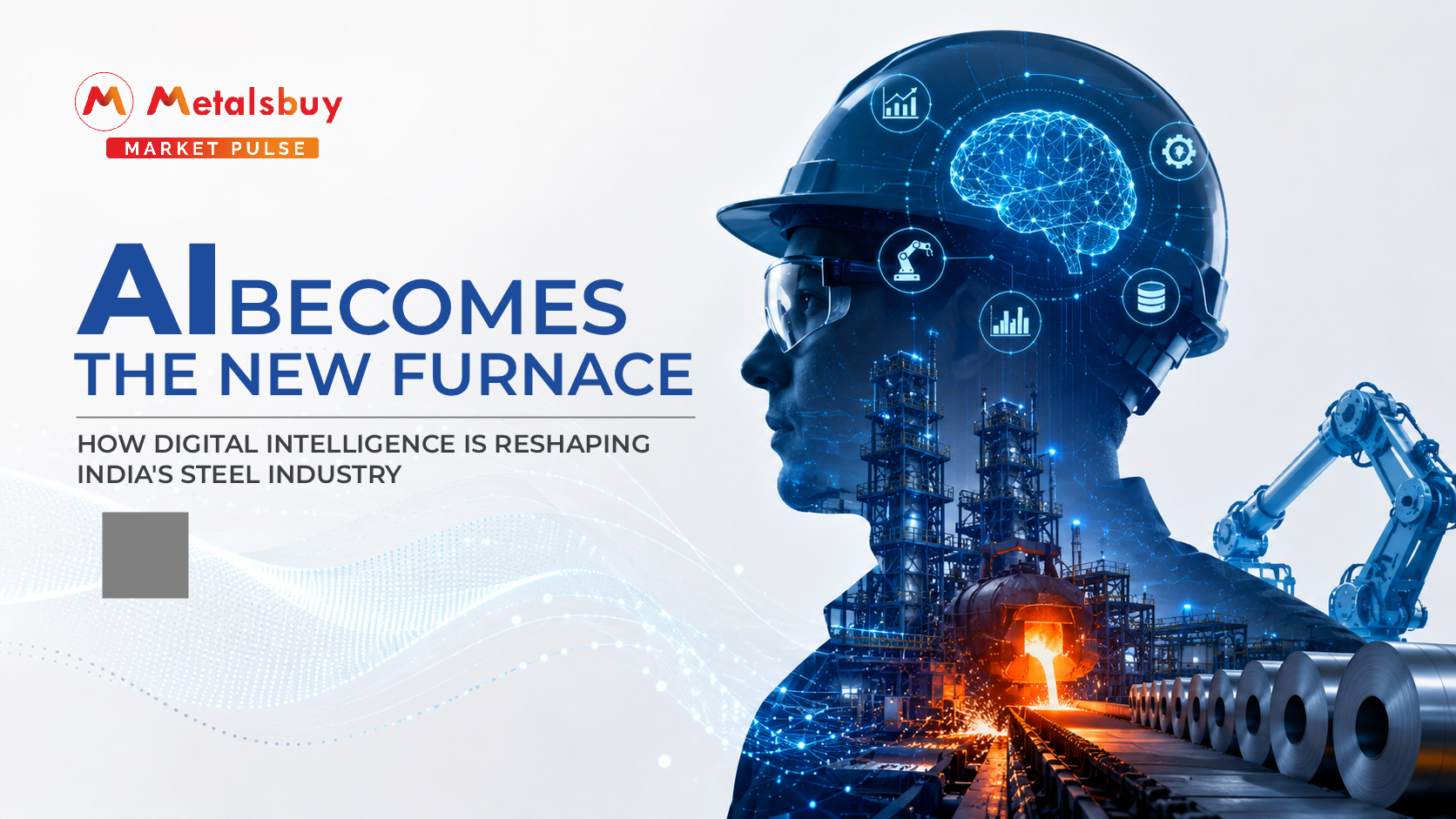
KEY TAKEAWAYS
- AI is moving from pilot projects to core steel plant operations.
- Digital twins are enabling real-time production optimisation.
- Predictive maintenance is reducing downtime and improving asset utilisation.
- AI-powered quality control is helping producers reduce defects and scrap generation.
- Steelmakers are leveraging AI for logistics, inventory management, and demand forecasting.
- The Ministry of Steel is actively promoting AI-led modernization to support India's 400 MT capacity vision.
- Data-driven manufacturing is emerging as a key competitive differentiator for steel producers.
MARKET ANALYSIS
For decades, competitiveness in the steel industry was largely determined by access to raw materials, production capacity, and operational scale. Today, a new factor is rapidly emerging as an equally important differentiator: data. Across India's steel sector, artificial intelligence is increasingly being integrated into operations, transforming how steel is produced, monitored, transported, and marketed. What began as isolated digital initiatives is gradually evolving into a broader industrial transformation that could redefine the economics of steelmaking over the coming decade.
The timing of this shift is significant. India is pursuing one of the world's most ambitious steel expansion programs, targeting 400 million tonnes of steelmaking capacity by 2035-36. Achieving this goal will require more than simply adding blast furnaces, rolling mills, and logistics infrastructure. As production scales up, maintaining efficiency, controlling costs, ensuring product quality, and meeting sustainability objectives will become increasingly complex. Industry leaders are therefore looking toward AI, automation, and advanced analytics as tools capable of delivering productivity gains that traditional operational improvements can no longer achieve.
The transformation is already visible across leading producers. Companies such as Tata Steel, JSW Steel, and SAIL are deploying AI across production planning, maintenance, quality assurance, supply-chain management, and energy optimisation. The objective is not merely automation but the creation of intelligent manufacturing systems capable of continuously learning, adapting, and improving performance through data-driven decision-making.
THE RISE OF THE SMART STEEL PLANT
Steel production remains one of the most complex industrial processes in the world. Every stage of production requires constant management of variables such as raw material quality, furnace temperatures, fuel consumption, rolling speeds, pressure levels, and product specifications. Traditionally, these decisions relied heavily on operator experience and periodic process reviews. AI is fundamentally changing that model by enabling real-time analysis of massive volumes of operational data.
One of the most transformative technologies being adopted is the digital twin. Digital twins create virtual replicas of production facilities that allow operators to simulate different scenarios before implementing changes in live operations. Instead of relying on trial-and-error approaches, steelmakers can test alternative production strategies, identify bottlenecks, optimise energy consumption, and improve yield within a digital environment. This significantly reduces operational risk while improving productivity and consistency.
As steel plants become increasingly connected through sensors, industrial IoT devices, and automated control systems, digital twins are expected to evolve from optimisation tools into intelligent operational command centres. This transition could fundamentally alter how future steel plants are designed and managed.
PREDICTIVE MAINTENANCE IS DELIVERING REAL ECONOMIC VALUE
Maintenance remains one of the largest cost centres for integrated steel producers. Unplanned equipment failures can disrupt production schedules, increase operating costs, and significantly reduce plant productivity. In a continuous process industry such as steel, even a short shutdown can trigger substantial financial losses across the value chain.
AI-powered predictive maintenance systems are helping address this challenge by analysing sensor data, vibration patterns, thermal signatures, and historical equipment performance to identify potential failures before they occur. Rather than relying on fixed maintenance schedules or reacting to breakdowns after they happen, companies can intervene only when equipment conditions indicate elevated risk. This improves equipment availability while reducing unnecessary maintenance expenditure.
Industry implementations have reported meaningful reductions in unexpected failures and downtime. Research into AI-enabled maintenance models suggests that advanced machine learning systems can significantly improve fault detection accuracy, enabling maintenance teams to make faster and more informed decisions. As steelmakers continue pursuing higher capacity utilisation rates, predictive maintenance is expected to become one of the most widely adopted AI applications across the industry.
QUALITY CONTROL IS MOVING FROM INSPECTION TO PREVENTION
Quality has become a critical competitive factor as Indian steelmakers increasingly target automotive, infrastructure, engineering, and export markets. Customers today demand tighter specifications, greater consistency, and lower defect rates. Meeting these expectations through traditional inspection methods is becoming increasingly challenging as production volumes expand.
AI-powered computer vision systems are helping manufacturers move from reactive inspection toward proactive quality assurance. High-speed cameras and machine learning algorithms can continuously monitor steel surfaces during production, identifying defects such as cracks, dents, surface irregularities, and dimensional variations in real time. This enables corrective actions to be taken immediately rather than after production is completed.
The benefits extend beyond improved quality. Reduced defect rates lead to lower scrap generation, improved yield, and reduced rework costs. Over time, these improvements can create substantial economic value while strengthening customer confidence. For producers competing in premium steel segments, AI-driven quality systems may become an essential component of long-term market differentiation.
AI IS EXPANDING BEYOND THE PLANT GATE
While production optimisation receives most of the attention, some of the most valuable AI applications are emerging outside the manufacturing process itself. Steel companies are increasingly using AI to improve demand forecasting, inventory management, logistics planning, and supply-chain optimisation. These functions have become particularly important in an industry characterised by volatile raw material prices, fluctuating demand patterns, and increasingly complex global trade flows.
Advanced forecasting systems can analyse historical demand trends, macroeconomic indicators, weather patterns, procurement cycles, and customer behaviour to improve planning accuracy. Better forecasts help producers optimise inventory levels, reduce working capital requirements, and improve customer service. At the same time, AI-enabled logistics platforms can optimise transportation routes, improve fleet utilisation, and reduce delivery lead times.
As India's steel industry continues expanding, these capabilities will become increasingly important. The companies that successfully integrate AI across both manufacturing and commercial functions are likely to achieve significant advantages in efficiency, responsiveness, and profitability.
AI AND SUSTAINABILITY ARE BECOMING INTERCONNECTED
The steel industry faces growing pressure to reduce emissions, improve energy efficiency, and align with global sustainability expectations. AI is emerging as a powerful tool in this transition by helping companies optimise energy consumption, reduce waste generation, and improve resource utilisation across operations.
Energy costs represent a significant component of steelmaking economics. AI systems can analyse consumption patterns across furnaces, rolling mills, and auxiliary equipment to identify opportunities for efficiency improvements. Even marginal reductions in energy intensity can generate substantial financial savings while supporting environmental objectives. As carbon reporting requirements become more stringent globally, these capabilities are expected to gain strategic importance.
The convergence of AI and sustainability is therefore creating a new framework for industrial competitiveness. Future leaders in the steel industry are likely to be those that successfully combine production scale with digital intelligence and environmental performance.
MARKET OUTLOOK
The adoption of artificial intelligence marks one of the most important structural shifts currently underway in India's steel industry. While previous decades were defined by capacity expansion and raw material integration, the next phase of growth is likely to be characterised by intelligent manufacturing and data-driven operations. Steelmakers that effectively leverage AI could achieve meaningful advantages in productivity, quality, maintenance efficiency, sustainability, and customer responsiveness.
The Ministry of Steel's recent digital roadmap signals that AI is no longer being viewed as an experimental technology but as a strategic enabler of India's long-term steel ambitions. The government's emphasis on AI-led modernisation reflects a broader recognition that future competitiveness will depend as much on software, analytics, and automation as on physical assets and production scale.
The pace of adoption is expected to accelerate as implementation costs decline and successful use cases become more visible across the industry. Early adopters are already demonstrating measurable benefits in maintenance, quality, energy management, and operational efficiency. These results are likely to encourage broader deployment across both integrated steelmakers and secondary producers.
Looking ahead, artificial intelligence will not replace metallurgical expertise or industrial experience. Instead, it will augment human decision-making with real-time intelligence and predictive capabilities. The future of Indian steel will continue to be forged in furnaces and rolling mills, but increasingly, it will also be shaped by algorithms, data platforms, and intelligent systems that redefine how industrial value is created.
---------------------