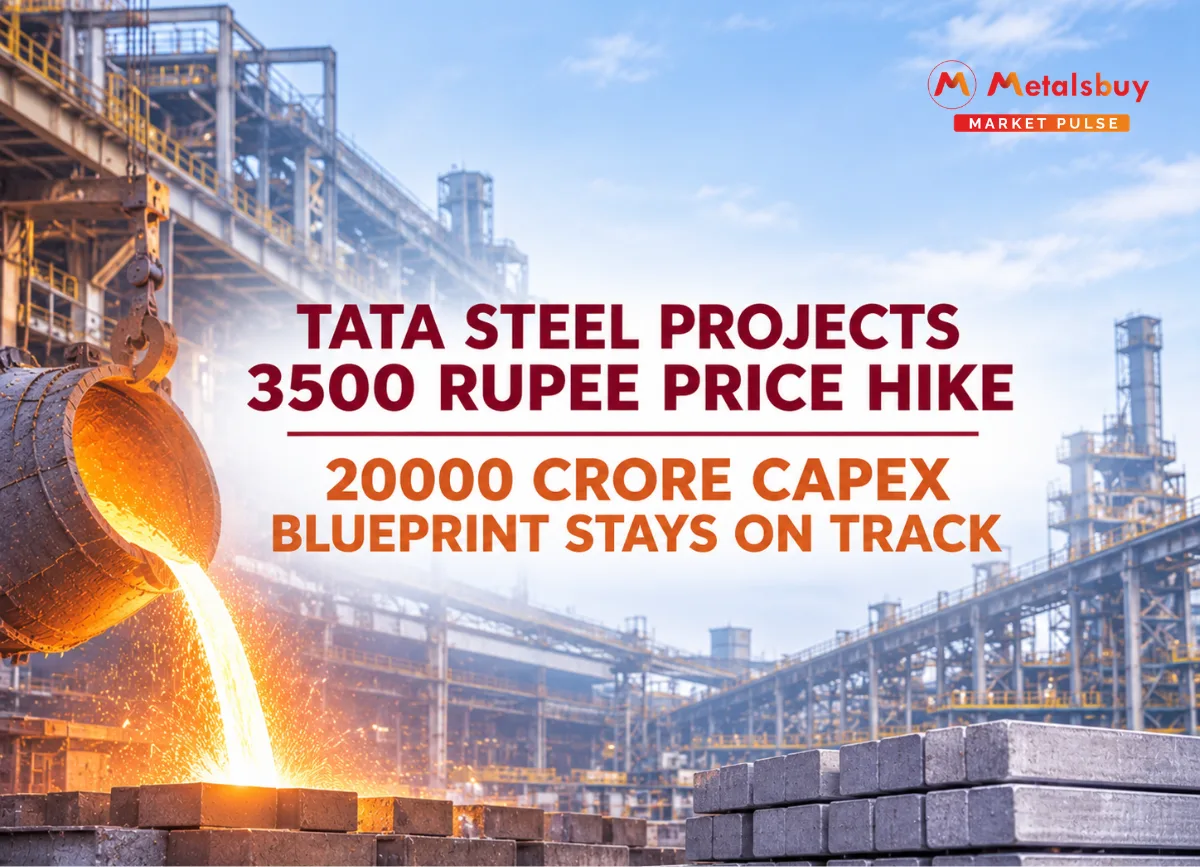
The Indian metallurgical landscape is currently demonstrating remarkable financial agility as top-tier manufacturers navigate a highly complex global trade environment. Tata Steel is spearheading this resilient narrative by maintaining a highly aggressive investment posture. Despite ongoing macroeconomic uncertainties and severe geopolitical friction disrupting international maritime logistics, the domestic steel giant is confidently advancing its multi-billion rupee expansion blueprint. By projecting a massive capital expenditure pipeline alongside a firm expectation of rising domestic steel prices, the corporate management is sending a strong signal of stability. This dual strategy of pouring capital into localized infrastructure while optimizing revenue realization ensures that the company remains deeply anchored to India's ongoing industrial boom.
Domestic capacity expansion drives aggressive capital deployment
Focusing heavily on indigenous growth, the steelmaker is funneling the lion's share of its investments into its massive eastern indian integrated facilities. The core of Tata Steel's current corporate strategy is an unyielding commitment to scaling its physical manufacturing footprint across the subcontinent. According to recent management disclosures led by Chief Executive Officer and Managing Director TV Narendran, the company is firmly on track to execute an ambitious capital expenditure target of 20,000 crore rupees for the current financial year. What makes this financial commitment truly significant is its geographical allocation. The enterprise is deliberately directing the absolute bulk of this capital—approximately 15,000 crore rupees—exclusively toward its domestic operations.
This inward-looking investment strategy proves that the management views the Indian market as its primary, high-yield growth engine. During the first half of the fiscal year, the company already successfully deployed roughly 6,800 crore rupees. As the market transitions into the busy winter construction season, the velocity of this capital outflow is expected to accelerate significantly. The primary beneficiary of this massive funding is the ongoing expansion at the Kalinganagar integrated plant in Odisha, which is systematically ramping up its operations. Additionally, substantial funds are being routed to execute vital technological upgrades and debottlenecking initiatives at the company’s historic Jamshedpur works and the Meramandali facility. By continuously upgrading these domestic heavy assets, Tata Steel ensures it has the physical bandwidth to meet the surging raw material demands of India's automotive and infrastructure developers.
Anticipated price hikes and strong demand to offset raw material pressures
An expected surge in domestic realization rates will provide a vital financial cushion against rising international fuel and logistics costs. Generating massive volumes of metal requires a favorable pricing environment to protect corporate balance sheets, especially when global input costs become volatile. The second quarter presented a distinct set of operational hurdles for the manufacturer. The ongoing geopolitical conflicts in the Gulf region triggered severe disruptions across global maritime shipping routes. This turbulence led to a massive spike in international freight rates, insurance premiums, and the cost of consumable materials, inflicting an additional cost burden of approximately 1,400 crore rupees on the company during the quarter.
Furthermore, the foundational raw material market remains challenging, with international coking coal costs experiencing a noticeable upward creep of 15 dollars per metric tonne. However, the corporate leadership remains exceptionally optimistic regarding the immediate financial horizon. Narendran recently indicated that domestic steel prices are projected to witness a robust recovery, with realization rates expected to climb by an average of 3,500 rupees per tonne during the third quarter. This anticipated price hike is heavily supported by aggressive post-monsoon construction activity and festive automotive manufacturing across India. The ability to command higher prices in the retail and wholesale markets will perfectly neutralize the rising cost of imported coking coal. Coupled with the company's firm commitment to achieving a strict annual cost-saving target of 7,000 crore rupees, this improved price realization guarantees a highly lucrative and margin-expansive second half of the year.
Restructuring european assets to align with green metallurgy mandates
The corporate management continues to navigate complex regulatory and infrastructural frameworks to modernize its legacy foreign operations. While the domestic market acts as the primary revenue driver, Tata Steel is simultaneously executing a highly complex structural overhaul of its European portfolio to meet strict global decarbonization standards. A portion of the overall 20,000 crore rupee capital expenditure budget is strategically earmarked for modernizing these overseas assets, ensuring they remain viable in a market that is rapidly penalizing high-carbon manufacturing.
In the United Kingdom, the company is fundamentally transforming its historic Port Talbot facility. The legacy blast furnaces are being permanently retired to make way for a state-of-the-art Electric Arc Furnace, a transition designed to produce green steel using recycled scrap metal. The management has set a firm target to have this electric furnace fully operational by March 2028. However, the execution timeline remains contingent on securing reliable, high-capacity grid electricity, and active dialogues are currently underway with the British government to expedite these essential infrastructural linkages. Simultaneously, across the English Channel, the company is actively negotiating the future of its Netherlands operations. The deadline for finalizing a non-binding Letter of Intent with the Dutch government regarding long-term support and ecological transition pathways has been strategically extended to the first of March, highlighting the intricate, multi-stakeholder nature of decarbonizing heavy European industries.
Securing long term resilience in the indian metals ecosystem
A robust operational strategy ensures that the manufacturing giant remains perfectly positioned to capitalize on the ongoing national infrastructure boom. From a broader macroeconomic viewpoint, Tata Steel's ability to seamlessly balance massive domestic expansions with complex international restructuring is a masterclass in industrial resilience. The company is actively proving that it can absorb severe geopolitical shocks and raw material inflation without derailing its long-term growth trajectory.
As the Indian government continues to pump multi-billion dollar budgets into national highway networks, dedicated railway corridors, and urban modernization projects, the baseline demand for high-grade structural and flat steel will only accelerate. By ensuring its localized facilities are heavily funded and operating at peak technological efficiency, Tata Steel is locking in its dominant market share. The anticipated 3,500 rupee per tonne price improvement in the third quarter acts as the ultimate financial catalyst, promising robust cash flows that will sustain this aggressive investment cycle. Ultimately, this confident forward momentum guarantees that India's domestic supply chain remains fiercely competitive, highly self-reliant, and perfectly equipped to lead the global metals market.