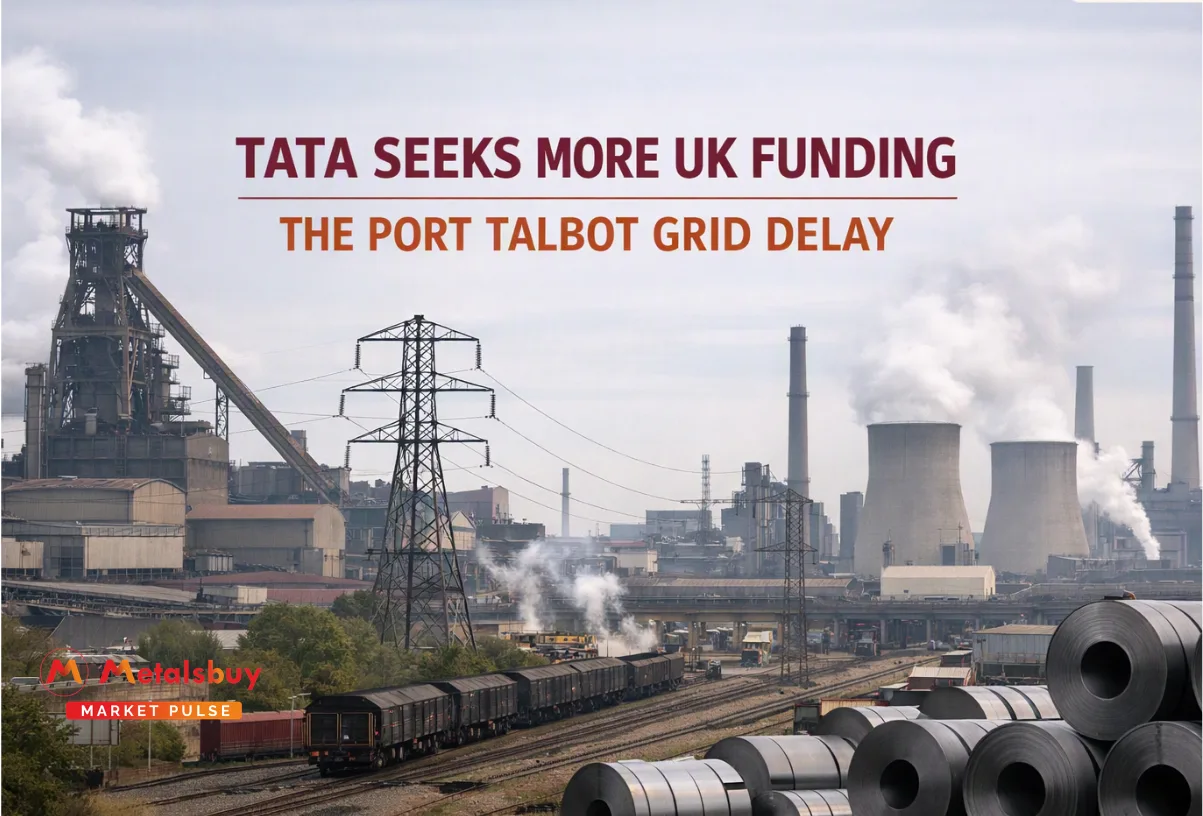
Indian steel manufacturing giant Tata Steel is reportedly engaged in discussions with the United Kingdom government to secure additional financial support for its major decarbonization project at the Port Talbot steelworks in South Wales. This latest push for extended government funding comes as the company faces significant project delays and escalating operational costs associated with transitioning the historic plant from traditional, coal-based blast furnaces to modern, low-emission Electric Arc Furnace technology. This development highlights the immense financial and logistical complexities involved in decarbonizing legacy heavy industries on a massive scale.
Navigating grid delays and rising project costs
The core issue driving the need for additional capital revolves around critical infrastructure delays, specifically concerning the plant's connection to the national power grid. The original £1.25 billion investment plan, which included a £500 million grant from the UK government awarded in 2023, was designed to see the new Electric Arc Furnace (EAF) fully operational by early 2028.
However, recent assessments by Tata Steel indicate that due to prolonged delays in securing the necessary high-capacity grid connections required to power the massive EAF, the timeline for the furnace becoming operational has been pushed back. The company now estimates that the new furnace will not be functional until late 2028 or potentially early 2029. This extended delay is creating a severe financial strain. Tata Steel is facing mounting capital expenditure costs as the project timeline stretches, combined with substantial lost revenue from the prolonged gap in full-scale steel production. To bridge this widening financial deficit, the company has formally approached the UK’s Department for Business, Innovation, and Skills to negotiate a new financial assistance package, which industry sources estimate could amount to millions of additional pounds.
The challenge of transitioning legacy infrastructure
The situation at Port Talbot serves as a critical case study for the global steel industry's shift toward green manufacturing. Transitioning a massive integrated steelworks is not merely about replacing one furnace with another; it requires a complete overhaul of the surrounding energy and logistical infrastructure.
Earlier in 2024, Tata Steel officially closed the last of its traditional, carbon-intensive blast furnaces at the Port Talbot site. This closure marked the end of an era for primary steelmaking in South Wales and was a mandatory step in the company's commitment to drastic carbon reduction. However, the gap between shutting down the old infrastructure and bringing the new EAF online has left the facility reliant on imported steel substrates to keep its downstream rolling and finishing lines operational. This reliance on imported intermediate materials severely impacts the plant's profit margins, highlighting why timely execution of the EAF project is essential for the long-term commercial survival of the UK operations.
Trade pressures complicate the domestic market
Adding to the financial pressure of the green transition are the challenging dynamics of the current global steel trade. Tata Steel UK has repeatedly voiced strong concerns over the state of the domestic British steel market, particularly regarding import protections.
In July 2026, the company issued a stark warning that the continued viability of its UK operations could be jeopardized by the government's trade policies. Tata Steel pointed out that increased duty-free import quotas granted to specific Asian steel suppliers threatened to flood the UK market with cheaper, highly competitive steel products. This influx of aggressively priced imports makes it exceptionally difficult for domestic producers, who are already bearing the massive financial burden of decarbonization, to maintain their market share and pricing power. The company argues that strong trade defense mechanisms are an absolute necessity to protect the domestic industry while it undergoes this vulnerable transitional phase.
Securing the future of British steelmaking
From a broader macroeconomic perspective, the negotiations between Tata Steel and the UK government carry massive implications for the future of British heavy manufacturing. Port Talbot remains one of the most critical industrial assets in the country, and its successful modernization is vital for the UK to meet its national net-zero emissions targets while retaining a sovereign steelmaking capability.