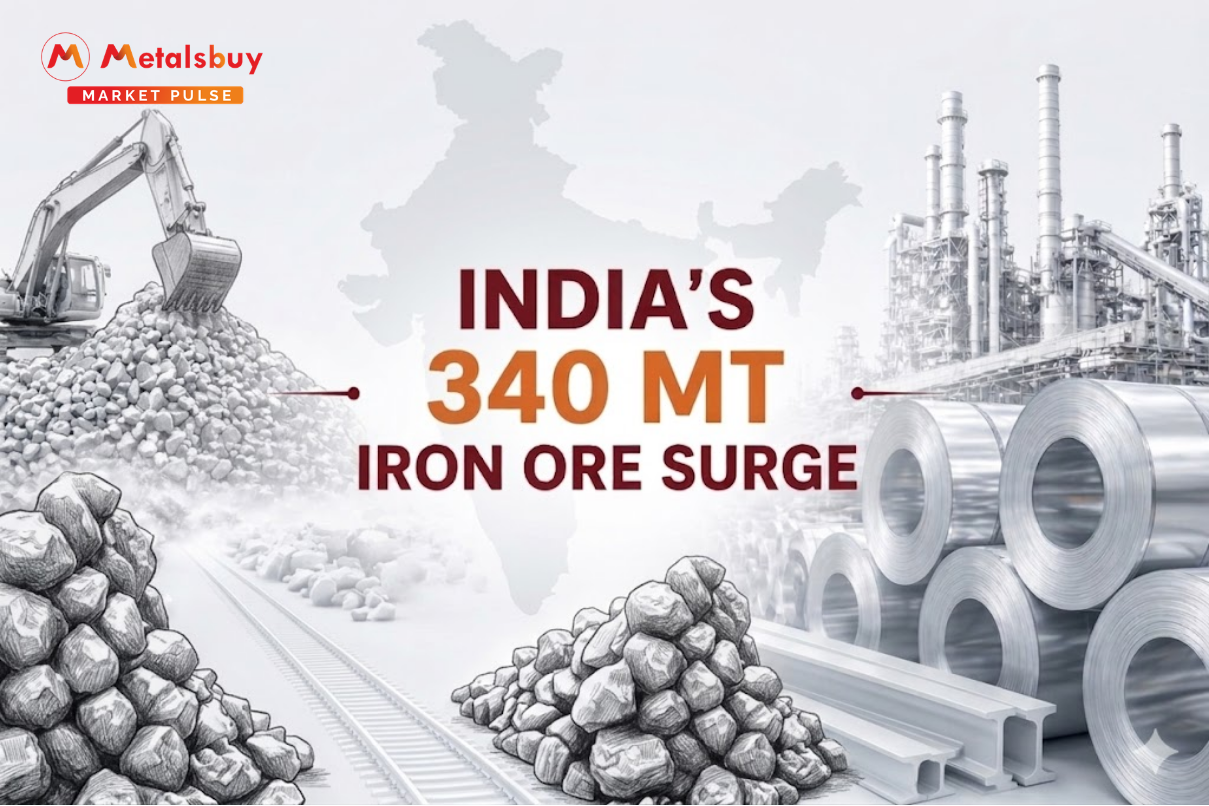
The global industrial landscape is experiencing a profound structural pivot, anchored largely by India’s rapid infrastructure acceleration and a booming manufacturing sector. At the heart of this economic engine lies the iron ore mining industry, which is currently orchestrating a massive supply-side expansion. Industry intelligence and the latest fiscal data project that India’s domestic iron ore production will escalate by a substantial 8 percent year-on-year in the financial year 2026-27. This upward trajectory will propel total output past the 340 million metric tonne threshold, a significant leap from the estimated 316 million metric tonnes recorded in FY26.
This is not merely an arithmetic increase; it represents a profound strategic transformation. The Indian mining sector is officially transitioning from a reactive, demand-responsive framework into a proactive, capacity-driven powerhouse. By ramping up operations ahead of immediate domestic consumption, India is securing its raw material future while simultaneously altering global trade dynamics.
Unprecedented Corporate and Regional Output Milestones
Understanding the sheer scale of this 8 percent production surge requires examining the phenomenal metrics recently posted by major state-run and private entities. During the recently concluded FY26, the state-owned National Mineral Development Corporation shattered historical ceilings. The mining giant logged a record-breaking 53.15 million tonnes of iron ore production, crossing the psychological 50 million tonne mark for the first time in Indian corporate mining history. This represented an exceptional 21 percent growth over the previous fiscal year's 44.07 million tonnes, alongside a robust 13 percent jump in sales volumes to 50.23 million tonnes.
Parallel to corporate milestones, regional geographies are rapidly accelerating their output. The eastern state of Odisha remains the undisputed nerve center of this mineral boom. Forecasts indicate Odisha will singularly account for a massive portion of the national output, targeting 178 million tonnes in FY27, up from an estimated 162 million tonnes in FY26. State-owned entities like the Odisha Mining Corporation are already setting the pace, having independently recorded their highest-ever total mineral output of 44.82 million tonnes in FY26, of which iron ore constituted a staggering 40.02 million tonnes—a robust 12.06 percent year-on-year expansion.
Other strategic mining corridors are firmly supporting this national momentum. Chhattisgarh is projected to escalate its production to roughly 56 million tonnes, while Karnataka is expected to hold a steady baseline of around 50 million tonnes for the upcoming fiscal cycle. Together, these regions form a highly reliable supply chain backbone for the domestic steel sector.
Navigating the Strategic Surplus and Complex Trade Dynamics
The most compelling angle of this production renaissance is the creation of a calculated supply surplus. India’s domestic crude steel output witnessed a formidable 10.7 percent growth in FY26, reaching 168.4 million tonnes, alongside an expanding finished steel consumption of 164 million tonnes. However, the aggressive 8 percent annual ramp-up in iron ore mining capacity is fundamentally outpacing the immediate incremental raw material requirements of domestic steel mills.
Rather than signaling a market imbalance, these dynamic engineers a highly advantageous strategic surplus. By maintaining a robust domestic inventory buffer, Indian steel manufacturers are effectively insulated against the volatile price shocks that frequently destabilize global commodity markets.
Furthermore, this excess capacity highlights an evolving, dual-pronged trade strategy. While India is optimizing its resource distribution by exporting surplus lower-grade iron ore fines—projected to approach nearly 29 million tonnes—it continues to selectively import 12 to 14 million tonnes of highly specific, high-grade ores. Concurrently, the nation has successfully leveraged this raw material security to regain its net exporter status in finished steel, shipping over 6.6 million tonnes globally in FY26, marking a remarkable 35.9 percent export surge.
Anchoring the 2030 Vision Through Sustainable Expansion
Looking forward, the alignment of enhanced raw material extraction and downstream manufacturing paints an overwhelmingly positive economic outlook. The central government has set an ambitious target to expand India’s total steelmaking capacity from its current footprint of roughly 220 million tonnes to a monumental 300 million tonnes by the year 2030. Ensuring an uninterrupted, cost-effective, and voluminous supply of iron ore is the absolute prerequisite for realizing this vision.
States are already mirroring these ambitious federal targets. Odisha, for instance, has committed to cultivating a regional steel production capacity of 100 million tonnes per annum by 2030, supported by record-breaking foreign direct investments and an expanding web of downstream industries.
To sustain this interconnected growth, both government and private stakeholders are prioritizing operational excellence. Billions are being injected into logistics modernization, enhanced rail freight corridors, and advanced beneficiation technologies to efficiently process lower-grade ores. Equally vital is the industry-wide shift toward sustainable practices. Mining majors are increasingly adopting IT-enabled monitoring, extensive afforestation drives, and advanced dust suppression systems to ensure that peak productivity does not compromise environmental integrity.
Ultimately, India is meticulously constructing a deeply resilient, self-sustaining industrial foundation. By engineering a raw material ecosystem that comfortably preempts future demand, the nation is rewriting the rules of global industrial commerce. This calculated 340 million tonne mining trajectory ensures that the country's broader goal of evolving into a dominant global economic powerhouse will advance unhindered by resource constraints.