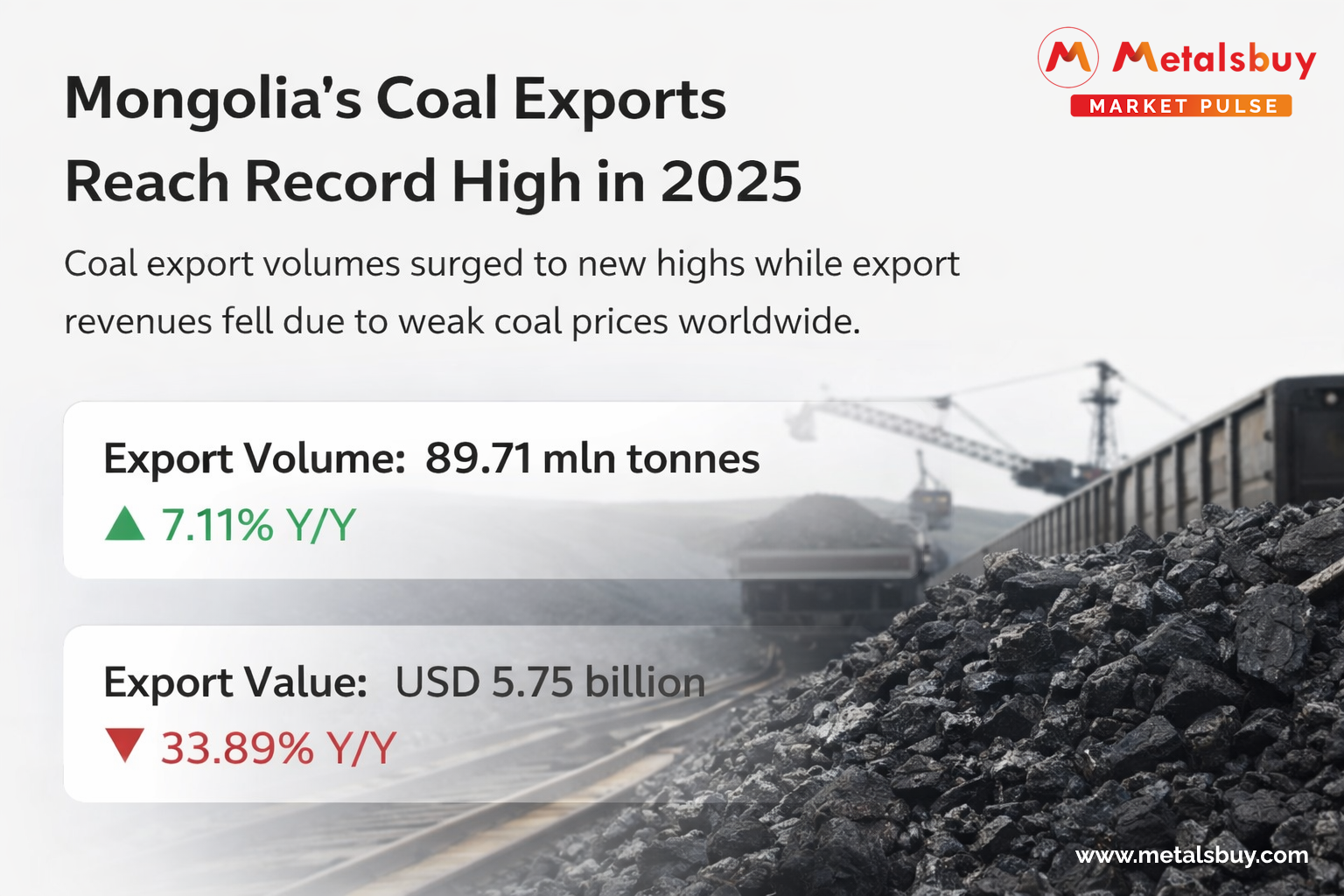
Mongolia achieved its highest-ever coal export volumes in 2025, supported by a sharp acceleration in shipments during the second half of the year, according to official customs data. While export tonnage continued to climb for the fourth consecutive year, the country faced a significant decline in export earnings due to prolonged weakness in coal prices.
Record Export Volumes Driven by Logistics and Border Efficiency
Total coal exports for the year stood at 89.71 million tonnes, representing a 7.11 percent increase year on year. The sustained growth reflects Mongolia’s strengthening position as a regional coal supplier, particularly in land-based trade routes connecting mining regions to neighboring consumption hubs.
According to data from the Mongolian Customs General Administration, export growth in 2025 was underpinned by:
-
Improved customs clearance efficiency at key border crossings
-
Higher operational utilization at major coal mines
-
Increased truck and rail movement capacity
-
Strong recovery in outbound flows during the second half of the year
This performance marks the fourth straight year of rising coal exports, signaling a structural improvement in Mongolia’s export logistics and mining output capabilities.
Export Value Contracts Sharply Amid Global Price Pressure
Despite record shipment volumes, coal export revenues declined substantially, highlighting the growing impact of pricing pressure on producer margins.
-
Total export value: USD 5.75 billion
-
Year-on-year decline: 33.89 percent
-
Average export price: USD 64.10 per tonne
-
Price drop compared to last year: USD 39.75 per tonne
The sharp reduction in realized prices more than offset gains from higher volumes. This disconnect between volume growth and revenue performance reflects broader softness in international coal pricing, driven by oversupply conditions, easing energy demand growth in certain markets, and increased competition among exporters.
December Exports Set New Monthly Benchmark
Export activity intensified sharply toward the end of the year. In December 2025, Mongolia recorded its highest-ever monthly coal exports, with shipments exceeding 10 million tonnes.
While customs authorities did not release an official figure for the month, calculations based on published customs data suggest exports of approximately 10.62 million tonnes.
Key growth indicators for December include:
-
66.47 percent increase year on year
-
13.53 percent rise month on month
The surge was largely attributed to accelerated year-end customs clearances, as exporters moved volumes ahead of calendar-year closures. Major border crossings experienced elevated traffic, reflecting strong logistical throughput despite challenging price conditions.
Structural Gains Offset by Market Volatility
The 2025 export performance highlights a mixed picture for Mongolia’s coal sector. On one hand, the country continues to strengthen its physical export capacity, supported by better infrastructure, operational efficiencies, and sustained mine output. On the other, revenue volatility remains a key challenge as pricing dynamics are increasingly shaped by global demand cycles rather than export volumes alone.
While higher shipment levels help maintain market presence and cash flow continuity, prolonged price weakness could limit investment appetite and strain margins, particularly for higher-cost producers.
Outlook
Looking ahead, Mongolia’s coal exports are expected to remain volume-driven in the near term, with further gains dependent on border capacity utilization and downstream demand recovery. However, a meaningful rebound in export earnings will hinge on price stabilization and improved market balance in key consuming regions.
As the global coal market continues to adjust to shifting energy policies and demand patterns, Mongolia’s experience in 2025 underscores the importance of balancing scale-driven growth with resilience against price fluctuations.