Key Numbers
-
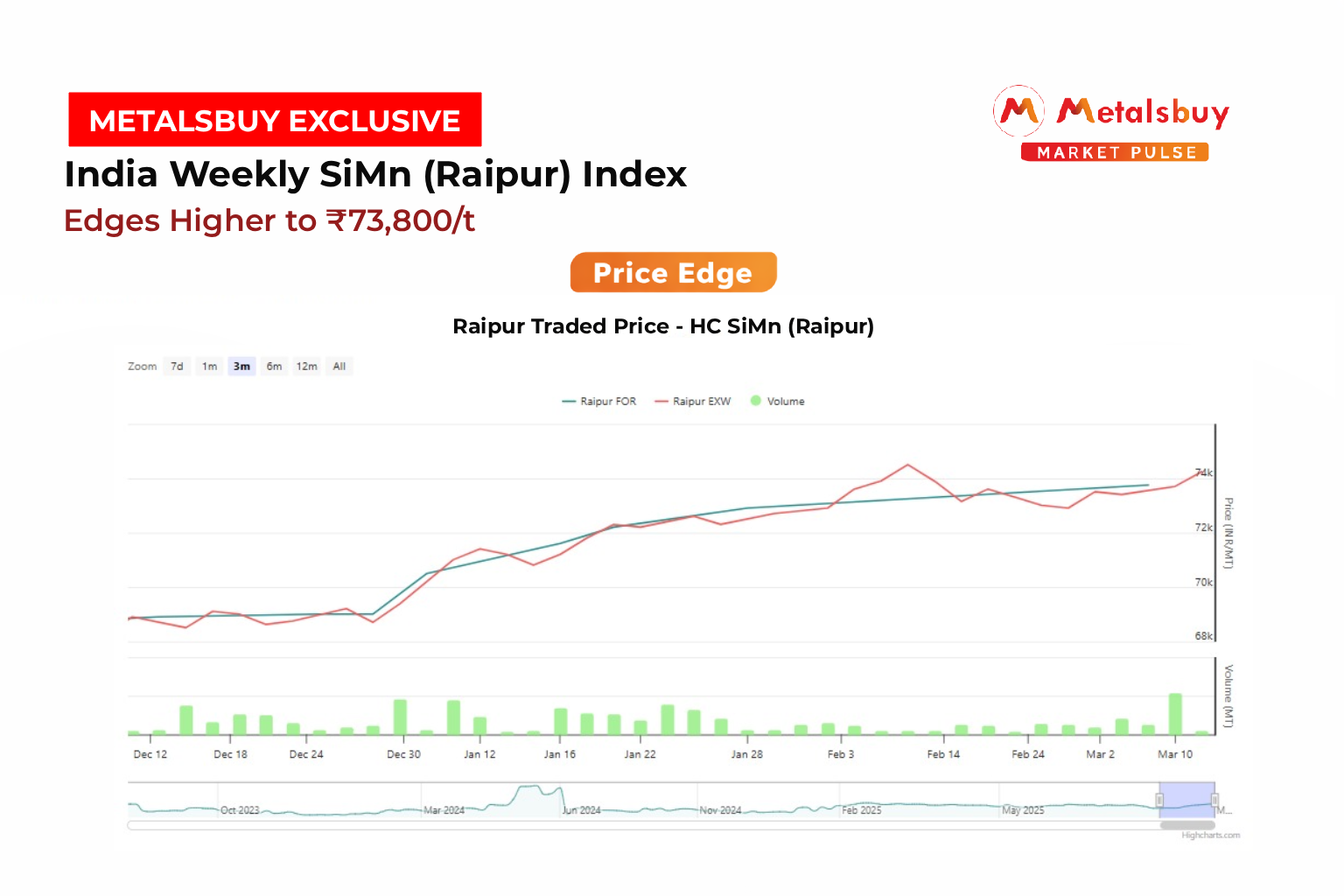
SiMn 60/14 (Ex-Raipur): ~₹73,800/PMT
-
Weekly Change: Mild increase compared to last week
-
SiMn 60/14 (Ex-Raigarh): ~₹73,000/PMT
-
Steel Billet (Mandi Gobindgarh): ~₹44,300–44,400/t range
-
Market Trend: Firm sentiment with cautious buying
Market Analysis
1. SiMn Prices Extend Upward Momentum
India’s silico manganese (SiMn) market witnessed a modest upward movement this week, with the Metalsbuy Weekly SiMn (Raipur) Index rising to around ₹73,800 per tonne.
Prices in the nearby alloy hub Raigarh were heard around ₹73,000/t, reflecting a similar upward bias across central India’s ferroalloy markets.
Market participants noted that the recent firmness in alloy prices is being driven primarily by rising raw material costs and improved sentiment across the steel value chain.
Market Interpretation: While the price increase remains moderate, the market appears to be testing higher levels amid improving cost support.
2. Imported Manganese Ore Offers Move Higher
One of the key factors supporting alloy prices has been the recent increase in seaborne manganese ore offers from major global suppliers.
Recent offer revisions include:
-
COMILOG (Gabon) raised April shipments of 44.5% Mn ore to $5.25/dmtu CIF China, up $0.27/dmtu m-o-m
-
CML (Australia) lifted 46% Mn ore offers to $5.60/dmtu, up $0.20/dmtu
-
South32 (Australia) increased 42% Mn ore offers to $5.25/dmtu, up $0.05/dmtu
The upward adjustment in manganese ore prices has reinforced cost pressure on alloy producers, particularly those dependent on imported ore.
Market Interpretation: Higher ore offers typically translate into stronger alloy price expectations, as smelters adjust selling prices to maintain margins.
3. Steel Billet Market Strength Adds Sentiment Support
Another factor influencing the ferroalloy market has been the improvement in steel billet prices, particularly in north Indian hubs.
Billet prices in Mandi Gobindgarh were heard hovering around ₹44,300–44,400/t, indicating relatively stable to firm conditions in the semi-finished steel market.
Since silico manganese is widely used in steelmaking, stronger billet sentiment often supports alloy procurement by steel mills.
Market Interpretation: The positive tone in billet markets has contributed to better sentiment across the ferroalloy supply chain.
4. Buyers Continue Need-Based Procurement
Despite the upward movement in prices, buying activity remains cautious, with most steel mills opting for need-based procurement rather than aggressive stocking.
Traders reported that some buyers are closely monitoring raw material costs and steel demand signals before committing to larger volumes.
Market Interpretation: The cautious procurement strategy suggests that market participants remain mindful of volatility, even as sentiment improves.
5. Geopolitical Developments Add Risk Premium
Market participants also pointed to ongoing geopolitical tensions and conflict developments globally, which have added an element of uncertainty across commodity markets.
Such developments can influence energy costs, freight markets, and overall commodity sentiment, indirectly supporting ferroalloy price expectations.
Market Interpretation: While the direct impact on alloy supply remains limited, geopolitical risks can create a mild risk premium across raw material markets.
Industry Impact
The latest movement in the India Weekly SiMn (Raipur) Index reflects a market balancing higher raw material costs with cautious downstream demand.
Key takeaways for the industry include:
-
Rising manganese ore offers supporting alloy prices
-
Improved steel billet sentiment aiding market confidence
-
Buyers maintaining disciplined, need-based procurement
For now, the ferroalloy market appears to be gradually firming rather than entering a sharp rally, with participants closely tracking raw material costs and steel sector demand signals.