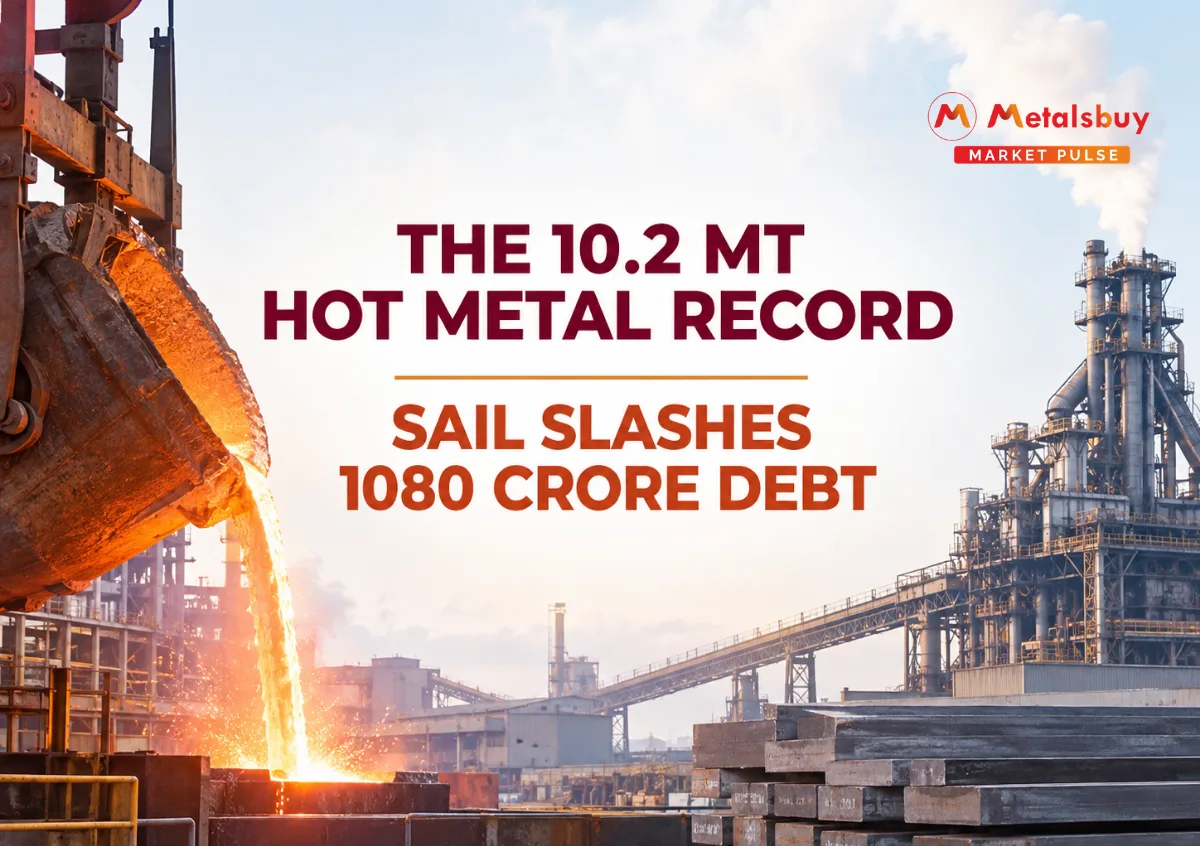
The Steel Authority of India Limited (SAIL) has reported an exceptionally strong operational performance for the first half of the 2026-27 financial year, defying broader global market sluggishness. India’s premier public sector steel manufacturer announced that it successfully achieved record-breaking output levels across key segments, including hot metal, crude steel, and finished steel, between April and September. This sustained production momentum, coupled with a deliberate shift towards high-value steel grades, highlights the company's robust operational capabilities and its critical role in fueling India's ongoing infrastructure expansion.
Achieving record-breaking production volumes
The latest operational data released by SAIL paints a highly positive picture of its manufacturing efficiency. During the first half of the current fiscal year (H1 FY27), the company achieved its best-ever April-September performance. Total hot metal production surged to a massive 10.2 million tonnes, representing a solid 2 percent year-on-year increase from the corresponding period last year.
This upstream growth seamlessly translated into higher output across the downstream value chain. SAIL reported that crude steel production grew by 1 percent year-on-year, reaching an impressive 9.6 million tonnes. Concurrently, the production of finished steel also saw a 1 percent annual increase, climbing to 8.39 million tonnes. This synchronized volume expansion proves that SAIL’s massive integrated blast furnaces and rolling mills are operating with high capacity utilization, ensuring a steady, uninterrupted flow of vital construction materials to the domestic market.
Shifting the product mix towards high-value steel
Beyond raw volume, the most significant takeaway from the H1 data is SAIL's aggressive and highly successful pivot toward premium, high-value manufacturing. The company is actively moving away from basic commodity-grade materials to protect its profit margins and cater to specialized industrial demand.
During the April-September period, the proportion of finished steel within the total saleable steel production mix improved significantly, rising to 89.2 percent from 86.8 percent in the previous year. Even more impressively, the output of specialized, high-end steel products touched a record 2 million tonnes. This marks a staggering 30 percent year-on-year growth in the premium segment. By ramping up the production of high-grade automotive steel, electrical sheets, and specialized defense alloys, SAIL is effectively insulating its revenue streams from the severe pricing pressures caused by cheap, standard-grade global imports.
Supporting national railway and retail infrastructure
A significant portion of SAIL’s strong first-half performance is closely tied to its strategic role as the primary supplier to the Indian Railways. As the national transporter executes massive track modernization and fleet expansion projects, SAIL’s specialized manufacturing units have stepped up to meet the accelerated demand.
The company reported that dispatches of heavy, long rails to the Indian Railways increased by a healthy 7 percent compared to the same period last year. Furthermore, the supply of specialized wheels and axles saw a 3 percent year-on-year rise. Simultaneously, the company achieved major retail milestones. Sales of its premium branded TMT bars, marketed under the 'SAIL SeQR' banner, successfully crossed the 1.5 lakh tonne mark. Additionally, Tier-II retail sales grew by 3 percent, indicating that the company's distribution networks are efficiently penetrating deeper into semi-urban and rural construction markets.
Optimizing backend operations and reducing debt
The strong sales and production metrics are fully supported by excellent supply chain management and backend operational efficiency. To fuel this massive steel output, SAIL ramped up its captive raw material extraction. Iron ore production from its captive mines rose by 13 percent, while external iron ore sales witnessed a massive 190 percent surge, reaching 2.671 million tonnes.
The company also reported significant improvements in its thermal efficiency. Specific energy consumption, a critical metric measuring the energy required to produce a tonne of steel, improved to 6.17 G.Cal/tcs—marking the best-ever H1 performance on this front. Improved energy efficiency directly lowers the base cost of production and reduces the overall carbon footprint of the manufacturing process.
Crucially, SAIL utilized this period of robust activity to strengthen its balance sheet. The company successfully reduced its inventory backlog by approximately 0.145 million tonnes and slashed its borrowings by an estimated ₹1,080 crore over the six-month period. Dr. A.K. Panda, Chairman and Managing Director of SAIL, attributed this phenomenal performance to the workforce's unwavering focus on efficiency, innovation, and sustainable growth. By matching high production with aggressive sales and prudent financial management, SAIL is establishing a highly resilient foundation for the remainder of the fiscal year, perfectly positioning itself to support the next wave of India’s economic expansion.