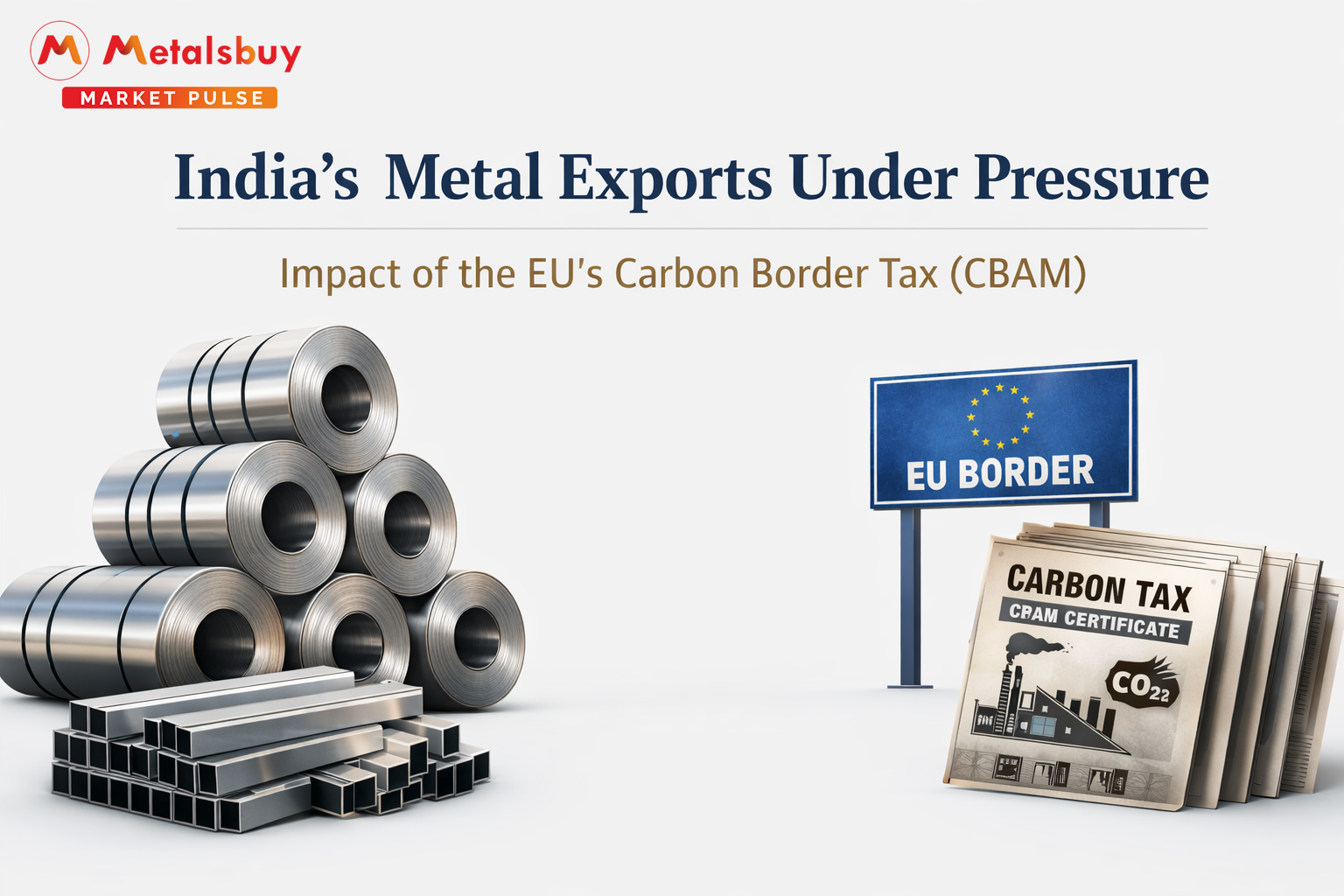
The European Union’s Carbon Border Adjustment Mechanism (CBAM) formally entered its financial enforcement phase on January 1, 2026, triggering a fundamental shift in how carbon-intensive goods are priced in global trade. For India’s metal exporters, particularly in steel and aluminium, the move introduces a new layer of cost competitiveness risk—one driven not by demand cycles or capacity additions, but by embedded carbon emissions.
CBAM, widely regarded as the world’s first comprehensive carbon border tax, converts climate policy into a trade-altering instrument, with implications that extend beyond pricing into market access, technology choices, and long-term export strategy.
What CBAM Changes in Global Trade
CBAM is designed to prevent carbon leakage, where production shifts to countries with weaker climate regulations. Under the mechanism, EU importers must purchase CBAM certificates corresponding to the embedded carbon emissions of imported goods, priced in line with the EU Emissions Trading System (ETS).
The system initially entered a transitional reporting phase in October 2023, during which importers were required to report emissions without financial liability. From January 2026, however, CBAM requires actual payments, effectively internalising carbon costs at the border.
Products Covered Under CBAM (Phase 1)
| Sector | Products |
|---|---|
| Iron & Steel | Flat steel, long steel, semi-finished products |
| Aluminium | Primary aluminium, select downstream products |
| Cement | Clinker and cement |
| Fertilisers | Nitrogen-based fertilisers |
| Electricity | Imported power |
| Hydrogen | Industrial hydrogen |
Iron and steel dominate India’s exposure, making the metals sector the primary transmission channel of CBAM-related stress.
India’s Exposure: Limited at Macro Level, Severe at Sector Level
While CBAM-affected exports form a small share of India’s overall economy, the sectoral concentration is high, amplifying its impact on metals producers.
India’s CBAM-Exposed Trade with the EU
| Indicator | Value |
|---|---|
| Total CBAM-covered exports | ~USD 8 billion |
| Share of India’s GDP | ~0.2% |
| Share from iron & steel | ~90% |
| EU share in India’s steel exports | ~23–25% |
Steel and aluminium together form the backbone of India’s EU-bound metal exports. Any sustained erosion in price competitiveness therefore has disproportionate implications for capacity utilisation and margins in export-oriented mills.
Carbon Intensity Gap: The Core Structural Challenge
The CBAM impact is magnified by differences in production technology. Indian steel production remains dominated by the blast furnace–basic oxygen furnace (BF–BOF) route, while EU producers increasingly rely on electric arc furnaces (EAF) and higher scrap usage.
Carbon Intensity of Steel Production (Indicative)
| Region / Route | CO₂ Emissions (tCO₂ / tonne of steel) |
|---|---|
| India (BF–BOF dominant) | 2.3 – 2.6 |
| EU (mixed route) | 1.2 – 1.6 |
| Electric Arc Furnace (EAF) | 0.4 – 0.7 |
This emissions differential directly translates into higher CBAM certificate requirements, making Indian steel structurally more expensive in EU markets unless offset through price adjustments.
Cost Impact: Price Cuts or Market Loss
Trade research estimates suggest that CBAM could impose a carbon-linked cost burden of €55–80 per tonne on Indian steel and aluminium exports. Since EU buyers purchase the certificates, the cost is typically passed back to exporters through price renegotiations.
Estimated CBAM Impact on Indian Metal Exports
| Parameter | Estimate |
|---|---|
| Carbon cost equivalent | €55–80 per tonne |
| Required export price reduction | 15–22% |
| Impact on margins | Significant compression |
For many Indian exporters—especially those operating on thin margins—absorbing such reductions is economically unsustainable over the medium term.
Early Trade Signals: Decline Ahead of Enforcement
Even before CBAM entered its financial phase, Indian metal exports to the EU showed signs of stress, reflecting buyer caution and compliance uncertainty.
India’s Metal Exports to EU – Trend Snapshot
| Period | YoY Change |
|---|---|
| FY25 (Steel & Aluminium) | -24.4% |
| H2 FY25 | Continued contraction |
This decline indicates that CBAM’s impact is not merely theoretical but already influencing procurement decisions and trade flows.
Compliance as a New Trade Barrier
Beyond cost, CBAM introduces data and verification challenges. Exporters must submit verified, plant-level emissions data, audited by recognised bodies. In the absence of credible data, EU authorities may apply default emission values, often significantly higher than actual emissions.
Key Compliance Challenges for Indian Exporters
| Challenge | Implication |
|---|---|
| Lack of granular emissions data | Higher assumed carbon cost |
| SME capability gaps | Disproportionate burden |
| Verification & audit costs | Rising fixed expenses |
| Administrative complexity | Shipment delays, buyer risk aversion |
Large integrated producers are better positioned to meet these requirements, while SMEs face the risk of gradual exclusion from regulated export markets.
Strategic Responses from Indian Producers
Indian exporters are responding along two broad lines:
Market Diversification
Producers are redirecting volumes toward Africa, West Asia, and Southeast Asia, where carbon border taxes are not yet operational. However, these markets typically offer lower price realisations compared to the EU.
Technology Transition
Longer-term competitiveness will depend on:
-
Increased EAF capacity
-
Higher scrap utilisation
-
Integration of renewable energy
-
Pilot adoption of green hydrogen
These measures, while necessary, involve substantial capital investment, posing near-term financial challenges.
Policy and Diplomatic Pushback
India has raised CBAM concerns at bilateral and multilateral forums, arguing that:
-
CBAM conflicts with the principle of Common But Differentiated Responsibilities (CBDR)
-
Developing economies face structural constraints in rapid decarbonisation
-
Climate policy should not become a de facto trade barrier
Industry bodies have sought transitional relief, mutual recognition of emissions certification, and flexibility for developing economies. However, EU authorities have signalled that CBAM is central to their climate framework and unlikely to be diluted.
Structural Implications for Metals Trade
CBAM marks a broader shift in global trade architecture:
-
Carbon intensity becomes a pricing variable
-
Market access increasingly tied to emissions performance
-
Larger, cleaner producers gain structural advantage
-
SMEs face rising barriers to entry in premium markets
Similar mechanisms are already under discussion in the UK, Canada, and the US, suggesting CBAM may be the first of many, not an exception.
Conclusion
The enforcement of CBAM transforms carbon emissions from an externality into a quantifiable trade cost. For India’s steel and aluminium exporters, the immediate impact will be felt through price pressure, margin compression, and compliance complexity.
Over the longer term, CBAM could accelerate industry consolidation and force a strategic reorientation toward low-carbon production and credible emissions tracking. While the transition will be uneven and capital-intensive, it also signals where global metals trade is heading.
For Indian metals, the question is no longer whether carbon costs will matter—but how quickly producers can adapt before emissions intensity determines not just profitability, but market access itself.