KEY HIGHLIGHTS
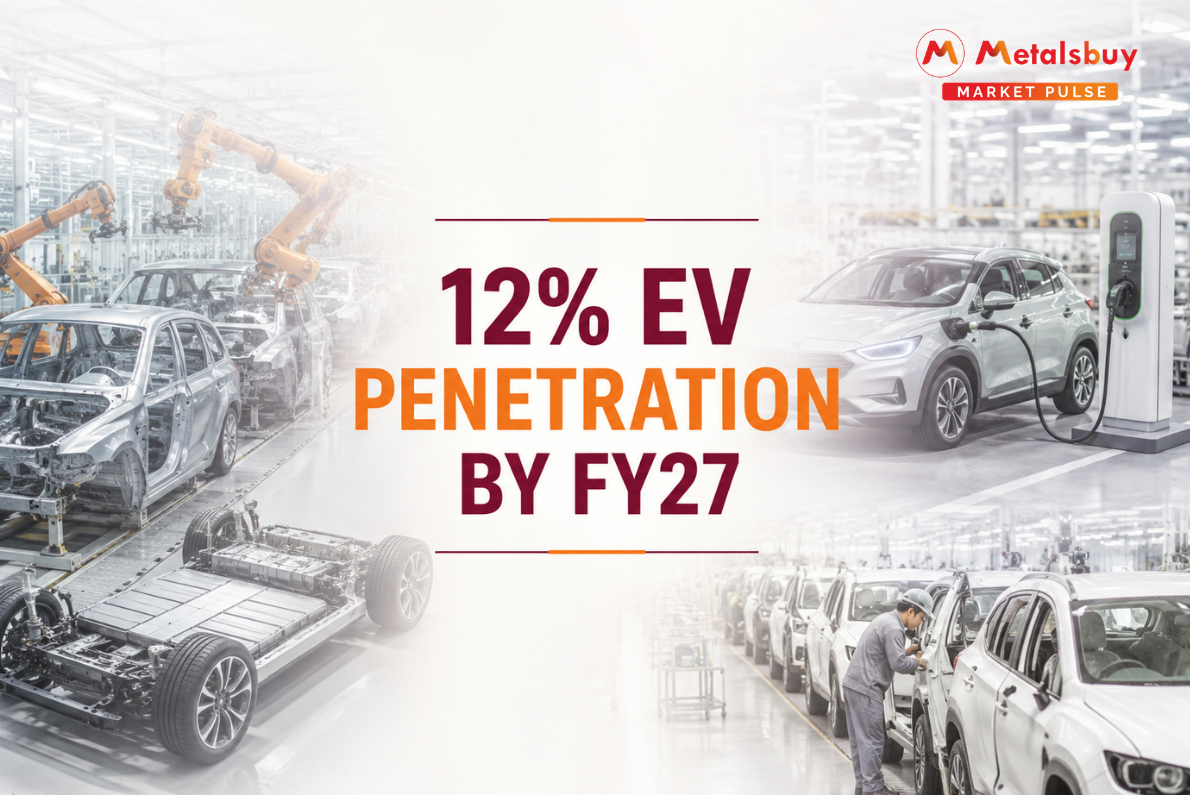
- Total EV Penetration: Projected to increase to 10-12% of overall vehicle sales in FY27 from 8.5% in FY26.
- Three-Wheeler Dominance: Expected to remain the most electrified category with a 62-65% adoption rate.
- Two-Wheeler Expansion: Penetration estimated to reach 8-10% driven by compelling operating economics.
- Passenger Vehicle Surge: Anticipated to grow to 6-8% from a smaller 4.4% base.
- Commercial Margins: Electric bus manufacturers expected to maintain healthy EBITDA margins of 10-12%.
MARKET ANALYSIS
India's electric mobility landscape is officially transitioning from an early-stage startup environment into a broader, nationwide scale-up phase. The latest projections from ratings agency India Ratings and Research (Ind-Ra) paint a highly optimistic picture for the automotive ecosystem, forecasting that electric vehicles will capture 10 to 12 percent of total vehicle sales by the fiscal year 2027. This represents a robust jump from the 8.5 percent penetration recorded in the previous fiscal cycle. The domestic market is showing remarkable maturity, with adoption becoming heavily concentrated in segments where the cost of ownership and daily operating economics are undeniable.
Electric three-wheelers continue to be the undisputed leaders of this transition. Driven by the commercial viability for fleet operators and sustained government policy support, this segment is on track to achieve a 62 to 65 percent electrification rate by FY27. Similarly, electric two-wheelers are experiencing a massive demand surge, particularly in urban and semi-urban centers. With home-charging options becoming more accessible and incumbent automakers rapidly expanding their electric product portfolios, two-wheeler penetration is projected to climb to 8-10 percent, up from 6.6 percent last year.
While commercial and short-distance commuting vehicles lead the volume game, the passenger vehicle segment is also preparing for a significant leap. Despite buyer evaluations surrounding higher upfront acquisition costs and highway charging accessibility, the launch of new, range-efficient models is expected to push electric passenger vehicle penetration to between 6 and 8 percent. Heavy commercial vehicles like electric buses are following a similar growth curve, eyeing a 6-8 percent penetration rate supported by strong state transport undertaking orders. However, the true catalyst for this next phase of growth relies heavily on structural localization. Reducing dependence on imported battery cells and strengthening indigenous capabilities across critical minerals and components will dictate how quickly manufacturers can achieve profitability and transfer cost benefits directly to the consumer.
WHAT IT MEANS FOR THE STEEL INDUSTRY
The accelerated shift toward electric mobility is not just a transformation for automakers; it is acting as a massive structural growth lever for the global and domestic steel manufacturing sectors. At first glance, the transition to battery-powered vehicles might seem unrelated to metallurgy, but the unique engineering requirements of electric vehicles are actively reshaping steel consumption patterns and driving demand for high-value, specialized alloys.
Because electric vehicles carry heavy lithium-ion battery packs—often adding anywhere from 300 to 500 kilograms to a passenger vehicle's total kerb weight—automakers are under immense pressure to reduce the mass of the vehicle's body and chassis without compromising passenger safety. This weight compounding effect has sparked a surge in demand for Advanced High-Strength Steel (AHSS) and Ultra-High-Strength Steel (UHSS). These innovative steel grades allow manufacturers to engineer thinner, lighter body panels and structural frames that absorb impact energy far better than traditional mild steel. This effectively offsets the heavy battery penalty while maintaining stringent global crash safety standards.
Furthermore, the heart of the electric vehicle—the electric motor—relies entirely on specialized metallurgical properties to function efficiently. Every modern EV motor requires approximately 30 to 40 kilograms of high-grade, non-grain oriented (NGO) electrical steel. This specific grade of steel is manufactured with precise silicon concentrations to minimize magnetic core losses, thereby improving the motor's efficiency and extending the vehicle's driving range on a single charge. As electric passenger vehicle and bus production scales up to meet the projected FY27 penetration targets, the volume demand for this niche electrical steel is expected to multiply exponentially.
Additionally, the steel industry is finding a highly lucrative application in battery enclosures. While aluminum was an early favorite for battery casings due to its low weight, advanced silicon-enriched steel is rapidly capturing market share. Steel enclosures offer superior thermal protection against battery fires, provide unmatched structural rigidity, and remain highly cost-effective. Moreover, steel perfectly aligns with the eco-friendly mandate of electric vehicles. As a 100 percent recyclable material, compliant end-of-life vehicle scrapping recovers roughly 750 kilograms of steel per passenger car, dramatically reducing the lifecycle carbon footprint of the automotive sector. Beyond the vehicles themselves, the nationwide rollout of electric charging infrastructure—requiring weather-resistant canopies, structural pylons, and protective bollards—will further secure a steady, long-term pipeline of demand for galvanized structural steel.
MARKET OUTLOOK
The forward momentum for India's electric vehicle ecosystem appears both sustainable and highly beneficial for allied manufacturing sectors. As the market steadily approaches the 12 percent penetration mark by FY27, the focus is naturally shifting from mere consumer adoption to building a self-reliant, vertically integrated manufacturing backbone. Government initiatives like the Production Linked Incentive (PLI) scheme and upcoming mobility programs are perfectly timed to support this transition, encouraging deep localization of supply chains and material sourcing.
Profitability, which has historically been a severe bottleneck for EV startups, is showing clear signs of stabilization. Electric bus manufacturers are already modeling strong financial health, and two-wheeler operators are expected to reach operational break-even within the next two to three years as scale kicks in. Ultimately, the interconnected growth of electric mobility and advanced material manufacturing paints a highly positive picture for the broader economy. As automakers and steel producers collaborate closely to engineer lighter, safer, and more efficient vehicles, the industrial sector is well-positioned to capture exceptional value in the coming years.