The Ministry of Mines has officially commenced a high-level strategic review of the National Mineral Policy 2019, aiming to align the country’s resource extraction framework with rapidly evolving global economic realities. This comprehensive overhaul is designed to address the surging global demand for critical minerals, streamline domestic auction processes, and heavily support the nation's transition toward green energy. For the domestic manufacturing and metals ecosystem, this policy update acts as a massive operational catalyst. By modernizing regulatory frameworks and incentivizing deep-seated exploration, the government guarantees that India's booming infrastructure and high-tech sectors will have uninterrupted, cost-effective access to vital raw materials over the coming decades.
Prioritizing critical minerals for the green energy transition
The foundational driver behind this urgent policy review is the shifting geopolitical landscape surrounding critical and deep-seated minerals, which are the absolute lifeblood of modern technology and renewable energy.
The 2019 policy framework was primarily structured around bulk commodities like iron ore, bauxite, and coal. However, the current industrial era demands massive quantities of lithium, cobalt, nickel, and rare earth elements to manufacture electric vehicle batteries, solar panels, and wind turbines. Currently, India imports nearly 100 percent of its lithium and cobalt requirements, exposing its booming electric mobility and renewable energy sectors to severe international price shocks and supply chain weaponization.
By restructuring the National Mineral Policy, the government aims to aggressively incentivize the exploration and extraction of these 24 identified critical minerals within domestic borders. The updated policy is expected to offer enhanced financial support and streamlined clearance windows for junior mining companies utilizing advanced aerial and geophysical surveying techniques. This strategic pivot ensures that the multi-billion dollar capital expenditure currently flowing into India's green manufacturing sector remains fully supported by a highly secure, localized raw material base.
Accelerating private sector participation and technological upgrades
A major objective of the revised framework is to structurally improve the ease of doing business to attract massive tranches of private and foreign direct investment into the mining sector. Historically, the Indian mining landscape has been heavily dominated by public sector undertakings, with private players often deterred by complex, multi-layered statutory clearance processes that delay project execution by several years. The mining sector currently contributes approximately 2.5 percent to the national gross domestic product, a figure the government is determined to push past the 5 percent mark. To achieve this, the new policy will likely propose single-window clearance mechanisms and introduce higher transparency in the allocation of captive and commercial mining blocks.
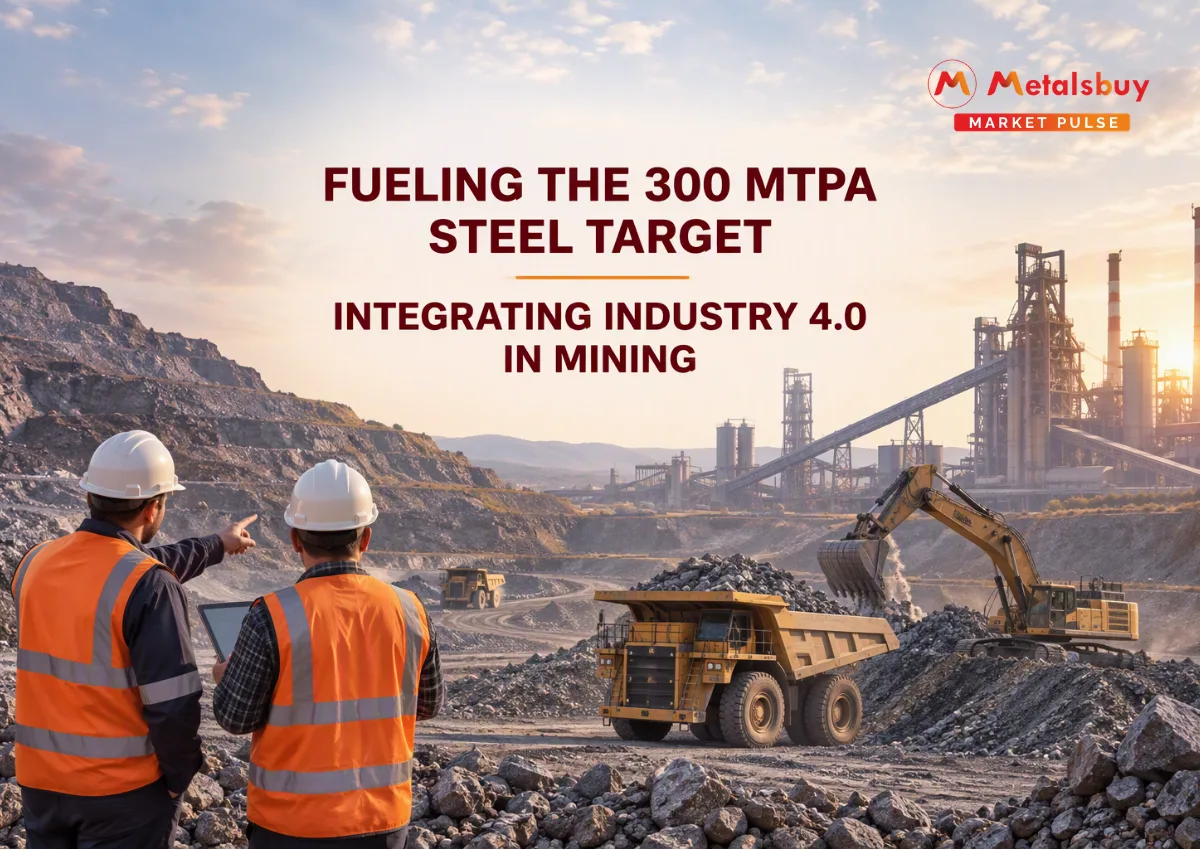
Furthermore, the updated framework will heavily mandate the integration of Industry 4.0 technologies at the pithead. The government wants to move away from legacy extraction methods and promote the use of artificial intelligence in geological data mapping, autonomous haulage systems, and drone-based volumetric analysis. By embracing these technological upgrades, private miners can significantly reduce their cost of extraction, minimize operational wastage, and vastly improve workplace safety, making Indian mining assets highly lucrative for global institutional investors.
Securing bulk commodities to support heavy manufacturing targets
While critical minerals command the spotlight, the revised policy simultaneously addresses the massive volumetric requirements of India's traditional heavy industries, specifically the primary steel and aluminum sectors.
The central government has mandated an aggressive target to achieve 300 million tonnes of annual crude steel production capacity by the year 2030. Feeding a domestic steel industry of that immense scale requires extracting over 400 million tonnes of iron ore and importing roughly 120 million tonnes of coking coal annually. The current review of the National Mineral Policy seeks to eliminate regional logistical bottlenecks and optimize the auction of bulk mineral blocks in resource-rich states like Odisha, Jharkhand, and Chhattisgarh.
The policy is expected to address the critical issue of resource sterilization by strictly enforcing concurrent mining and reclamation plans. It will also likely incentivize the establishment of massive beneficiation and pelletization plants near the mine heads. By upgrading low-grade iron ore fines into high-quality pellets domestically, the industry can maximize its resource utilization, drastically reducing the volume of raw material that needs to be transported via the congested national railway network.
Establishing a sustainable framework for long term economic resilience
From a macroeconomic perspective, updating the National Mineral Policy is a massive positive indicator of India's maturing industrial governance. The revised blueprint will heavily embed environmental, social, and governance compliance directly into the operational DNA of domestic miners.
As international trade mechanisms, such as the European Union's Carbon Border Adjustment Mechanism, begin to penalize carbon-heavy supply chains, Indian manufacturers must prove that their raw materials are sourced sustainably. The new policy will strictly enforce ecological rehabilitation, water conservation, and the transition toward renewable captive power for mining operations. By creating a regulatory environment that rewards green mining practices and heavily penalizes unscientific extraction, the government ensures that India’s vast mineral wealth is leveraged responsibly. Ultimately, this strategic policy review guarantees that the foundation of India's economic boom remains incredibly strong, deeply self-reliant, and perfectly equipped to navigate the complex raw material demands of the 21st century.