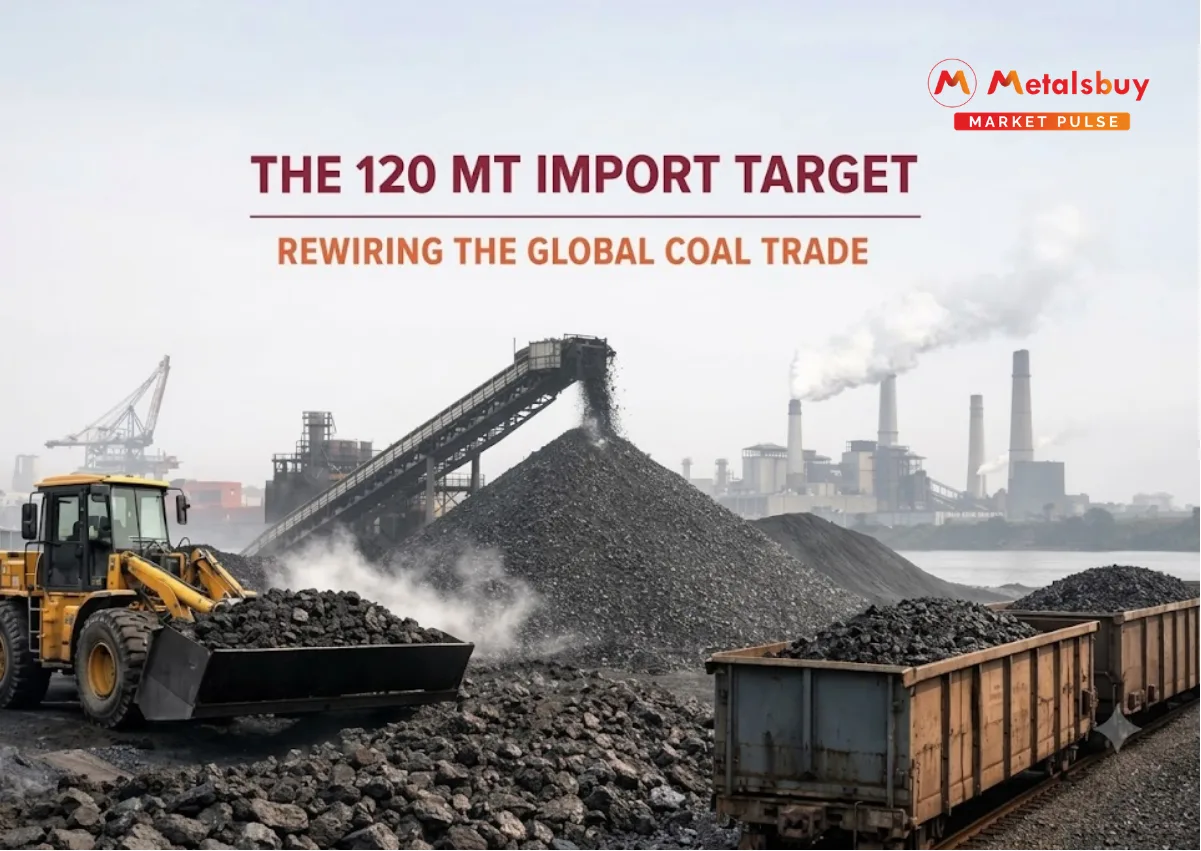
India's rapidly growing steel industry is acting as a major catalyst for change across the international raw materials market. As domestic steelmakers aggressively ramp up their production capacities to meet massive infrastructure demand, the country's reliance on imported metallurgical coal and coke is surging. This growing appetite is not only increasing overall global trade volumes but also fundamentally reshaping the geographical flow of these critical commodities. Traditional supply channels are being challenged as Indian buyers increasingly seek cost-effective, high-quality alternatives from a diverse range of international suppliers to fuel their blast furnaces.
Rapid capacity expansion demands massive raw material influx
The foundation of this shifting trade dynamic is the unprecedented scale of India's domestic steel expansion. According to industry analysts, India's actual steel production has witnessed a dramatic upward trajectory, escalating from 104 million tonnes in 2021 to an estimated 169 million tonnes in 2026. This production boom is supported by an installed capacity that has now reached approximately 220 million tonnes.
Looking further ahead, the Indian government’s National Steel Policy envisions pushing this installed capacity toward the 300 million tonne mark by 2030. Operating a steel industry of this magnitude requires a colossal and uninterrupted feed of raw materials. Currently, India consumes roughly 175 million tonnes of coking coal annually. However, domestic extraction capabilities lag significantly, providing only about 20 million tonnes per year. This massive structural deficit leaves the Indian steel sector critically dependent on the global seaborne market. Market projections indicate that by 2030, India's total annual imports of coking coal and pulverized coal injection (PCI) fuels will surge to approximately 120 million tonnes, comprising 90 million tonnes of pure coking coal and 30 million tonnes of PCI.
Diversifying supply sources away from traditional hubs
As the sheer volume of required imports grows, Indian steelmakers are actively recalibrating their procurement strategies. Historically, Australian miners have dominated the supply of premium hard coking coal to the Indian subcontinent. While Australia remains a vital partner, its overwhelming market share is gradually diluting.
To protect their operational margins against supply disruptions and volatile pricing in traditional hubs, Indian buyers are aggressively diversifying their import portfolios. There is a marked increase in coking coal procurement from the United States and Mozambique. More notably, imports of PCI coal from the Russian Federation have witnessed a significant spike. Russian suppliers are successfully capturing Indian market share by offering a compelling combination of high-quality metallurgical fuel and highly attractive, discounted pricing structures. This geographical diversification ensures that Indian blast furnace operators are not overly reliant on any single supply corridor.
Indonesia emerges as a dominant force in the coke market
The transformation of trade routes extends beyond raw coking coal into the market for processed metallurgical coke. The Indian demand for imported coke has remained exceptionally robust. During the first seven months of 2026, the country imported roughly 4 million tonnes of metallurgical coke. Industry forecasts suggest that this figure could reach 6.5 million tonnes by the end of the year and stabilize in the range of 6 to 7 million tonnes annually through 2030.
The most striking development in this segment is the rapid ascent of Indonesia as the primary supplier to India. In just the first seven months of 2026, Indonesian producers exported a massive 2.7 million tonnes of coke to Indian buyers. This dominance is driven by a confluence of favorable factors, including highly competitive pricing, shorter and cheaper maritime logistics compared to other regions, and the advantage of lower anti-dumping duties. The aggressive expansion of coking capacity within Indonesia is now actively threatening China's long-standing position as the world's largest exporter of metallurgical coke.
Cost optimization and the global raw material outlook
For Indian primary steelmakers, the ultimate driver behind these shifting procurement patterns is the optimization of the final landed cost of raw materials. Integrated mills must constantly balance maritime freight rates, the intrinsic quality and yield of the raw materials, applicable anti-dumping tariffs, and the relative cost of producing their own coke domestically versus importing finished coke.
While Indonesia expands its footprint, China remains a critical variable in the global pricing equation. Recent production disruptions and regulatory shutdowns in China's key coal-producing regions, such as Shanxi province, have constrained domestic Chinese coking coal supplies. This internal shortage is expected to persist until at least the first half of 2027, forcing China to maintain high import levels, which in turn provides a strong baseline of support for global coking coal prices. Ultimately, the relentless expansion of the Indian steel sector guarantees long-term, structural demand for metallurgical coal and coke, creating a highly lucrative and deeply contested global market for international raw material suppliers.