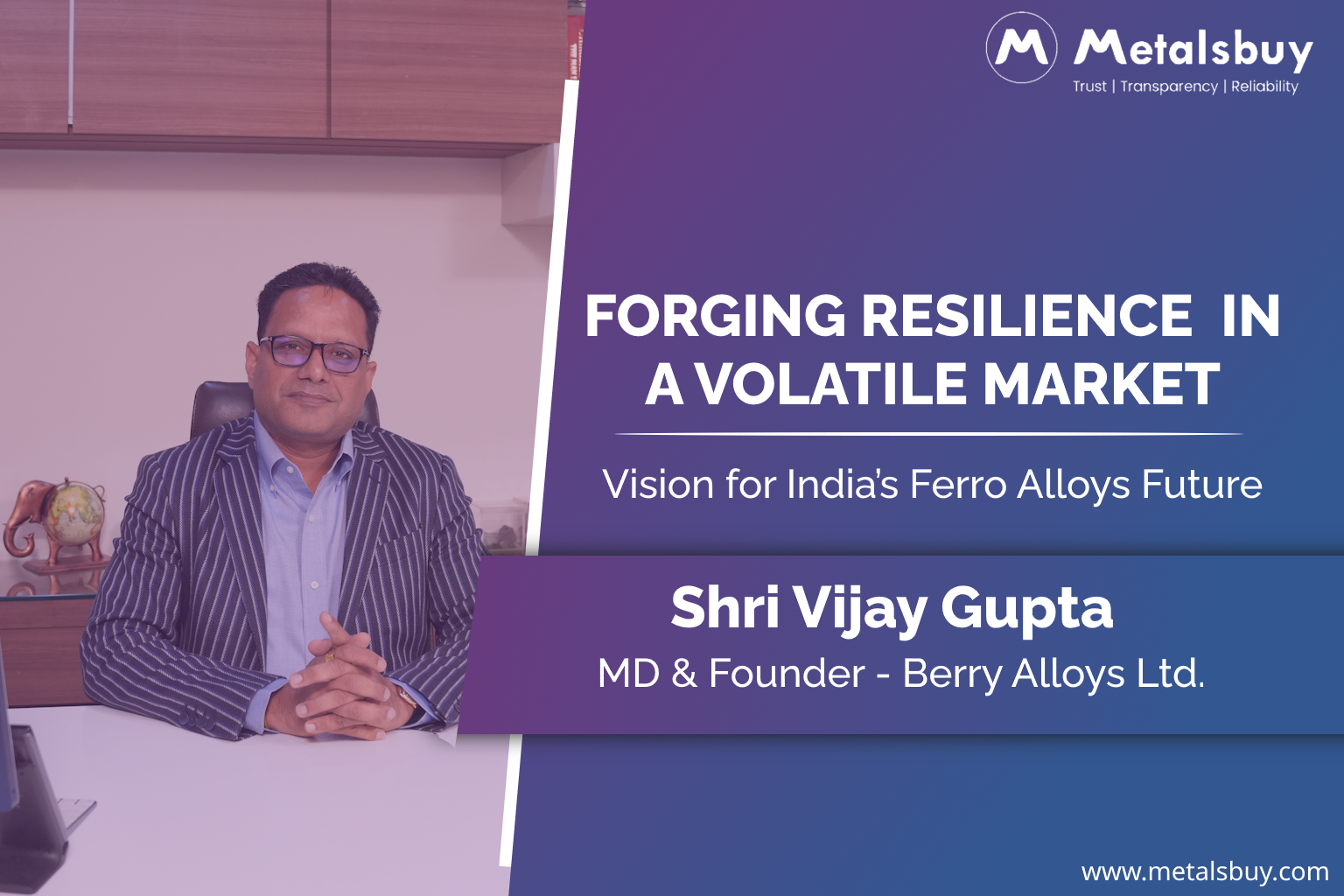
India’s ferro alloys industry is standing at a defining crossroads. Capacity expansion is accelerating, steel demand remains structurally strong, yet margins are increasingly shaped by energy costs, raw material uncertainty, and global trade barriers. In this environment, sustainable leadership is less about chasing scale and more about building resilience.
Few leaders articulate this reality as clearly as Mr Vijay Gupta, Managing Director of Berry Alloys Limited.
Drawing from over two decades of experience across ferro alloys, steel, and exports, Mr. Gupta offers a grounded and long term perspective on where the industry is headed and what it will take to succeed.
An Industry Expanding, but Under Pressure
India’s ferro alloys sector has witnessed a dramatic expansion over the last five years, with installed capacity nearly doubling. This growth is closely aligned with rising domestic steel production, infrastructure spending, and India’s ambition to emerge as a global manufacturing hub.
According to Mr. Gupta, domestic demand for ferro alloys is expected to grow at around 7 to 8 percent CAGR over the next five years, driven primarily by higher steel output. However, this growth story is unfolding alongside heightened volatility.
Demand is not the concern, he observes. The real challenge lies in managing cost instability, whether it is raw materials, power, or exports.
Raw Materials: The Structural Bottleneck
Raw material availability continues to be one of the most critical constraints for the ferro alloys industry. Dependence on manganese ore, both domestic and imported, exposes producers to supply disruptions, price volatility, and quality inconsistencies. Coke and coal markets add another layer of uncertainty, influenced by global pricing cycles, regulatory changes, and logistical bottlenecks.
For producers without captive resources or diversified sourcing strategies, these challenges translate into volatile production costs and limited visibility for long term planning.
In Mr. Gupta’s view, the next phase of industry consolidation will strongly favour companies that can secure raw materials through scale, integration, and strategic sourcing rather than spot market dependence.
Berry Alloys: Scale Built on Discipline
Berry Alloys’ growth journey reflects this philosophy of disciplined expansion. Established in 2006, the company has evolved into one of India’s largest refined ferro alloys producers, with a strong focus on Silico Manganese and Ferro Manganese in low and medium carbon grades.
Its flagship manufacturing complex at Bobbili in Andhra Pradesh houses 13 submerged arc furnaces, AOD facilities, and an installed capacity of over 4,11,000 tonnes per annum, making it among the largest single location ferro alloys facilities in the country. Proximity to Visakhapatnam Port provides logistical efficiency, supporting both domestic deliveries and exports.
Berry Alloys supplies consistently to leading Indian steelmakers including Tata Steel, JSW Steel, Jindal Steel and Power, RINL, and SAIL, underscoring its strategic role in the steel value chain.
What sets the company apart, however, is financial discipline. Operating in one of the most power intensive segments of metallurgy, Berry Alloys has maintained a zero debt balance sheet alongside an ICRA A credit rating, a rare achievement in the sector.
Exports and the New Trade Reality
While India has strengthened its position as a global ferro alloys supplier, the export landscape is becoming increasingly complex. Safeguard measures, carbon border adjustment mechanisms, and tightening environmental norms in key markets are altering trade flows.
Mr. Gupta points out that rising production capacities in regions such as China and Southeast Asia, combined with softer stainless steel demand in certain global markets, are creating competitive pressure on Indian exporters.
In the coming years, cost efficiency and compliance will determine export viability, he notes. Producers who cannot adapt will struggle to retain market share.
Energy Self Reliance as a Competitive Advantage
Recognising energy as the single largest cost driver, Berry Alloys has placed energy security at the centre of its long term strategy. Through its subsidiary operations in Jharkhand, the group is undertaking a major backward integration and expansion project scheduled for commissioning by March 2026.
The project includes sponge iron plants, a 90 MW waste heat recovery power plant, and additional submerged arc furnaces. Once operational, it will significantly enhance cost efficiency, reduce external power dependence, and strengthen Berry Alloys’ position as a vertically integrated producer.
This focus on captive energy and waste heat recovery is not only about cost control but also about sustainability, an increasingly important consideration for global customers.
Leadership Beyond Industry
Beyond balance sheets and capacities, Mr. Vijay Gupta’s leadership reflects a broader commitment to social responsibility. From large scale COVID relief operations in Visakhapatnam to ongoing initiatives in healthcare, rural infrastructure, water access, and environmental conservation, his approach reinforces the belief that industrial growth must be inclusive.
A second generation entrepreneur who has navigated multiple market cycles, Mr. Gupta’s journey underscores a central truth of Indian manufacturing. Enduring leadership is shaped by adversity, not comfort.
The Road Ahead
As India accelerates its steel and infrastructure ambitions, ferro alloys will remain a critical enabler of this growth. Yet the next phase will not be defined by volume alone. It will reward producers who combine scale with integration, growth with financial prudence, and expansion with sustainability.
In Mr. Vijay Gupta’s vision, the future of Indian ferro alloys lies in building enterprises that can absorb volatility, adapt to global shifts, and remain competitive across cycles.
For an industry forged in fire, resilience may prove to be its strongest alloy.