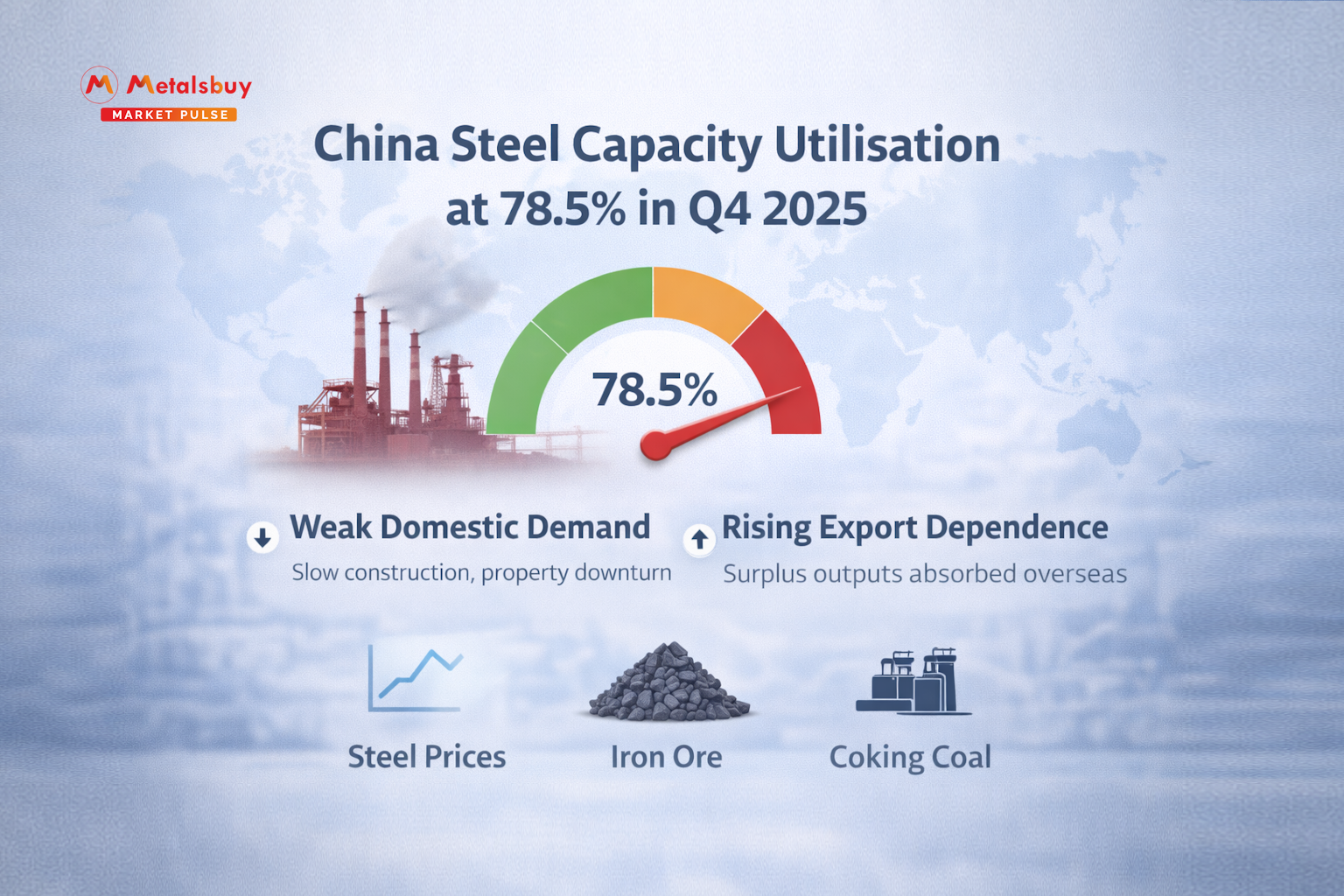
China’s ferrous metals industry registered a capacity utilisation rate of approximately 78.5 percent in the fourth quarter of 2025, signalling continued adjustment in output activity as demand dynamics shift amid broader economic headwinds. The latest data reflects ongoing structural pressures within China’s steel ecosystem, with implications for both domestic pricing and global supply flows.
What the Utilisation Rate Means
Capacity utilisation measures actual production relative to available installed capacity. In the context of steelmaking, covering smelting, rolling, and processing, a rate below 80 percent typically suggests under-utilised mills, weaker demand, or both. In Q4 2025, this metric stayed around 78.5 percent, indicating that China’s steel sector is operating below full capacity, even as output stabilises following cyclical downturns.
Shrinkage in utilisation often reflects subdued end-market activity, particularly from construction and heavy industry segments, which traditionally drive demand for rebar and long products.
Broader Output Trends and Industry Context
China’s broader industrial and steel production data for 2025 reinforce this narrative of moderation:
- Crude steel output in 2025 fell to around 960.8 million tons, marking the lowest annual total in several years and a notable decline from 2024. This drop was driven in part by slow domestic sectors such as property development.
- Despite weaker local demand, China’s steel exports surged to record highs, exceeding 119 million tons in 2025, with flat steel products such as hot-rolled coils leading the way.
The divergence between domestic consumption and international shipments illustrates a shift in market focus: producers are increasingly relying on export channels to absorb excess capacity.
Economics Behind Lower Utilisation
Several key forces are contributing to the sub-80 percent utilisation reading:
1. Soft Domestic Demand
China’s apparent steel consumption has been under pressure, with construction activity slowing and infrastructure demand flattening. WorldSteel forecasts point to a decline in steel demand in China through 2025 and into 2026 as property sector weakness persists and industrial activity cools.
2. Oversupply Concerns
Even as utilisation rates moderate, total nominal capacity remains high. China’s steel industry has long grappled with overcapacity, and excess production vis-à-vis domestic demand contributes to lower average use of installed capacity facilities.
3. Structural Shifts in Production Mix
Producers have been pivoting towards flat steel products that enjoy stronger global demand, even as output of traditional construction steels, such as rebar, diminishes. This strategic shift helps export performance but does not fully offset under-utilisation at facilities geared to other product lines.
Policy and Structural Implications
Chinese authorities have signalled continued efforts to adjust capacity through regulatory measures that discourage inefficient output and promote higher-value, low-carbon steelmaking. Initiatives include:
- Policies aimed at phasing out outdated production units
- Encouragement of emissions-reducing upgrades across mills
- More stringent control over net capacity additions and swaps.
These efforts align with Beijing’s broader industrial restructuring objectives, including improved profit margins and environmental compliance.
Global Market Impact
China’s under-80 percent utilisation in Q4 2025 has tangible implications beyond its borders:
- Export-driven supply: As domestic demand weakens, surplus steel is increasingly channelled into global markets, exerting price pressure and prompting trade defence responses from importing economies.
- Price signals: Lower utilisation typically translates into downward pressure on domestic prices, affecting related raw materials such as iron ore and coking coal.
- Competitive shifts: Markets in Southeast Asia, the Middle East, and India are adjusting to the competitive landscape shaped by China’s evolving supply mix.
Outlook
Looking ahead, analysts expect China’s steel sector to navigate a transitional phase where structural realignment rather than volumetric growth becomes the industry’s core focus. Continued moderation of utilisation rates, aligned with cleaner production targets and capacity rationalisation, could solidify a longer-term equilibrium between supply and demand.
Whether utilisation rebounds beyond the key 80 percent threshold will depend on the pace of domestic economic recovery, property sector stability, and the effectiveness of capacity control policies. In the meantime, China’s steel utilisation rate remains a bellwether for both regional and global steel market trends.