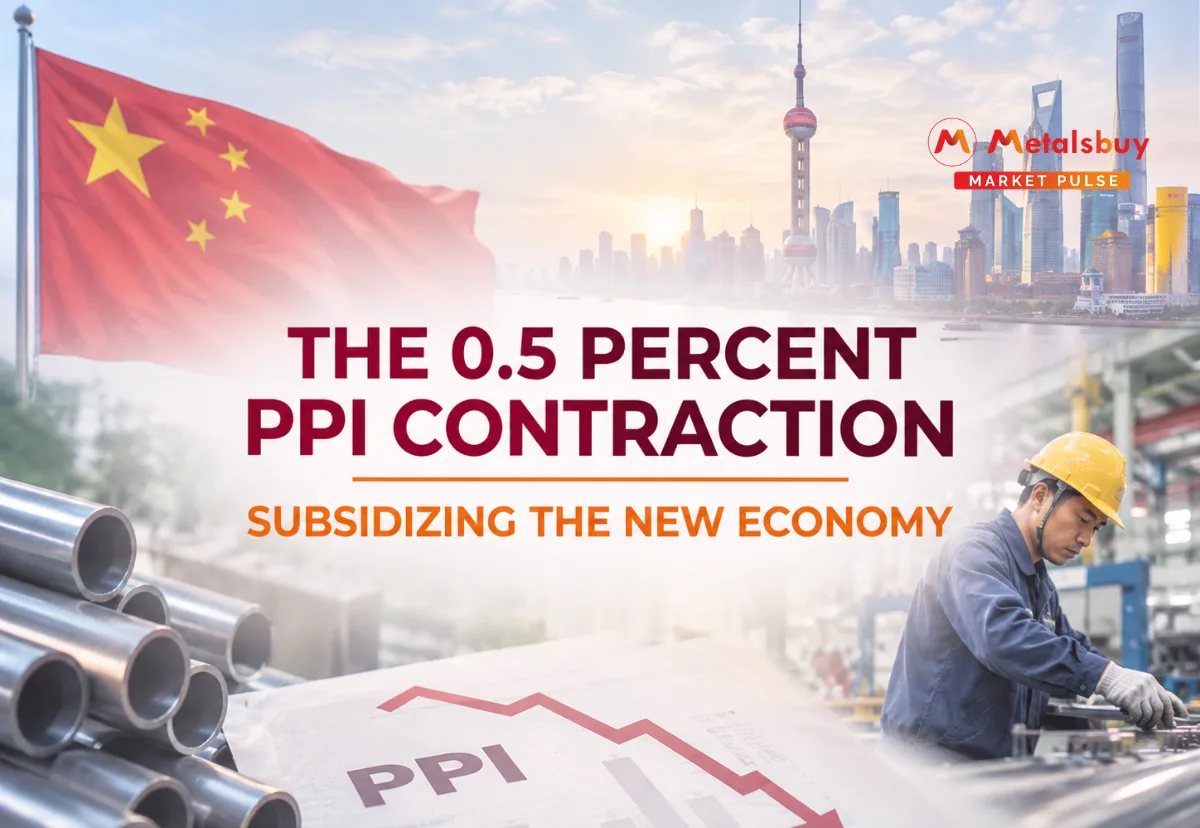
The macroeconomic landscape of the world’s largest metals market is undergoing a highly measured and strategic recalibration. According to the latest data released by the National Bureau of Statistics, the Producer Price Index for China's ferrous metal smelting and pressing industry experienced a fractional downward adjustment over the first three quarters of the year. Rather than signaling severe industrial distress, this marginal contraction in factory-gate prices actually serves as a vital economic shock absorber. By stabilizing raw material costs, the steel sector is actively subsidizing the rapid growth of China's advanced downstream manufacturing industries, ensuring that the broader national economy remains highly competitive on the global stage.
Evaluating the producer price index contraction within the ferrous sector
The most recent statistical release provides a clear window into the pricing dynamics at the factory gates of major Chinese steel mills. Official data confirms that the Producer Price Index for the ferrous metal smelting and pressing sector declined by 0.5 percent year-on-year during the comprehensive January to September 2026 period. This metric is a crucial barometer, tracking the average changes in prices that domestic steel producers receive for their output before it hits the retail market. A deeper look at the month-of-September data reveals that the downward pressure was slightly more pronounced as the third quarter closed, reflecting a broader trend of cautious industrial procurement and elevated domestic inventories.
This 0.5 percent cumulative dip is deeply intertwined with the ongoing structural shift in the Chinese economy. Historically, domestic steel prices were heavily inflated by the relentless, debt-driven expansion of the real estate and heavy civil construction sectors. As the central government deliberately guides the economy away from speculative property development, the immediate demand for basic construction materials like commercial rebar and wire rod has naturally softened. Consequently, primary mills have had to adjust their ex-works pricing downward to move these traditional commodity-grade inventories, directly resulting in the fractional decline captured by the national index.
Downstream domestic industries capitalize on stabilized material costs
While primary steel producers face tightening operational margins, this downward pricing adjustment represents a massive financial windfall for critical downstream manufacturing sectors. The unique selling proposition of this current economic cycle is how a slight dip in the steel Producer Price Index acts as an indirect stimulus for China's "new economy." Advanced manufacturing sectors, particularly the booming New Energy Vehicle market, industrial machinery fabricators, and consumer appliance brands, are heavily reliant on high-quality flat steel and cold-rolled coils. When factory-gate prices for these essential metallic inputs soften, downstream manufacturers experience immediate relief in their cost of goods sold.
This stabilization of raw material costs allows Chinese automakers and electronics manufacturers to protect their profit margins without having to pass inflationary price hikes onto the end consumer. As a result, these high-tech industries can maintain aggressive, highly competitive retail pricing in both domestic and international markets. Essentially, the primary steel sector is absorbing the initial economic friction, allowing value-added manufacturing to thrive and drive the next decade of national gross domestic product growth.
Supply side discipline prevents severe market imbalances
To prevent this marginal price decline from accelerating into a catastrophic market collapse, Chinese steelmakers are exhibiting unprecedented levels of operational discipline. Unlike previous market cycles where mills would blindly flood the market with excess capacity to capture marginal revenues, the current response is highly measured. Facing a 0.5 percent drop in producer prices and corresponding margin compression, major integrated blast furnace operators are actively balancing the supply equation. Industry reports indicate that an increasing number of mills voluntarily initiated maintenance halts and scaled back their daily hot metal output throughout August and September.
By tightly controlling the volume of fresh crude steel entering the domestic supply chain, manufacturers are successfully putting a firm floor under spot prices. Furthermore, this controlled production strategy heavily supports the industry's broader environmental mandates. Reducing the run-rates of carbon-intensive blast furnaces helps major industrial provinces meet their strict ultra-low emission targets and energy consumption quotas ahead of the winter heating season, perfectly aligning commercial strategy with ecological compliance.
Setting a resilient baseline for global commodity markets
From a global macroeconomic perspective, the fractional decline in China's steel Producer Price Index sends a highly stabilizing signal to international trade corridors. For the global commodities market, a hyper-inflated Chinese steel sector often exports severe inflationary pressures worldwide. By keeping domestic factory-gate prices in check, China is indirectly helping to moderate global industrial inflation. International buyers of Chinese specialized steel products are benefiting from highly stable, predictable pricing, which allows foreign construction firms and manufacturers to plan their long-term capital expenditures with absolute confidence.
As the market transitions into the fourth quarter of 2026, the domestic steel industry is expected to find a healthy equilibrium. Recent monetary easing measures announced by the central bank, combined with targeted fiscal stimulus for infrastructure, will gradually revive localized demand. However, the overarching theme remains clear. The Chinese steel sector is no longer prioritizing unchecked price inflation and volume growth; instead, it is maturing into a stable, cost-efficient foundation designed to propel the nation's high-value manufacturing ambitions well into the future.