KEY NUMBERS
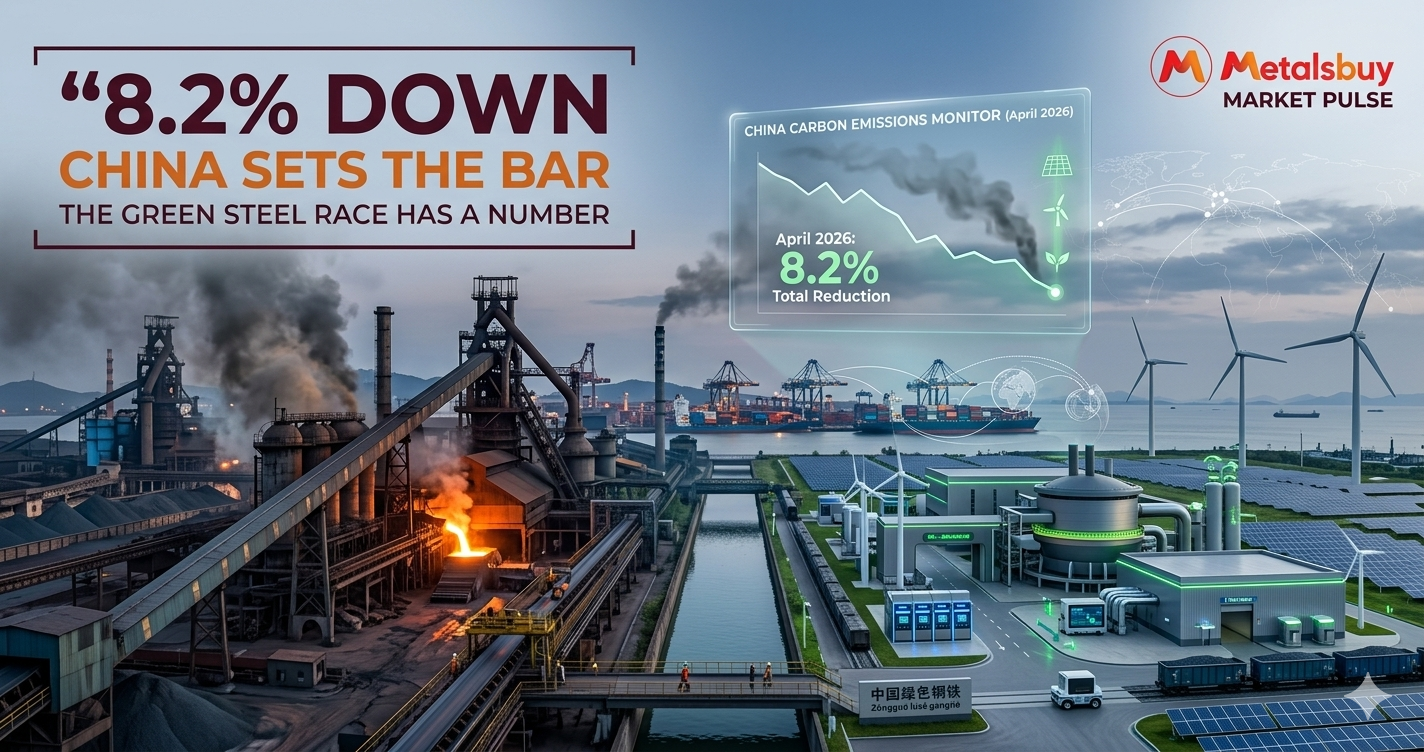
8.2% : Reduction in China’s steel industry carbon emissions during April 2026
2.8% : Decline in Chinese steel output during April
April 2026 : Reporting period for emissions reduction
2018 : Last time China recorded a weaker April steel production month
€25 To €35 Per Tonne : Estimated CBAM related carbon cost on steel shipments into Europe
CBAM : European Union Carbon Border Adjustment Mechanism
10 To 12% : Share of India’s greenhouse gas emissions attributed to the steel sector
China : World’s largest steel producer
European Union : Largest driver of carbon related trade regulation
Green Steel : Fastest growing competitive theme in global steelmaking
MARKET ANALYSIS
For decades, the steel industry measured success in tonnes.
How many tonnes were produced. How many tonnes were exported. How many tonnes were consumed.
That metric is no longer enough.
A second number is becoming just as important: emissions.
China’s steel industry reduced carbon emissions by 8.2 percent in April 2026 while steel output fell only 2.8 percent. On the surface, the figures may appear like another routine industrial data release. They are not. They represent one of the clearest signals yet that the world’s largest steel producer is actively restructuring itself around a future where carbon intensity matters almost as much as production volume.
The timing is not accidental.
Europe’s Carbon Border Adjustment Mechanism is rapidly changing the economics of global steel trade. Steel exporters shipping material into the European Union now face increasing pressure to account for the carbon embedded within their products. Industry estimates suggest the mechanism could add between €25 and €35 per tonne to some steel shipments depending on emissions intensity.
That changes behaviour.
For years, Chinese steelmakers focused primarily on efficiency, scale and production costs. Today, emissions have become another competitive variable. The result is visible in April’s numbers. Carbon emissions fell faster than steel output itself, suggesting that improvements are being driven not only by lower production but also by cleaner production practices.
The implications extend far beyond China.
India’s steel industry contributes roughly 10 to 12 percent of the country’s greenhouse gas emissions. At the same time, India is preparing for one of the largest steel capacity expansions anywhere in the world. New projects are rising across Odisha, Maharashtra and Chhattisgarh. Steel output is expected to grow for years.
That creates a challenge.
India wants to produce more steel. Europe increasingly wants cleaner steel. Those objectives can coexist, but only if producers successfully manage emissions while expanding capacity.
The race is already underway.
What makes China’s latest data significant is that it provides a measurable benchmark. Until now, green steel discussions often revolved around targets, commitments and future ambitions. An 8.2 percent emissions reduction creates something tangible. It establishes a number competitors can compare themselves against.
The ferro alloy market should pay attention.
Every major decarbonisation strategy eventually reaches the raw materials chain. Ferrochrome, ferrosilicon and silico manganese producers increasingly face questions about electricity sources, furnace efficiency and carbon intensity. Green steel does not exist in isolation. It depends on a broader industrial supply chain becoming cleaner alongside it.
That process has only begun.
INDUSTRY IMPACT
The most important consequence of China’s emissions reduction may not be environmental.
It may be competitive.
Global steelmakers increasingly operate in a world where carbon intensity influences market access, financing costs and customer preferences. Producers that reduce emissions successfully gain advantages extending beyond compliance alone.
Europe is accelerating that trend.
CBAM effectively places a financial value on emissions. Once carbon carries a measurable cost, cleaner production becomes a commercial advantage rather than simply a sustainability objective.
China appears to understand that reality.
The country remains the largest steel producer in the world, yet recent policy direction suggests authorities are increasingly willing to sacrifice some production volume in exchange for improved environmental performance. April’s figures support that interpretation.
India now faces an important strategic decision.
The country enjoys strong demand growth, expanding infrastructure spending and significant steel investment. Those advantages remain powerful. The question is whether future growth will be accompanied by equally ambitious decarbonisation efforts.
For ferro alloy producers, the message is clear.
Steel customers are paying closer attention to emissions across the value chain. Producers capable of demonstrating cleaner power sources, efficient furnace operations and lower carbon intensity may gradually gain advantages as sustainability expectations move deeper into industrial procurement decisions.
WHAT TO WATCH NEXT
China’s next few months of emissions data will be critical.
If reductions continue while production stabilises, markets may conclude that structural efficiency improvements are driving the trend rather than temporary output weakness.
Watch India’s response carefully.
Several major steel producers are already investing in renewable energy, cleaner DRI technologies and emissions reduction initiatives. Future announcements may reveal how aggressively the industry intends to compete in a lower carbon environment.
CBAM implementation remains another major variable.
The financial impact on exporters will become clearer as compliance requirements tighten and carbon accounting systems mature. Steel producers across Asia are watching closely because the consequences extend directly into export competitiveness.
The ferro alloy sector will increasingly become part of that conversation.
MARKET OUTLOOK
China’s 8.2 percent emissions reduction matters because it transforms an abstract discussion into a measurable benchmark.
The steel industry is entering a period where production volume alone no longer defines leadership.
Efficiency matters.
Carbon intensity matters.
Market access matters.
China’s latest data suggests the world’s largest steel producer understands that reality and is adapting accordingly.
India remains exceptionally well positioned to benefit from the next decade of steel demand growth. New plants are being built. Capacity is expanding. Domestic consumption remains strong.
The opportunity is enormous.
The challenge is equally clear.
The next generation of steel competitiveness may be determined not only by who produces the most steel, but by who produces it most efficiently.
China has just provided the industry with a number to beat.