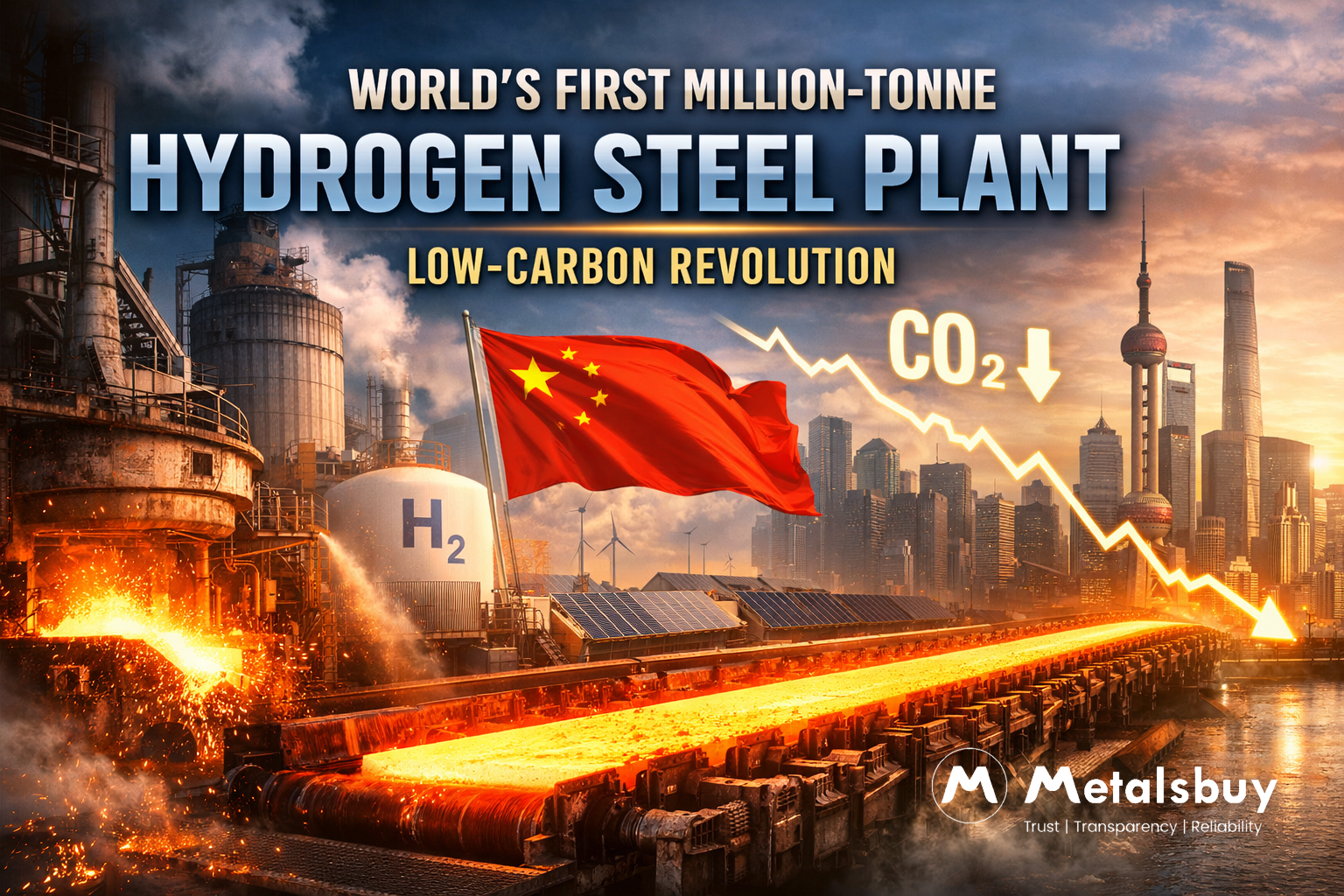
China has taken a decisive step in industrial decarbonisation by commissioning what is being described as the world’s first million-tonne per annum near-zero-carbon steel production line. The facility, operated by China Baowu Steel Group at its Zhanjiang base in Guangdong, entered full-capacity commercial operation in late December 2025.
While pilot projects in hydrogen steelmaking have existed for several years globally, this development is significant because it moves the technology into commercial, industrial scale production, a threshold that has long been viewed as the real test for green steel viability.
What has happened: hydrogen steel moves from pilot to volume production
The newly commissioned line is designed to produce around one million tonnes of steel annually, positioning it among the first low-carbon steel facilities capable of supplying meaningful volumes to large industrial consumers.
According to publicly available information, the process integrates:
-
Hydrogen-based metallurgical reduction, where hydrogen replaces coke as the primary reducing agent for iron ore.
-
Electric furnace-based steelmaking, reducing reliance on coal-intensive blast furnace routes.
-
A production flow designed to significantly lower direct carbon emissions compared with conventional BF-BOF steelmaking.
Reported estimates suggest carbon emission reductions of 50-80 percent versus traditional routes, with annual CO₂ reductions exceeding 3 million tonnes once the facility operates steadily at rated capacity.
The importance of this milestone lies less in the headline numbers and more in the scale. At one million tonnes, green steel moves closer to being a commercial supply option, rather than a symbolic or experimental product.
Why this matters: steel decarbonisation meets supply chain reality
Steel remains one of the most carbon-intensive industrial sectors globally, and meaningful decarbonisation has been constrained by three factors: technology readiness, cost, and scale. China’s move directly addresses the third.
For downstream buyers, especially in automotive, appliances, and infrastructure, supply assurance is critical. Until now, green steel has often been limited to small batches or niche contracts. A million-tonne facility signals that low-carbon steel can begin integrating into mainstream procurement, at least for selected product segments.
This also aligns with China’s broader industrial strategy of maintaining competitiveness as global markets gradually move toward carbon-linked trade mechanisms, including stricter disclosure norms and border carbon adjustments.
How the technology reshapes cost drivers
Hydrogen-based steelmaking fundamentally alters the steel cost structure:
-
Coal and coke dependency declines, reducing exposure to metallurgical coal volatility.
-
Electricity and hydrogen availability become central, shifting competitiveness toward regions with access to stable, lower-carbon power.
-
Raw material quality sensitivity increases, particularly for DRI-grade iron ore and clean scrap inputs.
In practical terms, steelmaking economics begin to depend less on traditional raw material arbitrage and more on energy system efficiency and integration.
This transition does not eliminate cost pressures. Hydrogen pricing, power tariffs, and infrastructure investment remain critical variables. However, the commissioning of a million-tonne line suggests that operators believe these variables are now manageable within a commercial framework.
What may happen next: likely market implications
Green steel premiums may become more structured
As volumes rise, green steel is likely to move from ad-hoc pricing toward defined premium bands linked to emissions intensity. This could introduce clearer benchmarks for low-carbon flat steel, particularly in export-oriented supply chains.
Energy becomes a strategic raw material
Electricity and hydrogen sourcing will increasingly influence steel competitiveness. Mills with access to stable, low-carbon energy may gain pricing and contract advantages, while others face pressure to adapt.
Pressure on conventional blast furnace exporters
BF-BOF based exporters may encounter growing scrutiny from buyers seeking lower embedded emissions. Over time, this could translate into:
-
Higher compliance costs
-
Limited access to premium markets
-
Accelerated investment in alternative routes, blending strategies, or carbon mitigation technologies
Upstream impacts on ore and scrap markets
Hydrogen-based routes typically require higher-quality iron ore and cleaner scrap, potentially widening spreads between premium and standard raw materials if adoption scales further.
Asia and India context: early signals, not immediate disruption
For Asian steel markets, this development does not signal immediate displacement of conventional steel. However, it does mark the beginning of a structural shift.
Buyers may increasingly factor emissions intensity into supplier selection, while producers will need to articulate clear decarbonisation roadmaps. Early movers in hydrogen and electrification may shape standards, certification frameworks, and long-term offtake structures.
The competitive risk for conventional producers is not only regulatory, but commercial: losing relevance in premium, specification-driven segments as buyer expectations evolve.
Key project snapshot (publicly reported)
| Parameter | Details |
|---|---|
| Location | Zhanjiang, Guangdong, China |
| Operator | China Baowu Steel Group |
| Capacity | ~1 million tonnes per year |
| Process route | Hydrogen-based reduction + electric furnace steelmaking |
| Emissions reduction | 50–80% vs conventional BF-BOF |
| Annual CO₂ reduction | >3 million tonnes |
Metalsbuy Outlook
The commissioning of a million-tonne hydrogen steel line marks a shift from ambition to execution in steel decarbonisation. While cost competitiveness will continue to evolve, the availability of real volumes changes buyer behaviour, contract structures, and long-term planning. If similar projects follow, Asia could see the early formation of green steel benchmarks, particularly for flat products, with energy access emerging as a defining competitive advantage.
Sources
-
CGTN coverage on the commissioning and process description
-
GMK Center summary citing Baowu Zhanjiang and route description
-
Additional industry reporting summarizing the milestone and impact claims