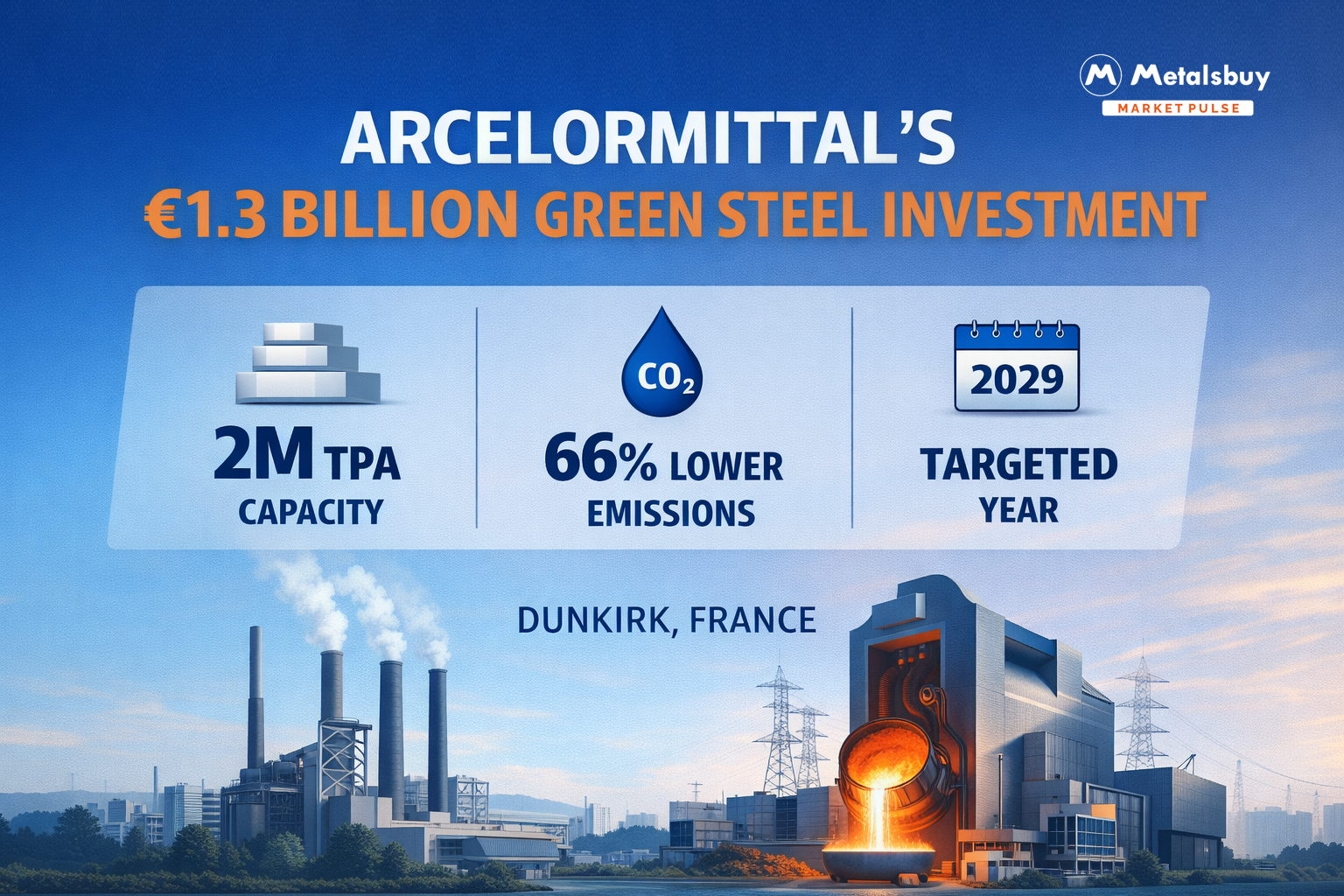
In a decisive move reinforcing Europe’s industrial decarbonisation agenda, ArcelorMittal has confirmed a €1.3 billion investment to construct a large electric arc furnace (EAF) at its Dunkirk facility in northern France. The project, targeted for commissioning in 2029, will add approximately 2 million tonnes per annum (Mtpa) of low-emission steelmaking capacity and marks one of the most significant green steel commitments in Europe this year.
The investment comes at a time when European steelmakers are navigating tightening carbon regulations, volatile energy markets, and intensifying global competition. With partial financial support expected through French energy-efficiency certificate mechanisms, the project signals both corporate commitment and state-backed industrial policy alignment.
Project Overview
The Dunkirk EAF will replace part of the existing blast furnace route with an electrified steelmaking process. According to company statements, the new furnace is expected to emit roughly three times less CO₂ per tonne of steel compared to the traditional blast furnace configuration currently in operation.
Key headline figures:
-
Total investment: €1.3 billion
-
Capacity: ~2.0 million tonnes per year
-
Estimated operational timeline: 2029
-
Emissions intensity: ~66% lower versus blast furnace route (company estimate)
-
Public support: Approximately 50% of CapEx supported via energy-efficiency mechanisms
This scale places Dunkirk among the largest decarbonisation initiatives in the European steel sector.
Why Dunkirk Matters
Dunkirk is one of ArcelorMittal’s flagship flat steel sites in Europe, strategically positioned near key automotive and industrial demand centres. Converting part of its capacity to EAF technology significantly strengthens France’s low-carbon steel footprint and enhances ArcelorMittal’s competitive positioning under the EU’s Carbon Border Adjustment Mechanism (CBAM).
As carbon costs rise across the European Emissions Trading System (ETS), high-emission blast furnace production faces increasing financial pressure. By lowering carbon intensity, ArcelorMittal effectively reduces future regulatory exposure while aligning with procurement requirements of automotive OEMs and infrastructure developers that are increasingly embedding Scope 3 emissions targets into sourcing decisions.
Economic Implications
From a capital efficiency perspective, a €1.3 billion investment amortised over 20 years at full 2 Mtpa utilisation translates to a simplified capital recovery cost of approximately €32–35 per tonne, excluding financing, operating costs and power inputs.
However, the true economic viability of the project hinges on three variables:
-
Electricity pricing stability
-
Scrap and DRI feedstock availability
-
Carbon price trajectory under EU ETS
EAF technology is significantly more sensitive to electricity pricing than blast furnace operations. Securing long-term low-carbon power contracts will therefore be critical to maintaining cost competitiveness. Reports indicate that power supply arrangements with EDF are under discussion, reinforcing the central role of energy economics in this transition.
Raw Material and Market Impact
The shift toward EAF production will gradually alter raw material demand patterns. Electric furnaces typically rely heavily on scrap and, in some cases, direct reduced iron (DRI). As additional European EAF capacity comes online over the next five years, regional scrap demand is expected to tighten, potentially exerting upward pressure on high-quality scrap grades.
For traders and procurement teams, this implies:
-
Increased competition for prime scrap grades
-
Potential structural strengthening of scrap price spreads
-
Gradual emergence of differentiated “green steel” product premiums
If Dunkirk optimises production toward flat products for automotive and industrial applications, buyers may increasingly prioritise low-carbon sourcing, accelerating market segmentation between conventional and green steel streams.
Strategic Context
The announcement also carries strong geopolitical undertones. French President Emmanuel Macron’s public endorsement underscores France’s broader objective to revitalise domestic industry while advancing climate commitments.
At the European level, trade protection measures combined with CBAM implementation have created a more supportive environment for domestic steel investment. Dunkirk may serve as a template for future EAF conversions across Europe if economic conditions remain supportive.
Importantly, ArcelorMittal had previously slowed certain hydrogen-based decarbonisation projects due to cost uncertainties. The Dunkirk EAF therefore reflects a pragmatic transition pathway prioritising electrification over hydrogen in the near term.
Risks and Watchpoints
Despite strong signalling, several risks remain:
-
Electricity price volatility could materially impact margins
-
Construction and permitting delays may shift the 2029 timeline
-
Labour relations and union dynamics could influence operational restructuring
-
Scrap market tightness could compress EAF spreads
Market participants should closely monitor power agreements, regulatory developments under EU ETS, and scrap trade flows over the next 12–24 months.
Outlook
The Dunkirk project positions ArcelorMittal as a leading force in Europe’s green steel transition while reinforcing France’s industrial base. If executed successfully, it may catalyse further large-scale EAF investments across the continent.
For Metalsbuy readers, the key takeaway is structural: Europe’s steel market is entering a period of capacity reconfiguration where carbon intensity becomes a commercial variable alongside price and logistics. Procurement strategies, hedging frameworks, and supplier selection models will need to evolve accordingly.
As 2029 approaches, Dunkirk will serve as a bellwether for whether Europe’s green steel ambitions can translate into sustained industrial competitiveness.